Nucléotides
Les nucléotides sont des composés organiques qui servent de building blocks aux acides nucléiques, essentiels à la formation de l'ADN et de l'ARN. Chaque nucléotide est composé d'une base azotée, d'une molécule de sucre et d'un ou plusieurs groupes phosphate. Ces nucléotides s'assemblent pour former de longues chaînes, créant le matériel génétique qui porte et transmet l'information génétique dans tous les organismes vivants. Dans cette section, vous trouverez une large gamme de nucléotides essentiels pour la recherche en génétique, biologie moléculaire et biochimie. Ils sont fondamentaux pour étudier les processus génétiques, synthétiser des acides nucléiques et développer des outils diagnostiques et thérapeutiques. Chez CymitQuimica, nous proposons des nucléotides de haute qualité pour soutenir vos recherches scientifiques et applications, garantissant précision et fiabilité dans vos expériences.
Sous-catégories appartenant à la catégorie "Nucléotides"
2634 produits trouvés pour "Nucléotides"
Trier par
Degré de pureté (%)
0
100
|
0
|
50
|
90
|
95
|
100
3'-O-Propargyluridine
CAS :<p>3'-O-Propargyluridine is a synthetic nucleoside with an alkyne functional handle on the 3'-position of the sugar</p>Formule :C12H14N2O6Degré de pureté :Min. 95%Couleur et forme :White PowderMasse moléculaire :282.25 g/mol5-(Methylaminomethyl)-2-thiouridine
CAS :<p>5-(Methylaminomethyl)-2-thiouridine is a nucleotide that is important for both DNA and RNA synthesis. It is the methyl donor in the formation of dTMP, an essential component of DNA. 5-(Methylaminomethyl)-2-thiouridine is synthesized by the enzyme thioredoxin reductase using NADPH and glutathione as cofactors. The synthesis of this nucleotide is regulated by hydrogen bonding, which may be due to its ability to form a cationic surfactant with a molecule such as typhimurium. This activity may be due to the presence of a disulfide bond that can react with other molecules such as guanine nucleotides.<br>5-(Methylaminomethyl)-2-thiouridine has been shown to have structural analysis and chemical biology applications when used in conjunction with E. coli K-12 cells, Methanobrevib</p>Formule :C11H17N3O5SDegré de pureté :(¹H-Nmr) Min. 95 Area-%Couleur et forme :PowderMasse moléculaire :303.34 g/mol2-Chloro-2',3'-O-isopropylideneadenosine
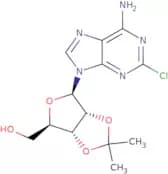
CAS :2-Chloro-2',3'-O-isopropylideneadenosine is a novel, anti-cancer drug that inhibits the synthesis of DNA. It is a phosphoramidite monophosphate with a molecular weight of 288.08 g/mol and an empirical formula C6H12ClNO5PS. The chemical name for this compound is 2-chloro-N-(2,3-diisopropyl)adenine diphosphate. This product has not yet been approved by the FDA for use in humans or animals.Formule :C13H16ClN5O4Degré de pureté :Min. 95%Couleur et forme :PowderMasse moléculaire :341.75 g/molN4-Acetyl-2'-deoxy-2'-fluorocytidine
CAS :N4-Acetyl-2'-deoxy-2'-fluorocytidine is a chemical compound that has been the subject of recent research in the field of complex system. It is an aromatic compound that is found in β-pinene, monoterpenes, and other plant products. N4-Acetyl-2'-deoxy-2'-fluorocytidine has not been shown to have any significant biological activity.Formule :C11H14FN3O5Degré de pureté :Min. 98 Area-%Couleur et forme :White PowderMasse moléculaire :287.24 g/molCaged GTP
CAS :Caged GTP is a modified nucleotide that is biologixally inactive until exposed to ultraviolet light, where GTP is released.Formule :C18H23N6O16P3Degré de pureté :Min. 95 Area-%Couleur et forme :White Off-White PowderMasse moléculaire :672.33 g/mol2',3'-Dideoxyadenosine
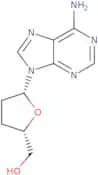
CAS :<p>2',3'-Dideoxyadenosine is a nucleoside analog that inhibits HIV replication and is a competitive inhibitor of adenylyl cyclase. This latter action reduces levels of cyclic adenosine monophosphate (cAMP)</p>Formule :C10H13N5O2Degré de pureté :Min. 95%Couleur et forme :PowderMasse moléculaire :235.25 g/mol5'-Deoxy-5'-iodoguanosine
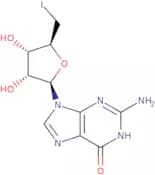
CAS :<p>5'-Deoxy-5'-iodoguanosine is a synthetic nucleoside that is used as a molecular probe to study the biochemical and physiological effects of UV irradiation. It has been shown to be reactive under in vitro conditions, and to have functionalities in vivo. 5'-Deoxy-5'-iodoguanosine has been used as a polymerase inhibitor, and it can also be used for the synthesis of oligonucleotides.</p>Formule :C10H12IN5O4Degré de pureté :Min. 95%Couleur et forme :Yellow PowderMasse moléculaire :393.14 g/mol2'-Deoxy-5'-O-DMT-N6-methyladenosine
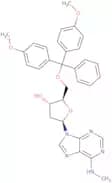
CAS :2'-Deoxy-5'-O-DMT-N6-methyladenosine is a mutant of the natural nucleoside adenosine which has been synthesized as a model for the study of the enzyme ribonucleotide reductase. The mutant has a frameshift mutation, and the resulting protein is unable to catalyze DNA synthesis. It can be complemented by adding wild type nucleotides to regenerate the original sequence. 2'-Deoxy-5'-O-DMT-N6-methyladenosine inhibits the synthetase activity of ribonucleotide reductase and also inhibits polymerization of erythromycin B and styrene. 2'-Deoxy-5'-O-DMT-N6-methyladenosine has been shown to inhibit dehydrogenase activity in auxotrophs of Escherichia coli.Formule :C32H33N5O5Degré de pureté :Min. 98 Area-%Couleur et forme :Off-White PowderMasse moléculaire :567.64 g/mol5-Chloro-5'-deoxyuridine
5-Chloro-5'-deoxyuridine is a nucleoside that is used as an antiviral agent and anticancer drug. It inhibits the viral DNA polymerase by acting as a phosphoramidite in the synthesis of viral DNA. 5-Chloro-5'-deoxyuridine is also used in the treatment of leukemia cells, which are resistant to other anticancer drugs. The high purity and modified nucleosides make this product highly desirable for research purposes. The novel syntheses of this product make it a desirable choice for many researchers.Formule :C9H11ClN2O5Degré de pureté :Min. 95%Couleur et forme :PowderMasse moléculaire :262.65 g/mol2'-Deoxy-N2-DMF-guanosine
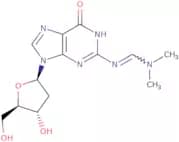
CAS :2'-Deoxy-N2-DMF-guanosine is a synthetic nucleoside that is used as a primer in DNA sequencing and hybridization experiments. It binds to the 5' end of single-stranded DNA and is complementary to guanosine. The 2'-deoxy group on the sugar moiety prevents the formation of hydrogen bonds with other bases, which increases stability. In addition, it has a high affinity for dna binding proteins. This synthetic nucleoside has been shown to be useful in clinical diagnostics and can be used as a probe for detecting diazirine residues in DNA sequences.Formule :C13H18N6O4Degré de pureté :Min. 97 Area-%Couleur et forme :White Off-White PowderMasse moléculaire :322.33 g/mol2'-Deoxyuridine
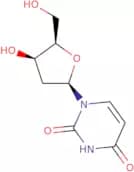
CAS :<p>2'-Deoxyuridine (2'-dU) is an intermediate in the synthesis of thymidylate, which is a precursor for DNA synthesis. It can be prepared through high-performance liquid chromatography. 2'-dU has been shown to inhibit the enzymatic activity of enzymes responsible for synthesizing uridine and thymidylate, leading to neuronal death. 2'-dU has also been shown to have a protective effect against mitochondrial dysfunction induced by hydrogen fluoride. It is also known to bind with toll-like receptor 4 (TLR4), which is involved in inflammatory responses. 2'-dU has been used as a fluorescence probe for nucleic acids and as a polymerase chain reaction (PCR) substrate.</p>Formule :C9H12N2O5Degré de pureté :Min. 98 Area-%Couleur et forme :White PowderMasse moléculaire :228.21 g/mol3'-Amino-2',3'-dideoxyguanosine
CAS :<p>3'-Amino-2',3'-dideoxyguanosine's lack of a 3'-hydroxyl group makes it a chain terminator for DNA polymerase, a key application in Sanger sequencing. Additionally, the 3'-amino group serves as a functional handle for modifying the 3' end of oligonucleotides with various labels or conjugates, expanding their utility in research and diagnostics.</p>Formule :C10H14N6O3Degré de pureté :(%) Min. 95%Couleur et forme :Off-White PowderMasse moléculaire :266.26 g/mol2-Thiouridine
CAS :<p>2-Thiouridine is a uridine derivative that acts as a precursor for protein synthesis. It is synthesized from 2-amino-5-thiazole carboxylic acid and uracil in two steps, first with the formation of 2-thiouridine monophosphate and then with the conversion to 2-thiouridine diphosphate. The synthesis of 2-thiouridine is catalyzed by the enzyme uridine phosphorylase, which converts it to uridine monophosphate. 2-Thiouridine has been shown to have immunomodulatory effects in cell culture systems and animal models. These effects are believed to be due to its ability to act as an inhibitor of fatty acid synthase, which generates fatty acids from acetyl CoA. This process prevents the production of prostaglandins and leukotrienes, thereby reducing inflammation.</p>Formule :C9H12N2O5SDegré de pureté :Min. 98 Area-%Couleur et forme :White PowderMasse moléculaire :260.27 g/molXanthosine 5'-monophosphate disodium salt
CAS :Xanthosine 5'-monophosphate disodium salt is a nucleotide that has been shown to react with nitrite in aqueous solution to form xanthosine 5'-monophosphate. The reaction system can be prepared by adding nitrite to a solution of xanthosine 5'-monophosphate disodium salt and deionized water. The crystallization process can be done by adding ethanol dropwise to the reaction system under controlled conditions. Impurities may result from the preparation process, such as sodium chloride, sodium sulfate, and sodium hydroxide.Formule :C10H11N4Na2O9PDegré de pureté :Min. 95%Couleur et forme :White Slightly Yellow PowderMasse moléculaire :408.17 g/mol2'-Deoxy-N3-methyluridine
CAS :<p>2'-Deoxy-N3-methyluridine is a nucleoside analog that is used as a substrate in the synthesis of DNA. It can be incorporated into the DNA strand by enzymes called thymidylate synthases. 2'-Deoxy-N3-methyluridine has been shown to inhibit bacterial growth in cell cultures, and it is also active against marine sponges. The protonation state of the molecule determines its hydrophobicity and can be altered by adding a test compound to the solution. Hydrophobic molecules are more likely to bind with water molecules than hydrophilic molecules, which are more soluble in water.</p>Formule :C10H14N2O5Degré de pureté :Min. 95%Couleur et forme :White PowderMasse moléculaire :242.23 g/mol2',3'-Dideoxyuridine
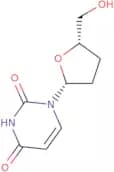
CAS :<p>Research tool for anti-viral and anti-cancer studies</p>Formule :C9H12N2O4Degré de pureté :Min. 98 Area-%Couleur et forme :White PowderMasse moléculaire :212.21 g/molN4,N4-Dimethylcytidine
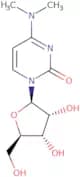
CAS :<p>N4,N4-Dimethylcytidine is a nucleoside that is an analog of cytidine. It has antiviral potency against influenza virus and inhibits the RNA-dependent DNA polymerase. N4,N4-Dimethylcytidine can be used to treat influenza and other viruses that are resistant to other antiviral drugs. This drug can be used in cell culture to inhibit the production of mismatched DNA strands, which is important for the replication of RNA viruses such as influenza. N4,N4-Dimethylcytidine also has been shown to be an inhibitor of miRNA activity in mammalian cells.</p>Formule :C11H17N3O5Degré de pureté :(%) Min. 95%Couleur et forme :White PowderMasse moléculaire :271.27 g/molN4-Benzoyl-2'-O-methylcytidine
CAS :<p>N4-Benzoyl-2'-O-methylcytidine is a triester of cytidine that is used in various biochemical research applications. It is enzymatically synthesized from cytidine and benzoyl chloride. N4-Benzoyl-2'-O-methylcytidine has been shown to have the same electrophoretic mobility as 5-hydroxyl cytidine, but it does not react with hydroxylamine to produce the corresponding hydroxylated product. This compound has also been used to study nucleic acid structure and function.</p>Formule :C17H19N3O6Degré de pureté :Min. 95%Couleur et forme :PowderMasse moléculaire :361.35 g/mol6-Methylpurine-2'-deoxyriboside
CAS :<p>6-Methylpurine-2'-deoxyriboside (6MPdR) is a nucleoside analog that inhibits viral polymerase activity. It is used in the treatment of bowel diseases, such as inflammatory bowel disease and hepatitis C. 6MPdR can be used to treat cancer by inhibiting cellular proliferation and inducing apoptosis. This drug has been shown to inhibit leishmania growth in cell culture. 6MPdR can be administered orally or intravenously, and is pegylated for greater stability in the blood stream.</p>Formule :C11H14N4O3Degré de pureté :Min. 95%Couleur et forme :PowderMasse moléculaire :250.25 g/molCoenzyme A hydrate
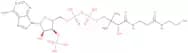
CAS :Coenzyme A hydrate is essential in the metabolism of fatty acids and the synthesis of acetyl-CoA. It is also employed in pharmaceutical applications, especially in drug development and formulation. Its distinctive properties improve drug solubility and bioavailability, making it an essential component in the creation of therapeutic agents.Formule :C21H36N7O16P3S·xH2ODegré de pureté :(Enzymatic) Min. 75%Couleur et forme :White Off-White Slightly Yellow PowderMasse moléculaire :767.54 g/mol