Nucléosides
3569 produits trouvés pour "Nucléosides"
Uracil Sodium salt
CAS :Pyrimidine nucleobase; allosteric regulator and coenzyme for reactions
Degré de pureté :Min. 95%Adenosine 5'-monophosphate [U-13C10,U-15N5]
CAS :Adenosine 5'-monophosphate (AMP) is a nucleoside that is used in the synthesis of DNA, RNA and other nucleic acids. AMP is also an antiviral and anticancer agent that can be used to activate other drugs. AMP is synthesized from adenosine triphosphate (ATP) by removing one phosphate group, resulting in the formation of adenosine diphosphate (ADP). ADP can then be converted to AMP by adding a phosphate group back on. This synthetic process can be modified to produce novel derivatives of AMP with enhanced properties.Formule :C10H14N5O7PDegré de pureté :Min. 95%Masse moléculaire :362.11 g/mol8,5'-(S)-Cycloadenosine
CAS :8,5'-(S)-Cycloadenosine is a radiosensitizer that is used in the treatment of cancer. It is an adenosine derivative that has been shown to increase the sensitivity of cells to radiation. 8,5'-(S)-Cycloadenosine has been used in clinical trials as a radiosensitizer for the treatment of non-small cell lung cancer and myeloma. It can be used with other chemotherapeutic agents or irradiation to reduce tumor size and improve survival rates. The compound binds to DNA and increases the formation of hydrogen peroxide by inhibiting DNA repair enzymes such as topoisomerase II, which are responsible for breaking down hydrogen peroxide. 8,5'-(S)-Cycloadenosine also prevents the production of reactive oxygen species (ROS) from azobisisobutyronitrile (AIBN), which is often used as a radical initiator during polymerization reactions.Formule :C10H11N5O4Degré de pureté :Min. 95%Couleur et forme :White to off-white solid.Masse moléculaire :265.23 g/molN4-Benzoyl-5'-O-DMT-2'-O-(2-methylacetamido)-5-methylcytidine 3'-CE phosphoramidite
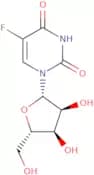
N4-Benzoyl-5'-O-DMT-2'-O-(2-methylacetamido)-5-methylcytidine 3'-CE phosphoramidite is a novel, antiviral, and anticancer agent. It has high purity and quality, and is modified with an acetyl group (N4-benzoyl) at the 5' position of the nucleotide sugar. This product has a CAS No. of 636371-27-0 and may be used as a monophosphate or diphosphate. The N4-benzoyl group is not present in natural nucleosides; therefore, this analog can serve as an activator for ribonucleoside kinase by mimicking the natural substrate.Degré de pureté :Min. 95%5-Fluoro-1-(b-L-ribofuranosyl)-uracil
CAS :5-Fluoro-1-(b-L-ribofuranosyl)-uracil is a triflate that is synthesized by the intramolecular, stereospecific reaction of l-guanosine and l-adenosine. It has been shown to have high yields in its synthesis. 5-Fluoro-1-(b-L-ribofuranosyl)-uracil can be used to produce glycosidations with d-galactose and l-thymidine. This product can also be used for the production of l-[5-(2,4,6-trimethoxybenzoyl)-1Hpyrazol]-3-[(2S,3R)-3-(bromomethyl)pyrrolidin]-2one (PBI), which is an inhibitor of protein kinase C.Degré de pureté :Min. 95%4'-a-C-Methylguanosine
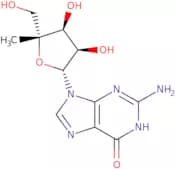
CAS :4'-a-C-Methylguanosine is a nucleoside that is synthesized by the condensation of 4'-amino-2',3'-dideoxyadenosine and 1,2-ethanediol. This product is an activator that can be used to synthesize novel DNA analogues with various chemical modifications. It has shown antiviral and anticancer activity in vitro. 4'-a-C-Methylguanosine was also found to be more active than guanosine when it came to inhibiting viral replication in human cells.Degré de pureté :Min. 95%2-(2-Furyl)-5-pyrimidinecarbaldehyde
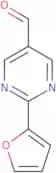
CAS :2-(2-Furyl)-5-pyrimidinecarbaldehyde (2FP) is a novel anticancer activator that belongs to the class of modified DNA. 2FP is a nucleoside analogue that inhibits the synthesis of DNA, RNA, and protein. It has been shown to inhibit the growth of cancer cells in vitro and in vivo. This compound may be used as an antiviral agent against HIV and herpes virus infections. 2FP has high purity and quality, with CAS number 959240-19-8.Formule :C9H6N2O2Degré de pureté :Min. 95%Masse moléculaire :174.16 g/molBenzoyl stavudine
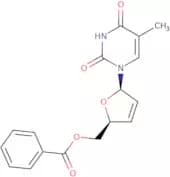
CAS :Benzoyl stavudine is a nucleoside that is used as an anti-HIV drug. It has been shown to be a prodrug of the active form, stavudine, by reductive elimination. Benzoyl stavudine has been shown to inhibit HIV replication by competitively binding to the viral reverse transcriptase enzyme and preventing the synthesis of RNA from DNA. This drug also inhibits ribonucleotide reductase, an enzyme that converts ribonucleotides into deoxyribonucleotides for DNA synthesis. This inhibition prevents the formation of new viral DNA and halts viral replication.Formule :C17H16N2O5Degré de pureté :Min. 95%Masse moléculaire :328.32 g/molN6-Benzoyl-2'-deoxy-5'-O-pixyladenosine
N6-Benzoyl-2'-deoxy-5'-O-pixyladenosine is a novel nucleoside that acts as an antiviral and anticancer agent. It inhibits the synthesis of DNA and RNA by binding to the ribonucleotide reductase enzyme. N6-Benzoyl-2'-deoxy-5'-O-pixyladenosine has shown activity against several human cancer cell lines, including leukemia cells. This drug also binds to the viral reverse transcriptase enzyme, preventing viral replication.Formule :C36H29N5O5Degré de pureté :Min. 95%Masse moléculaire :611.66 g/molUridine 5'-triphosphate
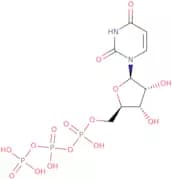
CAS :P2Y receptor agonist; precursor in RNA biosynthesis
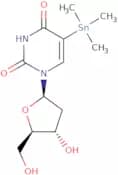
Formule :C9H15N2O15P3Degré de pureté :Min. 95%Masse moléculaire :484.14 g/mol5-(Trimethylstannyl)-2'-deoxyuridine
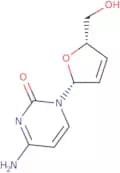
CAS :5-(Trimethylstannyl)-2'-deoxyuridine is a nucleoside analogue that is structurally related to thymidine. It has been shown to be cytotoxic in vitro, with high cytotoxicity for human glioma cells. This drug has been detected in vivo using autoradiography and microspectrophotometry, with a maximum uptake in the brain and detectable levels in the kidneys and liver. 5-(Trimethylstannyl)-2'-deoxyuridine is taken up by cells through an energy transfer process. The drug is demercurated from the cell surface by extracellular enzymes, such as sulfatases and phosphatases, converting it into 5-mercapto-2'-deoxyuridine (MdUrd), which can be detected by its UV-absorption characteristics.Formule :C12H20N2O5SnDegré de pureté :Min. 95%Masse moléculaire :391.01 g/mol2',3'-Dideoxy-2',3'-didehydrocytidine
CAS :2',3'-Dideoxy-2',3'-didehydrocytidine (ddC) is a nucleoside analog that is used in the treatment of hepatitis B and C. This drug inhibits the reverse transcriptase enzyme and has cytostatic effects on viruses, for example, by preventing cell division. 2',3'-Dideoxy-2',3'-didehydrocytidine also inhibits viral replication by acting as an antigen and inducing antibody production. This drug binds to a variety of enzymes, including preparations of cellular enzymes, human immunodeficiency virus type 1 (HIV-1), and reverse transcriptase. The effective dose of ddC is 300 mg/day given orally.Formule :C9H11N3O3Degré de pureté :Min. 95%Masse moléculaire :209.2 g/mol2',3',5'-Tri-O-acetylnebularine
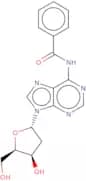
CAS :2',3',5'-Tri-O-acetylnebularine is a modified nucleoside that is synthesized from nebulareine. It has been shown to inhibit the growth of cancer cells, as well as HIV and influenza virus. This drug also has antiviral effects against herpes simplex virus type 1 (HSV-1) and herpes simplex virus type 2 (HSV-2). 2',3',5'-Tri-O-acetylnebularine inhibits viral replication by inhibiting DNA synthesis and RNA transcription, which prevents the production of proteins needed for cell multiplication.Formule :C16H18N4O7Degré de pureté :Min. 95%Masse moléculaire :378.34 g/molN6-Benzoyl-2'-deoxy-a-adenosine
N6-Benzoyl-2'-deoxy-a-adenosine is a synthetic nucleoside analog. N6-Benzoyl-2'-deoxy-a-adenosine has antiviral and anticancer properties. It is a potent inhibitor of DNA polymerase and also inhibits ribonucleotide reductase, which are enzymes crucial for DNA synthesis. N6-Benzoyl-2'-deoxy-a-adenosine inhibits the synthesis of viral RNA, leading to inhibition of viral replication. It has been shown to inhibit proliferation of tumor cells in vitro and in vivo by inhibiting DNA synthesis and inducing apoptosis.Formule :C17H17N5O4Degré de pureté :Min. 95%Masse moléculaire :355.36 g/mol3'-Azido-2',3'-dideoxyuridine
CAS :3'-Azido-2',3'-dideoxyuridine is an analog of the nucleoside dideoxyuridine that inhibits HIV replication. It has a high inhibitory dose and low toxicity. 3'-Azido-2',3'-dideoxyuridine is converted to its active form, 3'-azido-2',3'-dideoxythymidine (AZT), by dephosphorylation in human serum. AZT inhibits HIV replication by competing with the natural substrate for viral DNA polymerase, thereby inhibiting synthesis of viral DNA. 3'-Azido-2',3'-dideoxyuridine has been shown to be effective against hepatitis B virus and hepatitis C virus in cell cultures.
Formule :C9H11N5O4Degré de pureté :Min. 95%Couleur et forme :Off-White PowderMasse moléculaire :253.21 g/mol2-Fluoro-I ce-phosphoramidite (convertible G ce-phosphoramidite)
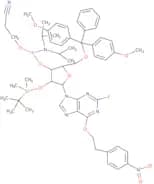
CAS :Please enquire for more information about 2-Fluoro-I ce-phosphoramidite (convertible G ce-phosphoramidite) including the price, delivery time and more detailed product information at the technical inquiry form on this pageFormule :C54H67FN7O10PSiDegré de pureté :Min. 95%Masse moléculaire :1,052.2 g/mol4'-C-Azido-2'-deoxy-2'-fluoro-b-D-arabinouridine
CAS :4'-C-Azido-2'-deoxy-2'-fluoro-b-D-arabinouridine is a novel nucleoside analog that can be activated to the monophosphate form for incorporation into DNA. It has antiviral and anticancer properties. 4'-C-Azido-2'-deoxy-2'-fluoro-b-D-arabinouridine has been shown to inhibit the proliferation of cultured tumor cells, suggesting a potential use in cancer chemotherapy.
Formule :C9H10FN5O5Degré de pureté :Min. 95%Masse moléculaire :287.2 g/molN4-Benzoyl-2'-deoxy-5'-O-levulinoylcytidine
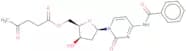
N4-Benzoyl-2'-deoxy-5'-O-levulinoylcytidine is a modified nucleoside that is synthesized from 2,4-dichloroacetophenone and cytidine. It has been shown to be an activator of the ribonucleotide reductase enzyme, which converts deoxyribonucleosides into their corresponding ribonucleotides. This drug is used in cancer therapy as well as antiviral and antiretroviral therapy. N4-Benzoyl-2'-deoxy-5'-O-levulinoylcytidine is also being investigated for use in treating other diseases such as malaria and AIDS.Formule :C21H23N3O7Degré de pureté :Min. 95%Masse moléculaire :429.43 g/mol3’-Azido-3’-deoxy-b-L-uridine
CAS :3’-Azido-3’-deoxy-b-L-uridine is a novel nucleoside analog that inhibits DNA polymerase. It is a modified, phosphoramidite precursor of the antiviral drug AZT and has been shown to inhibit human immunodeficiency virus (HIV) in vitro. 3’-Azido-3’-deoxy-b-L-uridine has also been found to be cytotoxic against cancer cells and may have antitumor activity. The phosphoramidite form of 3’ azido 3’ deoxy b L uridine can be used for the synthesis of oligonucleotides with high purity and quality.Formule :C9H11N5O5Degré de pureté :Min. 95%Masse moléculaire :269.21 g/mol5-Chlorouridine
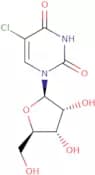
CAS :5-Chlorouridine is a nucleoside with hypochlorous acid. It has been shown to inhibit the growth of tumor cells in tissue culture and to have an inhibitory effect on cervical cancer, which may be due to its ability to inhibit cellular metabolism and DNA synthesis. 5-Chlorouridine inhibits the uptake of uridine by blocking the conversion of uridine into cytosine, thereby preventing DNA synthesis. This prodrug also prevents radiation from inducing mutations in DNA. The molecular modeling study shows that 5-chlorouridine forms hydrogen bonds with hydroxyl groups in RNA, which may be important for its anti-cancer activity.Formule :C9H11ClN2O6Degré de pureté :Min. 95%Couleur et forme :White PowderMasse moléculaire :278.65 g/mol


![Adenosine 5'-monophosphate [U-13C10,U-15N5]](/_next/image/?url=https%3A%2Fstatic.cymitquimica.com%2Fproducts%2F3D%2Fthumb-webp%2FNA31536.webp&w=3840&q=75)