


Nucléosides
Les nucléosides sont des building blocks fondamentaux des acides nucléiques, composés d'une base azotée attachée à une molécule de sucre. Dans cette section, vous trouverez une large gamme de nucléosides essentiels pour la recherche en biologie moléculaire, biochimie et pharmacologie. Ces composés jouent des rôles cruciaux dans la synthèse de l'ADN et de l'ARN, et sont également vitaux dans divers processus métaboliques. Les nucléosides sont utilisés pour étudier le matériel génétique, développer des thérapies antivirales et anticancéreuses, et comprendre les mécanismes cellulaires. Chez CymitQuimica, nous proposons des nucléosides de haute qualité pour soutenir vos besoins en recherche et développement, garantissant pureté et fiabilité pour vos applications expérimentales.
3569 produits trouvés pour "Nucléosides"
Trier par
Degré de pureté (%)
0
100
|
0
|
50
|
90
|
95
|
100
N4-Benzoyl-5'-O-DMT-2'-O-(2-methylacetamido)-5-methylcytidine 3'-CE phosphoramidite
<p>N4-Benzoyl-5'-O-DMT-2'-O-(2-methylacetamido)-5-methylcytidine 3'-CE phosphoramidite is a novel, antiviral, and anticancer agent. It has high purity and quality, and is modified with an acetyl group (N4-benzoyl) at the 5' position of the nucleotide sugar. This product has a CAS No. of 636371-27-0 and may be used as a monophosphate or diphosphate. The N4-benzoyl group is not present in natural nucleosides; therefore, this analog can serve as an activator for ribonucleoside kinase by mimicking the natural substrate.</p>Degré de pureté :Min. 95%2'-O-tert-Butyldimethylsilyl-N2-DMF-5'-O-DMT-guanosine 3'-CE phosphoramidite
2'-O-tert-Butyldimethylsilyl-N2-DMF-5'-O-DMT-guanosine 3'-CE phosphoramidite is a nucleoside monophosphate with CAS No. 58822-52-3. It is an activator that has anticancer and antiviral properties. This product is modified, novel and high purity and quality. 2'-O-tert-Butyldimethylsilyl-N2-DMF-5'-O-DMT-guanosine 3'-CE phosphoramidite can be used in the synthesis of oligonucleotides for use as probes or drugs in the treatment of cancer, HIV, hepatitis B and influenza A.Formule :C49H67N8O8PSiDegré de pureté :Min. 95%Masse moléculaire :955.19 g/molDisodium adenosine 5'-phosphate hydrate
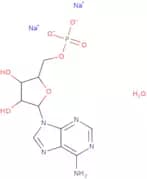
CAS :Disodium adenosine 5'-phosphate hydrate is a novel, modified nucleotide analogue that is used in antiviral therapy. It has been shown to be an effective inhibitor of herpes simplex virus type 1 (HSV-1), herpes simplex virus type 2 (HSV-2), and cytomegalovirus. Disodium adenosine 5'-phosphate hydrate also inhibits DNA polymerase and RNA polymerase, thereby preventing replication of the virus genome. Disodium adenosine 5'-phosphate hydrate has been shown to be active against cancer cells in vitro and in vivo, as well as being useful in the treatment of cancer.Formule :C10H14N5Na2O8PDegré de pureté :Min. 95%Masse moléculaire :409.2 g/mol(-)-Adenosine 3'-monophosphate hydrate
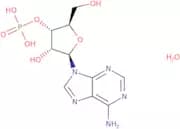
CAS :<p>Adenosine 3'-monophosphate hydrate is a nucleoside that is an important intermediate in the biosynthesis of DNA and RNA. It is a phosphodiesterase inhibitor, which prevents the breakdown of adenosine 3'-monophosphate (cAMP). This compound also has a role in various other metabolic pathways, such as the synthesis of purines. Adenosine 3'-monophosphate hydrate is used for preparing adenosylcobalamin and for studies on phosphodiesterases. The nature of this compound is determined by its chemical structure, including functional groups and sequences. Its modification includes the addition of phosphate groups to its ribose sugar moiety. Adenosine 3'-monophosphate hydrate has a molecular weight of 372.4 g/mol and optimum pH of 7-8.<br>The hybridization behavior and ph optimum are characteristic properties of this compound.</p>Formule :C10H16N5O8PDegré de pureté :Min. 95%Masse moléculaire :365.24 g/mol2-Chloro-4-hydroxy-5-fluoropyrimidine
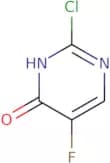
CAS :2-Chloro-4-hydroxy-5-fluoropyrimidine is a nucleoside with antiviral and anticancer activity. It has shown to be an effective agent against HIV, herpes virus and human papilloma virus. 2-Chloro-4-hydroxy-5-fluoropyrimidine inhibits the synthesis of DNA by inhibiting the enzyme DNA polymerase, which catalyzes the formation of diphosphate from monophosphate. In addition, it inhibits protein synthesis by inhibiting ribonucleotide reductase, which catalyzes the conversion of ribonucleotides to deoxyribonucleotides.Formule :C4H2ClFN2ODegré de pureté :Min. 95%Masse moléculaire :148.52 g/mol5-Fluoro-1-(b-L-ribofuranosyl)-uracil
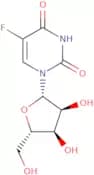
CAS :<p>5-Fluoro-1-(b-L-ribofuranosyl)-uracil is a triflate that is synthesized by the intramolecular, stereospecific reaction of l-guanosine and l-adenosine. It has been shown to have high yields in its synthesis. 5-Fluoro-1-(b-L-ribofuranosyl)-uracil can be used to produce glycosidations with d-galactose and l-thymidine. This product can also be used for the production of l-[5-(2,4,6-trimethoxybenzoyl)-1Hpyrazol]-3-[(2S,3R)-3-(bromomethyl)pyrrolidin]-2one (PBI), which is an inhibitor of protein kinase C.</p>Degré de pureté :Min. 95%2,2'-Anhydro-5'-O-tert-butyldiphenylsilylthymidine
2,2'-Anhydro-5'-O-tert-butyldiphenylsilylthymidine is a novel monophosphate nucleoside analog that has antiviral activity against herpes simplex virus type 1 (HSV-1) and herpes simplex virus type 2 (HSV-2). This compound is chemically synthesized by the reaction between thymidine with bis-(2,6-diisopropylphenyl) disilazane in the presence of an activator. The synthesis of 2,2'-anhydro-5'-O-tert-butyldiphenylsilylthymidine is performed by reacting 5'-O-(4,4'-dimethoxytrityl)-thymidine with bis-(2,6-diisopropylphenyl) disilazane in the presence of tetrakis(triphenylphosphine)palladium(0Degré de pureté :Min. 95%N2-Isobutyryl-7’-tert-butyldimethylsilyl-N-trityl-morpholino guanosine
N2-Isobutyryl-7’-tert-butyldimethylsilyl-N-trityl-morpholino guanosine is a modified nucleoside that can be used in the synthesis of DNA, RNA, and other nucleic acids. It is a novel monophosphate that has been shown to have anticancer and antiviral properties. N2-Isobutyryl-7’-tert-butyldimethylsilyl-N-trityl-morpholino guanosine is synthesized by reacting 2,4,6 trichlorobenzoyl chloride with morpholine and silylation. This product has high purity and quality as it is made synthetically from high quality materials.Degré de pureté :Min. 95%3'-Deoxy-L-thymidine
CAS :<p>3'-Deoxy-L-thymidine is a nucleoside analog that inhibits HIV replication by interfering with the synthesis of viral DNA. The drug binds to the enzyme thymidine phosphorylase, which converts thymidine into deoxyuridine monophosphate, and prevents conversion of deoxyuridine to deoxythymidine monophosphate. This leads to inhibition of both DNA synthesis and the production of RNA. 3'-Deoxy-L-thymidine has dose-limiting toxicity at high doses and is not active against other viruses such as herpes simplex virus or cytomegalovirus. It is metabolized in the liver by enzymes such as 5-fluorocytosine, which converts it into its active form, 5-fluorouracil.</p>Formule :C10H14N2O4Degré de pureté :Min. 95%Masse moléculaire :226.23 g/mol5,6-Dihydrothymidine
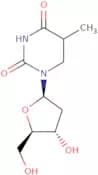
CAS :<p>5,6-Dihydrothymidine is a hydroxylated thymidine analogue. It binds to the leukocyte antigen, which is found on many different types of cells. 5,6-Dihydrothymidine inhibits the replication of herpes simplex virus and can be used for diagnostic purposes. 5,6-Dihydrothymidine has been shown to have conformational properties that are similar to those of thymine, which allows it to bind to the template strand in DNA. This binding prevents the synthesis of messenger RNA from DNA. 5,6-Dihydrothymidine is also able to inhibit cell growth in culture and can be used as a cell culture medium supplement.</p>Formule :C10H16N2O5Degré de pureté :Min. 95%Couleur et forme :PowderMasse moléculaire :244.24 g/mol3,5-Di-o-(p-toluoyl)-5-(2-hydroxyethyl)-2-deoxyuridine
CAS :<p>3,5-Di-o-(p-toluoyl)-5-(2-hydroxyethyl)-2-deoxyuridine is a nucleoside analogue that has antiviral and anticancer activities. It is synthesized by the condensation of orotic acid with 2'-deoxyuridine in the presence of N,N'-dicyclohexylcarbodiimide (DCC). 3,5-Di-o-(p-toluoyl)-5-(2-hydroxyethyl)-2-deoxyuridine is an activator of ribonucleotide reductase, which is an enzyme involved in DNA synthesis and repair. 3,5-Di-o-(p-toluoyl)-5-(2-hydroxyethyl)-2-deoxyuridine is also capable of inhibiting DNA polymerases and RNA polymerases. This drug can be used for treatment against cancer and antiviral infections.</p>Formule :C27H28N2O8Degré de pureté :Min. 95%Masse moléculaire :508.50 g/molN4-Benzoyl-1-(a-D-mannopyranosyl)cytosine
N4-Benzoyl-1-(a-D-mannopyranosyl)cytosine is a modified deoxyribonucleoside that has antiviral and anticancer activities. It is a phosphoramidite, which can be converted to nucleosides using standard methods. N4-Benzoyl-1-(a-D-mannopyranosyl)cytosine is also an activator of the DNA polymerase enzyme and a high quality, novel anti-cancer drug.Formule :C17H19N3O7Degré de pureté :Min. 95%Couleur et forme :White to off-white powder.Masse moléculaire :377.35 g/mol5'-O-Levulinoylthymidine 3'-CE phosphoramidite
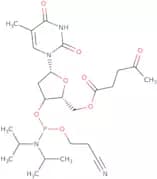
CAS :<p>5'-O-Levulinoylthymidine 3'-CE phosphoramidite is a novel, high quality diphosphate nucleoside. It is modified with levulinic acid and has antiviral and anticancer properties. 5'-O-Levulinoylthymidine 3'-CE phosphoramidite is synthesized from 5'-O-levulinoylthymidine monophosphate, which is synthesized from thymidine and levulinic acid. The synthesis of 5'-O-levulinoylthymidine 3'-CE phosphoramidite starts with the reaction of 1 equivalent of thymidine with 1 equivalent of levulinic acid in aqueous solution at pH 7 to 8 at 100°C for 2 hours, followed by purification by HPLC.</p>Formule :C24H37N4O8PDegré de pureté :Min. 95%Masse moléculaire :540.55 g/molLNA-guanosine 3'-CE phosphoramidite
CAS :<p>LNA-guanosine 3'-CE phosphoramidite is a novel, high purity, activated nucleoside. It is an anti-cancer and antiviral agent that is synthetically modified to include a phosphate group at the 3' position of the sugar moiety. This modification prevents viral inhibition by inhibiting viral DNA synthesis. LNA-guanosine 3'-CE phosphoramidite is also used as an anticancer agent due to its ability to inhibit ribonucleotide reductase and diphosphate reductase, which are enzymes required for DNA synthesis.</p>Degré de pureté :Min. 95%4'-C-Azido-2'-deoxy-2'-fluoro-b-D-arabinouridine
CAS :<p>4'-C-Azido-2'-deoxy-2'-fluoro-b-D-arabinouridine is a novel nucleoside analog that can be activated to the monophosphate form for incorporation into DNA. It has antiviral and anticancer properties. 4'-C-Azido-2'-deoxy-2'-fluoro-b-D-arabinouridine has been shown to inhibit the proliferation of cultured tumor cells, suggesting a potential use in cancer chemotherapy.</p>Formule :C9H10FN5O5Degré de pureté :Min. 95%Masse moléculaire :287.2 g/mol2'-O-Acetyl-5'-O-benzoyl-3'-deoxy-5-methyluridine
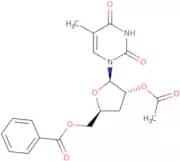
CAS :2'-O-Acetyl-5'-O-benzoyl-3'-deoxy-5-methyluridine (ABT-888) is a nucleoside analog that inhibits DNA synthesis and RNA transcription. It has been shown to induce apoptosis in human cancer cells, including leukemia, lymphoma and breast cancer cells. ABT-888 also has antiviral activity against herpes simplex virus type 1 and 2, vaccinia virus, and vesicular stomatitis virus.Formule :C19H20N2O7Degré de pureté :Min. 95%Masse moléculaire :388.37 g/molcis-Zeatin-o-glucoside riboside
CAS :<p>Cis-Zeatin-o-glucoside riboside is a plant metabolite that belongs to the class of phenylpropanoids. It is the product of the conversion of zeatin by a polyphenol oxidase. Cis-Zeatin-o-glucoside riboside has been found in plants, such as Eucomis and Alnifolia, at levels ranging from 0.2 to 1%. This metabolite is also present in animal tissues, such as rat brain and bovine mammary gland. The metabolic pathway for cis-Zeatin-o-glucoside riboside has been elucidated through tissue culture experiments with Eucomis and 24-epibrassinolide. The biosynthesis of this metabolite involves a two step process: first, an oxidative cleavage of zeatin to indole-3-acetyl l -aspartic acid and then conversion to</p>Formule :C21H31N5O10Degré de pureté :Min. 95%Masse moléculaire :513.5 g/molO6-Chlorophenyl-I ce-phosphoramidite
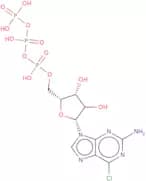
CAS :<p>Please enquire for more information about O6-Chlorophenyl-I ce-phosphoramidite including the price, delivery time and more detailed product information at the technical inquiry form on this page</p>Formule :C52H64ClN6O8PSiDegré de pureté :Min. 95%Masse moléculaire :995.6 g/mol2-Amino-6-chloro-(b-D-ribofuranosyl)purine-5'-triphosphate
2-Amino-6-chloro-(b-D-ribofuranosyl)purine-5'-triphosphate is a modified nucleotide analog that is used as an antiviral agent. It inhibits the synthesis of viral DNA by competitively inhibiting the incorporation of deoxyribonucleoside triphosphates into the growing DNA chain. 2-Amino-6-chloro-(b-D-ribofuranosyl)purine-5'-triphosphate is phosphorylated to 2-[2-(2,6,8,10,12,14,16,-doxohexadecyl)-1H--imidazo[4,5--c]pyridine--1--carboxylic acid]ethanol phosphate in vivo and this active form inhibits human immunodeficiency virus type 1 (HIV1) replication in vitro with an IC 50 of 0.06 μM.Formule :C10H15ClN5O13P3Degré de pureté :Min. 95%Masse moléculaire :541.63 g/mol3-(2'-Deoxy-β-D-2-ribofuranosyl)pyrido[2,3-d]pyrimidine-2,7(8H)-dione
CAS :3-(2'-Deoxy-β-D-2-ribofuranosyl)pyrido[2,3-d]pyrimidine-2,7(8H)-dione is a synthetic nucleoside analogue that has been modified by the replacement of the 2' oxygen atom. The phosphoramidite is used to produce 3-(2'-Deoxy-β-D-2-ribofuranosyl)pyrido[2,3-d]pyrimidine-2,7(8H)-dione in high purity and high quality. This product can be used as an antiviral agent and as an anticancer agent. It has also been shown to inhibit DNA synthesis and RNA synthesis.Formule :C12H13N3O5Degré de pureté :Min. 95%Masse moléculaire :279.25 g/mol









![3-(2'-Deoxy-β-D-2-ribofuranosyl)pyrido[2,3-d]pyrimidine-2,7(8H)-dione](/_next/image/?url=https%3A%2Fstatic.cymitquimica.com%2Fproducts%2F3D%2Fthumb-webp%2FZDA51798.webp&w=3840&q=75)