Nucléosides
3569 produits trouvés pour "Nucléosides"
3-N-Boc-5'-O-DMT-3'-fluorothymidine
CAS :3-N-Boc-5'-O-DMT-3'-fluorothymidine is a monophosphate nucleoside with antiviral and anticancer activity. It is a novel synthetic analogue of fluoro thymidine (FT) that has been shown to be an activator of DNA polymerase α, RNA polymerase β and γ, and protein kinase C. This compound is also an inhibitor of the reverse transcriptase enzyme HIV-1. 3-N-Boc-5'-O-DMT-3'-fluorothymidine has been shown to inhibit cancer cell growth in vitro and in vivo. The synthesis of this compound can be achieved by phosphoramidite chemistry using a commercially available automated synthesizer.Degré de pureté :Min. 95%2'-Deoxycytidine-5'-monophosphate
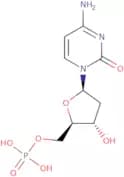
CAS :2'-Deoxycytidine-5'-monophosphate (dCMP) is a nucleotide that is synthesized by the enzyme cytidine monophosphate synthetase. It has been shown to inhibit the activity of many enzymes, including those involved in DNA synthesis and repair. The incorporation of dCMP into DNA can be used as a probe for studying various biological processes, such as radiation damage and cellular physiology. In addition, it has been shown that dCMP inhibits the growth of human osteosarcoma cells. This drug is also used in combination preparations with other drugs, such as with 5-fluorouracil and doxorubicin, to treat cancer tumors.Formule :C9H14N3O7PDegré de pureté :Min. 99 Area-%Couleur et forme :White PowderMasse moléculaire :307.2 g/mol2'-O-tert-Butyldimethylsilyl-5'-O-DMT-N3-methylcytidine 3'-CE phosphoramidite
2'-O-tert-Butyldimethylsilyl-5'-O-DMT-N3-methylcytidine 3'-CE phosphoramidite is a modified nucleoside that is synthesized by the reaction of 2'-deoxycytidine with bis(2,4,6-trichlorophenyl)carbonate in the presence of a base. 2'-O-tert-Butyldimethylsilyl-5'-O-DMT-N3 methylcytidine 3'-CE phosphoramidite has been shown to have anticancer activity and is used as an activator in the synthesis of oligonucleotides. This product is available as a white powder and can be used for research purposes only.Degré de pureté :Min. 95%Guanosine-5'-[(b,gamma)-methyleno]triphosphate sodium salt
CAS :Guanosine-5'-[(b,gamma)-methyleno]triphosphate sodium salt (GMPP) is an analog of guanosine triphosphate that is enzymatically inactivated by the enzyme kinesin. GMPP inhibits the polymerization of microtubules by binding to the kinesin molecule and preventing it from binding to tubulin. GMPP has been shown to inhibit sephadex g-100 chromatography and act as a competitive inhibitor for protein synthesis in vitro. GMPP has also been shown to have a fat cell differentiation effect which may be due to its ability to inhibit microtubule polymerization.Formule :C11H18N5O13P3·xNaDegré de pureté :Min. 95 Area-%Couleur et forme :PowderMasse moléculaire :521.21 g/mol2,3'-Anhydro-N4-benzoyl-2'-deoxycytidine 5'-CE phosphoramidite
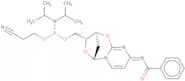
2,3'-Anhydro-N4-benzoyl-2'-deoxycytidine 5'-CE phosphoramidite is a novel nucleoside analog that has been synthesized to have the same chemistry as 2,3'-dideoxycytidine 5'-C phosphoramidite. It has antiviral and anticancer properties. This compound can be used in the synthesis of oligonucleotides for DNA sequencing and for gene therapy. 2,3'-Anhydro-N4-benzoyl-2'-deoxycytidine 5'-CE phosphoramidite is not toxic to normal cells, but it inhibits replication of viruses such as HIV and herpes simplex virus.Formule :C25H32N5O5PDegré de pureté :Min. 95%Masse moléculaire :513.54 g/mol5’-Deoxy-5’-iodo-2’-O-(2-methoxyethyl)-5-methyluridine
CAS :5’-Deoxy-5’-iodo-2’-O-(2-methoxyethyl)-5-methyluridine is an antiviral drug that inhibits the synthesis of viral DNA. It is synthesized by reacting 5'-deoxyadenosine monophosphate with 2'-O-(2-methoxyethyl)iodoacetamide and methylating the resulting product with methyl iodide. 5'-Deoxy-5’-iodo-2’-O-(2-methoxyethyl)-5-methyluridine has a novel structure and can be used as an activator of ribonucleosides in DNA synthesis. The drug also has anticancer properties, which may be due to its ability to inhibit cellular proliferation by inhibiting the enzyme DNA polymerase or by arresting cells at the G1 phase of the cell cycle.Degré de pureté :Min. 95%N4-Acetyl-2'-deoxy-5'-O-DMT-2'-fluorocytidine
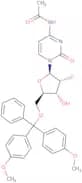
CAS :N4-Acetyl-2'-deoxy-5'-O-DMT-2'-fluorocytidine is a cytosine analog with high affinity for the T cell receptor. It can be used to generate antibodies against cytosine and as a screening tool for plasmon resonance.
Formule :C32H32FN3O7Degré de pureté :Min. 95%Couleur et forme :White PowderMasse moléculaire :589.61 g/mol4'-C-Azido-2'-deoxy-2'-fluoro-4-[bis(2-hydroxyethyl)]-b-D-arabinocytidine
CAS :4'-C-Azido-2'-deoxy-2'-fluoro-4-[bis(2-hydroxyethyl)]-b-D-arabinocytidine is a novel nucleoside analog with antiviral and anticancer activities. It is a chemical compound with the molecular formula C8H14N6O5P and a molecular weight of 288.28 g/mol. 4'-C-Azido-2'-deoxy-2'-fluoro-4-[bis(2-hydroxyethyl)]-b-D-arabinocytidine has the CAS number 136045902, which can be found in PubChem Compound Database.Degré de pureté :Min. 95%1-(4’-Azido-2’-deoxy-2’-fluoro-b-D-arabinofuranosyl)N4-(n-palmitoyl)-cytosine
1-(4’-Azido-2’-deoxy-2’-fluoro-b-D-arabinofuranosyl)N4-(n-palmitoyl)-cytosine is a deoxyribonucleoside, modified nucleoside that is synthesized by using a novel phosphoramidite chemistry. 1-(4’-Azido-2’-deoxy-2’-fluoro-b-D-arabinofuranosyl)N4-(n-palmitoyl)-cytosine is an activator of ribonucleotide reductase and can be used in anticancer and antiviral therapy.Degré de pureté :Min. 95%N6-Dimethyl-3’-b-C-methyladenosine
CAS :N6-Dimethyl-3’-b-C-methyladenosine is a novel nucleoside analog that has antiviral and anticancer properties. It is a phosphoramidite, which can be used as an activator for the synthesis of modified oligonucleotides. N6-Dimethyl-3’-b-C-methyladenosine has been shown to activate ribonucleosides and deoxyribonucleosides in vitro. This compound also has anticancer properties, which may be due to its ability to act as an activator in the synthesis of DNA.Degré de pureté :Min. 95%1'-13CCytidine
CAS :Please enquire for more information about 1'-13CCytidine including the price, delivery time and more detailed product information at the technical inquiry form on this pageFormule :CC8H13N3O5Degré de pureté :Min. 95%Couleur et forme :PowderMasse moléculaire :244.21 g/mol2'-O-(2-Methoxyethyl)-5-methyluridine 5'-monophosphate
2'-O-(2-Methoxyethyl)-5-methyluridine 5'-monophosphate is an antiviral nucleoside with anticancer properties that is synthesized from 2'-deoxyuridine monophosphate and 5-methyluridine. This novel compound has shown antiviral activity against HIV, herpes simplex virus type 1, and herpes simplex virus type 2. It also inhibits the growth of human breast cancer cells in vitro.Degré de pureté :Min. 95%5'-O-p-Anisoyl-D3-thymidine
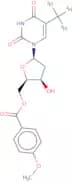
Produit contrôlé5'-O-p-Anisoyl-D3-thymidine is a nucleoside analogue that is used in antiviral and anticancer treatments. It is synthesized by the condensation of 3,4-dihydroxyacetophenone with 2,6-diaminopurine followed by phosphorylation of the 5' hydroxyl group. This product has been shown to be an activator of both DNA polymerase and RNA polymerase. In addition, it can inhibit the production of viral proteins such as HIV protease without affecting protein synthesis in mammalian cells. It also inhibits cancer cell growth by stopping DNA replication at the G2 phase. 5'-O-p-Anisoyl-D3-thymidine has been shown to be highly purified and can be used for research purposes. This product may have a CAS number but it will not be listed on this website due to company policy.Formule :C18H17N2O7D3Degré de pureté :Min. 95%Masse moléculaire :379.38 g/mol3',5'-Di-O-benzoyl-gemcitabine - Bio-X ™
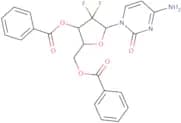
CAS :3',5'-Di-O-benzoyl-2'-deoxy-2',2'-difluorocytidine is a nucleoside analog, which is metabolized to its active form, 2',2'-difluoro-3'-O-methylcytidine. 3',5'-Di-O-benzoyl-2'-deoxy-2',2'-difluorocytidine has been shown to be a potent inhibitor of human tumor cell growth and is also effective in stimulating antitumor immunity. This drug binds to the DNA of cells and prevents transcription and replication.Formule :C23H19F2N3O6Degré de pureté :Min. 95%Couleur et forme :PowderMasse moléculaire :471.41 g/molN2-Phenylacetyl-L-guanosine
N2-Phenylacetyl-L-guanosine is a nucleoside that has been synthetically modified to have the desired properties of an anticancer agent. This compound inhibits DNA synthesis and is therefore cytotoxic to cells. It also inhibits RNA synthesis and is antiviral. N2-Phenylacetyl-L-guanosine has been found to be effective in preventing the growth of leukemia cells, breast cancer cells, prostate cancer cells, and ovarian cancer cells. N2-Phenylacetyl-L-guanosine is a nucleotide analogue that can be used as a building block for DNA or RNA synthesis. It can be used as a phosphate donor in phosphoramidite chemistry and can activate other nucleosides for use in chemical biology.
Formule :C18H19N5O6Degré de pureté :Min. 95%Masse moléculaire :401.37 g/molN7-Methylguanosine
CAS :N-7-Methylguanosine is a nucleotide that has potent anti-viral activity. It inhibits viral replication by binding to the effector proteins of a virus and preventing translation, transcriptional regulation, and other biochemical processes. N7-Methylguanosine also binds to the x-ray crystal structures of the viral genome and blocks the binding of RNA polymerase to DNA. This drug can be used as an antiviral agent for the treatment of HIV infection and hepatitis B infection. N7-Methylguanosine is not active against some viruses such as herpes simplex virus type 1 or 2, influenza virus type A/B, or rhinovirus type 2. N7-Methylguanosine has been shown to have an effect on body mass index in humans by reducing weight gain in patients with metabolic syndrome. It also has an enzyme form that can be used for therapeutic use in human serum.Formule :C11H15N5O5Degré de pureté :Min. 95%Couleur et forme :White PowderMasse moléculaire :297.27 g/mol4,6-Diamino-2-(b-D-ribofuranosyl)-2H-pyrazolo[3,4-d]pyrimidine
CAS :4,6-Diamino-2-(b-D-ribofuranosyl)-2H-pyrazolo[3,4-d]pyrimidine is a nucleoside monophosphate that is used as an antiviral agent. It inhibits the synthesis of viral DNA and RNA by inhibiting the activity of enzymes needed for nucleotide synthesis. 4,6-Diamino-2-(b-D-ribofuranosyl)-2H-pyrazolo[3,4-d]pyrimidine has shown anticancer properties in vitro against human colon cancer cells. This drug has been shown to inhibit the growth of tumor cells with high expression levels of cyclin D1 and low levels of p27 (a cell cycle regulatory protein).Degré de pureté :Min. 95%6-Chloro-3'-deoxy-3'-fluoroinosine
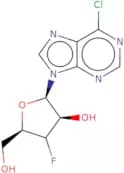
6-Chloro-3'-deoxy-3'-fluoroinosine (6-Cl-dF) is an analog of the nucleotide base, adenosine. It has been shown to be effective in the treatment of cancer and HIV infections. 6-Cl-dF inhibits DNA synthesis by inhibiting the activity of ribonucleotide reductase and DNA polymerase, which are enzymes that are required for DNA replication. 6-Cl-dF has been shown to inhibit viral replication by blocking reverse transcriptase (an enzyme necessary for viral replication). This drug has also been shown to have antiangiogenic properties.Formule :C10H10ClFN4O3Degré de pureté :Min. 95%Masse moléculaire :288.66 g/molN2,N2-Dimethylguanosine
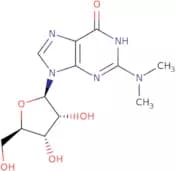
CAS :N2,N2-Dimethylguanosine is a purine nucleoside that is found in human serum. It belongs to the group of purines and has been shown to be involved in energy metabolism. N2,N2-Dimethylguanosine has been shown to be present at high levels in patients with autoimmune diseases such as rheumatoid arthritis. The x-ray crystal structures of wild-type strains of Escherichia coli and Streptococcus pneumoniae have been determined, which revealed that this compound interacts with the enzyme activity for primary sclerosing cholangitis. This nucleoside can also be detected by LC-MS/MS methods and multivariate logistic regression analysis.Formule :C12H17N5O5Degré de pureté :Min. 98 Area-%Couleur et forme :Off-White PowderMasse moléculaire :311.3 g/mol2'-Deoxy-5-(2-iodoethyl)uridine
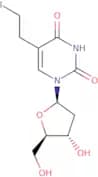
CAS :2'-Deoxy-5-(2-iodoethyl)uridine is a nucleoside analog with antiviral and anticancer activity. It has been shown to be an activator of DNA replication, as well as inhibiting the synthesis of deoxyribonucleotides. This drug also has a novel structure that is modified from the natural nucleosides found in DNA and RNA. 2'-Deoxy-5-(2-iodoethyl)uridine can be synthesized using phosphoramidites, which are activated by iodine and sulfurizing agents. The purity of this compound is high and it is available at high quality.Degré de pureté :Min. 95%



![Guanosine-5'-[(b,gamma)-methyleno]triphosphate sodium salt](/_next/image/?url=https%3A%2Fstatic.cymitquimica.com%2Fproducts%2F3D%2Fthumb-webp%2FNG46689.webp&w=3840&q=75)

![4'-C-Azido-2'-deoxy-2'-fluoro-4-[bis(2-hydroxyethyl)]-b-D-arabinocytidine](/_next/image/?url=https%3A%2Fstatic.cymitquimica.com%2Fproducts%2F3D%2Fthumb-webp%2FNA167989.webp&w=3840&q=75)






![4,6-Diamino-2-(b-D-ribofuranosyl)-2H-pyrazolo[3,4-d]pyrimidine](/_next/image/?url=https%3A%2Fstatic.cymitquimica.com%2Fproducts%2F3D%2Fthumb-webp%2FND162980.webp&w=3840&q=75)