Nucléosides
3569 produits trouvés pour "Nucléosides"
2'-Deoxy-5'-O-DMT-2'-fluorouridine
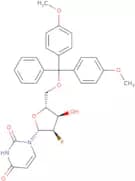
CAS :2'-Deoxy-5'-O-DMT-2'-fluorouridine is a medicament that belongs to the group of antineoplastic agents and is used in cancer treatment. It inhibits the synthesis of DNA by inhibiting the enzyme thymidylate synthetase, which is required for the formation of thymine nucleotides. This drug has been shown to be effective against some cancer cells in vitro and in vivo, but not all. 2'-Deoxy-5'-O-DMT-2'-fluorouridine can also inhibit terminal growth phases and induce programmed cell death. Solid phase synthesis has been used to synthesize this molecule as a phosphoramidite.Formule :C30H29FN2O7Degré de pureté :Min. 98 Area-%Couleur et forme :White PowderMasse moléculaire :548.57 g/mol5-(N-Isopentenyl-N-trifluoroacetyl)aminomethyluridine
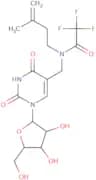
CAS :5-(N-Isopentenyl-N-trifluoroacetyl)aminomethyluridine is a nucleoside analog that is structurally related to cytidine. It was first synthesized in the 1970s, and has been shown to possess antiviral activity against herpes simplex virus type 1. In addition, it has been shown to inhibit DNA synthesis and the formation of DNA double strands. 5-(N-Isopentenyl-N-trifluoroacetyl)aminomethyluridine is an activator of protein kinase C and cyclic AMP phosphodiesterase, as well as a DNA polymerase inhibitor with anticancer properties.Degré de pureté :Min. 95%N6-Acetyladenosine
CAS :N6-Acetyladenosine is a nucleoside that belongs to the group of N-acetylated adenosines. It is found in thermophilic organisms and has been shown to be involved in optimal growth. N6-Acetyladenosine has also been found to be an important part of the coding and population modifications of crenarchaeota, archaeal organisms that are phylogenetically related to methanogens. Unfractionated populations of methanogen contain both N6-acetyladenosine residues and other modified adenosines, with each organism differing in the types of modifications they contain. Transfer of these modified adenosines from one organism to another can lead to changes in their coding and population modifications.Formule :C12H15N5O5Degré de pureté :Area-% Min. 90 Area-%Couleur et forme :White PowderMasse moléculaire :309.28 g/mol2'-Azido-2'-deoxyadenosine
CAS :2'-Azido-2'-deoxyadenosine is a synthetic nucleoside analog of adenosine in which the 2'-hydroxyl group of the ribose sugar is replaced by an azido group (–N₃), and the 3'- and 5'-hydroxyl groups remain intact. This modification confers unique chemical properties, including the ability to participate in bioorthogonal "click" chemistry reactions, particularly azide-alkyne cycloadditions, making it useful for labeling and tracking nucleic acids in biochemical studies. Additionally, the azido substitution can influence enzymatic recognition and incorporation by polymerases, allowing its use in studying nucleic acid metabolism, drug design, and therapeutic nucleoside analog development.Formule :C10H12N8O3Degré de pureté :Min. 95%Couleur et forme :PowderMasse moléculaire :292.25 g/mol2’-Deoxy-2’-fluoroadenosine 5’-monophosphate triethyl ammonium salt
2’-Deoxy-2’-fluoroadenosine 5’-monophosphate triethyl ammonium salt is a nucleoside phosphoramidite that acts as an antiviral agent. It is used to treat influenza and herpes simplex virus infections. 2’-Deoxy-2’-fluoroadenosine 5’-monophosphate triethyl ammonium salt also inhibits the growth of cancer cells, but has not been shown to be effective against bacterial or fungal infections.Degré de pureté :Min. 95%2'-Deoxyadenosine-5'-monophosphate disodium salt
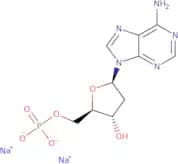
CAS :2'-Deoxyadenosine-5'-monophosphate disodium salt (DAP) is a white crystalline powder. It is soluble in water and insoluble in ethanol. DAP can be neutralised by aqueous solutions of hydroxide, such as sodium hydroxide or ammonium hydroxide. DAP is also reactive with aluminium oxide, which can be used for drying the compound to form anhydrous particles. DAP reacts with chloride ions to form 2',3'-diacetylpyridine-5'-diphosphate dibasic chloride, which has been shown to inhibit bacterial growth and act as an antibacterial agent. Autoclaving may be required for preparation of this drug due to its sensitivity to heat energy.Formule :C10H12N5Na2O6PDegré de pureté :Min. 99 Area-%Couleur et forme :White PowderMasse moléculaire :375.19 g/molCyclopentenyl cytosine
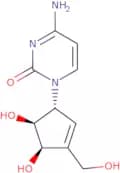
CAS :Cyclopentenyl cytosine is a cytotoxic drug that inhibits the synthesis of DNA, RNA, and proteins. It is a nucleoside analogue that inhibits the enzyme activity of ribonucleotide reductase. Cyclopentenyl cytosine has significant cytotoxicity against hl-60 cells, as well as squamous carcinoma and MDA-MB-231 breast cancer cells. It also has significant activity against cyclopentenyl, dextran sulfate, and mitochondrial functions in vivo in human cells. Cyclopentenyl cytosine binds to the response element on the DNA strand, preventing transcription of genes for protein synthesis and cell division.
Formule :C10H13N3O4Degré de pureté :Min. 95%Couleur et forme :PowderMasse moléculaire :239.23 g/mol2-Amino-9-(2'-deoxy-β-D-ribofuranosyl)purine
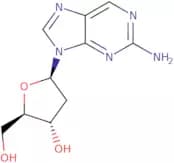
CAS :2-Amino-9-(2'-deoxy-b-D-ribofuranosyl)purine is a nucleoside analog that has been found to be effective in the treatment of leukemia.Formule :C10H13N5O3Degré de pureté :(Hplc) Min. 98.00%Couleur et forme :PowderMasse moléculaire :251.24 g/molAdenosine 5'-phosphosulfate sodium salt, 10 mM in water
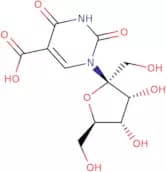
CAS :Adenosine 5′-phosphosulfate sodium salt has been used quantify pyrophosphate and in enzyme-linked bioluminescence assay for adenosine triphosphate (ATP).Product provided as 10 mM solution in water.Formule :C10H14N5O10PSDegré de pureté :Min. 90.0 Area-%Masse moléculaire :427.28 g/mol5-Carboxyhydroxymethyluridine
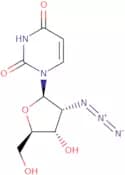
CAS :5-Carboxyhydroxymethyluridine is a hydroxylated nucleoside that is used to study DNA repair. It is a nucleotide analogue that has been modified at the hydroxyl group by methylation. 5-Carboxyhydroxymethyluridine can be converted back to uridine by escherichia coli hydroxylases, but this conversion does not occur in vivo. 5-Carboxyhydroxymethyluridine can be used as a substrate for methyltransferase enzymes, which are involved in DNA repair. The enzyme 5'-methylthioadenosine phosphorylase converts 5-carboxyhydroxymethyluridine into S-adenosylhomocysteine and adenine. This conversion can be reversed by the enzyme methionine synthase. Some homologues of 5-carboxyhydroxymethyluridine have been found in nature and other modifications have been made on theFormule :C11H14N2O9Degré de pureté :Min. 95%Couleur et forme :PowderMasse moléculaire :318.24 g/mol2'-Azido-2'-deoxyuridine
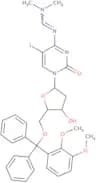
CAS :2'-Azido-2'-deoxyuridine is a synthetic nucleoside analog of uridine in which the 2'-hydroxyl group on the ribose sugar is replaced with an azido group (–N₃), and the base is unmodified uracil. This modification alters the sugar's conformation and chemical reactivity, enabling the use of this analog in bioorthogonal labeling strategies, particularly through azide-alkyne "click" chemistry. Its incorporation into nucleic acids can influence polymerase recognition and chain elongation, making it a useful probe in studies of RNA synthesis, structure, and function.Formule :C9H11N5O5Degré de pureté :Min. 98 Area-%Couleur et forme :White Off-White PowderMasse moléculaire :269.21 g/mol5-o-(Dimethoxytrityl)-N4-dimethylaminomethylidene-5-iodo-2'-deoxycytidine
CAS :Dimethoxytrityl-5-iodo-2'-deoxycytidine is a novel, modified nucleoside that has anticancer and antiviral properties. It is synthesized by reacting 5-iodo-2'-deoxycytidine with dimethoxytrityl chloride in the presence of triethylamine. This compound can be used to synthesize oligonucleotide phosphoramidites, ribonucleosides, and diphosphates.Formule :C33H35IN4O6Degré de pureté :Min. 95%Masse moléculaire :710.6 g/mol5'-O-p-Anisoyl-3'-fluoro-2',3'-dideoxyuridine
5'-O-p-Anisoyl-3'-fluoro-2',3'-dideoxyuridine (5-FAU) is a deoxynucleoside that is synthesized by the phosphoramidite method, and it has been used as an antiviral agent. 5-FAU is a novel nucleoside analog with anticancer activity. It inhibits replication of herpes simplex virus type 1 and 2, varicella zoster virus, and Epstein Barr virus in cell culture. 5-FAU also inhibits HIV replication in vitro and in animal models. The antiviral activity of 5-FAU is due to its inhibition of viral DNA polymerase, which prevents the synthesis of viral DNA from viral RNA templates.Formule :C17H17FN2O6Degré de pureté :Min. 95%Masse moléculaire :364.33 g/mol4’,5’-Didehydro-2’-O-(2-methoxyethyl)uridine
CAS :4’,5’-Didehydro-2’-O-(2-methoxyethyl)uridine (4,5DDMU) is a novel nucleoside analog that is phosphorylated to 4,5-didehydro-2'-O-(2-methoxyethyl)uridine 5'-triphosphate. This nucleoside has been shown to inhibit the proliferation of human cancer cells in vitro and in vivo. 4,5DDMU inhibits viral replication by generating diphosphate derivatives of the viral DNA polymerase enzyme that are unable to synthesize DNA. 4,5DDMU also inhibits HIV replication by inhibiting reverse transcriptase activity in the virus.End>Degré de pureté :Min. 95%N4-Benzoyl-3'-O-tert-butydimethylsilylcytidine 2'-CE-phosphoramidite
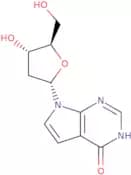
N4-Benzoyl-3'-O-tert-butydimethylsilylcytidine 2'-CE-phosphoramidite is a novel nucleoside analog that has shown anticancer and antiviral activity. It is a monophosphate, modified nucleoside that inhibits the deoxyribonucleotide biosynthetic pathway in cells. N4-Benzoyl-3'-O-tert-butydimethylsilylcytidine 2'-CE-phosphoramidite can be used as an activator of ribonuclease S1 and ribonuclease T1, which are enzymes involved in the process of DNA replication. In addition to its use as a therapeutic agent, this compound is also used for research purposes.Formule :C52H66N5O9PSiDegré de pureté :Min. 95%Masse moléculaire :964.17 g/mol7-Deaza-2'-deoxyinosine
CAS :7-Deaza-2'-deoxyinosine is a purine nucleoside analog that has been shown to be a hydrogen bond donor and formamide acceptor. This drug destabilizes duplex DNA by interfering with the formation of the hydrogen bonds between the bases, which may result in strand breakage. 7-Deaza-2'-deoxyinosine has also been shown to inhibit RNA polymerase activity, thereby inhibiting protein synthesis. It has been used as a tool for studying enzyme mechanisms and in solid phase synthesis.
Formule :C11H13N3O4Degré de pureté :Min. 95%Couleur et forme :PowderMasse moléculaire :251.24 g/mol4-7H-Chloro-5-iodo-7-(2-C-methyl-b-D-ribofuranosyl)-7H-pyrrolo[2,3-d]pyrimidin-2-amine
CAS :4-7H-Chloro-5-iodo-7-(2-C-methyl-b-D-ribofuranosyl)-7H-pyrrolo[2,3-d]pyrimidin-2-amine is a modified nucleoside that has been shown to have antiviral, anticancer and activator properties. This compound is synthesized by the reaction of 4,7H chloro 5 Iodo 7 (2 C methyl b D ribofuranosyl) 7 H pyrrolo[2,3 d]pyrimidine with 2 C methyl b D ribofuranosyl in aqueous solution at neutral pH. 4 - 7 H Chloro 5 Iodo 7 (2 C methyl b D ribofuranosyl) 7 H pyrrolo [2,3 d] pyrimidine reacts with 2 C methyl b D ribofuranosyl to form 4 - 7 H ChlorDegré de pureté :Min. 95%5'-O-tert-Butyldimethylsilyl-D3-thymidine
Produit contrôlé5'-O-tert-Butyldimethylsilyl-D3-thymidine is a synthetic nucleoside, labeled with the radioactive isotope carbon-14. It is used as an antiviral agent in the treatment of herpes zoster and other viral infections. 5'-O-tert-Butyldimethylsilyl-D3-thymidine is a novel monophosphate, which can be activated to a diphosphate by either kinases or phosphoramidites. It has been shown to be effective against herpes virus and other DNA viruses that infect cells from various species. This drug also has antiviral activity against HIV, although it is not currently approved for this use by the U.S. Food and Drug Administration (FDA).
Formule :C16H25N2O5SiD3Degré de pureté :Min. 95%Masse moléculaire :359.52 g/mol2,4-Dithiothymidine
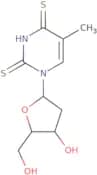
CAS :2,4-Dithiothymidine (DT) is a chemotherapeutic that has been shown to be clinically effective in the treatment of hematopoietic malignancies. It is an oligothymidylate analogue that contains a pyrimidine heterocycle and an ethylthio group. DT is not a nucleoside analog, but it inhibits DNA synthesis by binding to the enzyme thymidylate synthase and preventing the formation of thymine from uracil. DT also binds to single-stranded DNA with high affinity and alters its conformation, which may inhibit transcription and replication. The photophysical properties of this molecule are studied theoretically using quantum mechanics and population analysis theory. The reagent DT can be used to focus attention on other molecules or conformation states of proteins that might have improved biological activity.
Formule :C10H14N2O3S2Degré de pureté :Min. 95%Masse moléculaire :274.36 g/molN4-Benzoyl-2'-deoxy-5'-O-DMT-2'-fluoro-cytidine 3-CE phosphoramidite
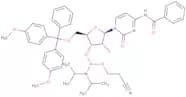
CAS :N4-Benzoyl-2'-deoxy-5'-O-DMT-2'-fluoro-cytidine 3-CE phosphoramidite is a novel nucleoside phosphoramidite that is used for the synthesis of DNA and RNA. It has anticancer properties and has been shown to inhibit the replication of HIV and herpes virus. N4-Benzoyl-2'-deoxy-5'-O-DMT-2'-fluoro-cytidine 3-CE phosphoramidite is also a potent antiviral that inhibits the production of diphosphate by inhibiting ribonucleotide reductase, an enzyme involved in DNA synthesis.Formule :C46H51FN5O8PDegré de pureté :Min. 95%Couleur et forme :White PowderMasse moléculaire :851.9 g/mol






![4-7H-Chloro-5-iodo-7-(2-C-methyl-b-D-ribofuranosyl)-7H-pyrrolo[2,3-d]pyrimidin-2-amine](/_next/image/?url=https%3A%2Fstatic.cymitquimica.com%2Fproducts%2F3D%2Fthumb-webp%2FNC14083.webp&w=3840&q=75)