Polysaccharides
Les polysaccharides sont des composés organiques formés par l'union de plusieurs monomères, liés entre eux par des liaisons glycosidiques pour créer de grandes molécules souvent ramifiées. Ces glucides complexes jouent des rôles cruciaux dans diverses fonctions biologiques, y compris le stockage d'énergie, le soutien structurel et la communication cellulaire. Dans cette section, vous trouverez une gamme variée de polysaccharides essentiels pour la recherche en biochimie, biologie moléculaire et glycosciences. Ces composés sont vitaux pour l'étude des voies métaboliques, des structures de la paroi cellulaire et du potentiel thérapeutique des glucides. Chez CymitQuimica, nous proposons des polysaccharides de haute qualité pour soutenir vos recherches scientifiques, garantissant précision et fiabilité dans vos résultats expérimentaux.
503 produits trouvés pour "Polysaccharides"
Trier par
Degré de pureté (%)
0
100
|
0
|
50
|
90
|
95
|
100
Chitosan (30 - 100 cps); low molecular weight, non-animal from fermentation, suitable for biotechnology
CAS :Formule :C6H11NO4nCouleur et forme :White powderChitosan (300 - 1000 cps); medium molecular weight, non-animal from fermentation, suitable for biotechnology
CAS :Formule :C6H11NO4nCouleur et forme :White powderAgarose, low EEO, GlenBiol™, suitable for molecular biology
CAS :Couleur et forme :White or off-white powderMasse moléculaire :-Dextran 40,000
CAS :Formule :C6H10O5nCouleur et forme :White or off-white crystalline powderMasse moléculaire :~40,000Chitosan (10 cps); very low molecular weight, non-animal from fermentation, suitable for biotechnology
CAS :Formule :C6H11NO4nCouleur et forme :White powderChitosan (2000 - 3500 cps); very high molecular weight
CAS :Formule :C6H11NO4nDegré de pureté :≥ 90.0%Couleur et forme :White to light-tan powderMasse moléculaire :1,800,000 (avg.)Chitosan (100 - 300 cps); low molecular weight, non-animal from fermentation, suitable for biotechnology
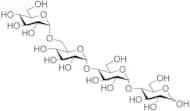
CAS :Formule :C6H11NO4nCouleur et forme :White powder6-α-D-Glucopyranosyl Maltotriose
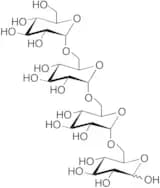
CAS :<p>Stability Hygroscopic<br>Applications Sugar composition of sake.<br>References Giri, N.Y., et al.: Arch. Biochem. Biophysics, 145, 505 (1971a<br></p>Formule :C24H42O21Couleur et forme :NeatMasse moléculaire :666.58Isomaltotetraose
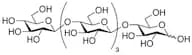
CAS :Produit contrôlé<p>Applications Isomaltotetraose, can be used for immunizication of hybridoma antibodies. the use of synthetic glycolipids as antigens enables one to study the gene control of antibody responses to glycolipids and to investigate the combining-site specificities of antibodies to a single antigenic determinant.<br>References Lai, E., et al.: Mol. Immunology, 22(9), 1021 (1985); Chen, H. T., et al.: Mol. Immunology, 24(4), 333 (1987);<br></p>Formule :C24H42O21Couleur et forme :NeatMasse moléculaire :666.58D-(+)-Cellopentaose
CAS :Produit contrôlé<p>Applications D-(+)-Cellopentaose (cas# 2240-27-9) is a compound useful in organic synthesis.<br></p>Formule :C30H52O26Couleur et forme :NeatMasse moléculaire :828.72Scleroglucan (Technical Grade)
CAS :Produit contrôlé<p>Applications Scleroglucan is a natural polymer produced by fungi, especially those of the genus Sclerotium. Scleroglucan fluids have been used to trap and treat Cr(VI) in environmental applications.<br>References Brigand, G.: Industrial Gums (Third Edition), pp. 461 (1993); Pensini, E.; et al.: Colloids Surf., A, 559, 191 (2018);<br></p>Formule :C24H40O21Couleur et forme :NeatMasse moléculaire :664.56Propylene glycol alginate
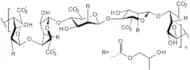
CAS :<p>Propylene glycol alginate is a reaction product of propylene oxide and alginic acid. At the 49th JECFA meeting (1997) it was resolved that the total dietary propylene glycol intake from all sources should be allocated an ADI of 0-25 mg/kg. Applications include as a stabiliser in beer foam due to electrostatic interaction between carboxyl groups on the glycol alginate molecules and amino groups on the peptides in the bubble wall and in ice cream by emulsifying the fat.Esterification is greater then 80%Viscosity (1% aq solution): 200-300 mpa.s</p>Degré de pureté :Min. 95%Couleur et forme :PowderLaminaran - from Laminaria cloustoni
CAS :<p>Laminaran is a polysaccharide that co-occurs with fucoidan and alginate in brown seaweeds such as Laminaria digitata, Laminaria cloustoni, Eisenia bicyclis and Thallus laminariae. It is a β-1,3-linked glucan which it is claimed stimulates the immune system in mammals and fish.<br>The image was kindly provided by Prof Mike Guiry from Cork who runs ‘The Seaweed Site’.</p>Degré de pureté :Min. 95%Couleur et forme :PowderFucoidan - Sargassum
CAS :<p>A fucan sulphate found in brown marine algae (Phaeophyta-typically Fucus vesiculotus, Sargassum (illustrated), Alaria and Cladosiphon) and has been shown to have anticoagulant activity. The main constituents are α-1,4 and α-1,2 linked L-fucose sulphates although galactose also occurs and there are many variations of the basic structure found in different species of Phaeophyta.<br>The image was kindly provided by Prof Mike Guiry from Cork who runs ‘The Seaweed Site’.</p>Degré de pureté :Min. 95%Couleur et forme :PowderNigeran
CAS :<p>Nigeran is a polysaccharide found in the cell wall of lower fungi. In certain Aspergillus and Penicillium spp., nigeran was first isolated from Penicillium expansum and Aspergillus niger (illustrated). The polysaccharide contains unbranched α-D- glucopyranose residues linked 1,3 and 1,4. Nigeran is part of the hyphal cell wall, where it can contribute up to 40 % of the cell dry weight. The polysaccharide occupies several domains or location on the hyphal wall and is highly crystalline in vivo. Deposition of nigeran is primarily at the outer surface of the hyphal wall.</p>Degré de pureté :Min. 95%Couleur et forme :PowderGlycogen - from oyster
CAS :<p>Glycogen is a highly branched polysaccharide of glucose that serves as a form of energy storage in animals and fungi. It is the main storage form of glucose in the body. In humans, glycogen is made and stored primarily in liver and muscle cells and functions as the second most important energy storage molecule to fat which is held in adipose tissue. Glycogen is analogous to starch and has a structure similar to amylopectin, but is more extensively branched and compact than starch. It occurs as granules in the cytosol/cytoplasm in many cell types, and plays an important role in the glucose cycle.</p>Formule :C24H42O21Couleur et forme :PowderMasse moléculaire :666.58 g/molChitosan - water soluble
CAS :<p>Chitosan is the deacetylated form of chitin. The polysaccharide is deacetylated in order to render it soluble, which is then possible at pH values of less than 7 (normally in dilute acid). This then allows the material to be used in a number of industrial applications as a binder and film former.MW typically 10-100kDa.</p>Couleur et forme :Off-White Powder