Autres
6277 produits trouvés pour "Autres"
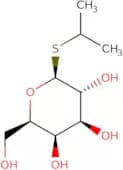
IPTG
CAS :Isopropyl-beta-D-thiogalactopyranoside (IPTG) is a non-metabolizable allolactose analogue, widely used in molecular biology for overexpression of recombinant proteins from inducible systems under the control of lac promoter. IPTG binds to the LacI repressor and causes its release from the lac operator, allowing gene expression of lac operon to take place. IPTG is present in vectors of pGEX, pGEM-T, pET, pRSET, pMAL class and others.
Formule :C9H18O5SDegré de pureté :Min. 99 Area-%Couleur et forme :White PowderMasse moléculaire :238.3 g/molAldol® 515 phosphate, disodium salt, Biosynth Patent: EP 2427431 and US 8940909
CAS :Aldol® 515 phosphate is a chromogenic and fluorogenic enzyme substrate used for detection of phosphatase activity. The colorless enzyme substrate is cleaved by acid and alkaline phosphatases secreted by bacteria in liquid or solid media, yielding intense red color and red fluorescence. Aldol® 515 phosphate can also be used in Western blots and other immunoassay applications with phosphatase-coupled secondary antibodies. Aldol® 515 phosphate can be used under aerobic and anaerobic conditions.Formule :C23H19N2Na2O5PDegré de pureté :Min. 95 Area-%Masse moléculaire :480.36 g/mol3,4-Cyclohexenoesculetine β-D-glucopyranoside
CAS :Chromogenic substrate for beta-glucosidase
Formule :C19H22O9Degré de pureté :Min. 95%Couleur et forme :PowderMasse moléculaire :394.37 g/molAldol® 455 β-D-glucopyranoside, Biosynth Patent: EP 2427431 and US 8940909
CAS :Aldol® 455 beta-D-glucopyranoside is a chromogenic and fluorogenic enzyme substrate used for detection of beta-glucosidase activity. The colorless enzyme substrate is cleaved by beta-glucosidase producing bacteria grown in liquid or solid media, yielding a yellow color and green to orange fluorescence. Aldol® 455 beta-D-glucopyranoside can be used under aerobic and anaerobic conditions.
Formule :C27H24ClNO7Degré de pureté :Min. 92.0 Area-%Masse moléculaire :509.94 g/molEspresso-Gal
Espresso-Gal (Espresso-beta-D-galactopyranoside) is a chromogenic indicator for beta-galactosidase activity. The colorless product is cleaved by lactose-utilizing bacteria in liquid media or on agar plates and yields an espresso brown colored precipitate. Espresso-Gal can also be used as detecting agent for beta-galactosidase activity in reporter gene assays or for identification of positive transformants on agar plates when using the α-complementation approach. Read more in the Application Notes.
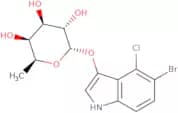
Degré de pureté :Min. 95%5-Bromo-4-chloro-3-indoxyl-alpha-L-fucopyranoside
CAS :5-Bromo-4-chloro-3-indoxyl-alpha-L-fucopyranoside is a chromogenic substrate for alpha-L-Fucosidase. It produces a green-blue color.
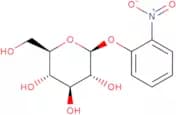
Formule :C14H15BrClNO5Degré de pureté :Min. 98 Area-%Couleur et forme :PowderMasse moléculaire :392.63 g/mol2-Nitrophenyl b-D-glucopyranoside
CAS :Chromogenic substrate for beta-glucosidase
Formule :C12H15NO8Degré de pureté :Min. 99 Area-%Couleur et forme :Off-White Yellow PowderMasse moléculaire :301.25 g/mol2-Chloro-4-nitrophenyl-α-L-fucopyranoside
CAS :2-Chloro-4-nitrophenyl-alpha-L-fucopyranoside is a compound that is commonly used as an enzyme substrate for glycogen synthase kinase (GSK). It is activated by GSK-3β and has been shown to inhibit the activity of this enzyme. This compound has also been found to have inhibitory effects on other enzymes such as carbonic anhydrase and lactate dehydrogenase. Additionally, 2-Chloro-4-nitrophenyl-alpha-L-fucopyranoside exhibits antifungal activity against various fungi, including those resistant to other antifungal agents such as fluopyram and prothioconazole. Its mechanism of action involves interfering with ergosterol biosynthesis, an essential component of fungal cell membranes. Furthermore, this compound has potential applications in the development of new drugs targeting GSK-3β and β-catenin signaling pathways, which are implicated in various diseases including cancer and neuro
Formule :C12H14ClNO7Degré de pureté :Min. 98 Area-%Masse moléculaire :319.7 g/mol4-Nitrophenyl a-D-glucopyranoside
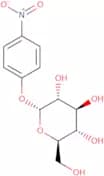
CAS :Chromogenic substrate for alpha-glucosidase
Formule :C12H15NO8Degré de pureté :Min. 98 Area-%Couleur et forme :White PowderMasse moléculaire :301.25 g/mol4-Nitrophenyl phosphate bis(cyclohexylammonium)
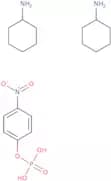
CAS :4-Nitrophenyl phosphate bis(cyclohexylammonium) is an excellent chromogenic substrate designed for the detection and quantification of phosphatase enzyme activities. Aided by the presence of the cyclohexylammonium cation, it undergoes enzymatic hydrolysis, yielding the colored 4-nitrophenolate ion, which can be readily observed at 405 nm. The substrate has become an essential tool for biomedical research, playing a crucial role in unearthing cellular mechanisms, function, and potential drug targets.
Formule :C18H32N3O6PDegré de pureté :97.0 To 103.0%Couleur et forme :PowderMasse moléculaire :417.44 g/mol4-Nitrophenyl 3-O-(β-D-glucopyranosyl)-α-D-glucopyranoside
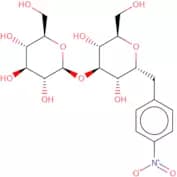
4-Nitrophenyl 3-O-(beta-D-glucopyranosyl)-alpha-D-glucopyranoside is a chromogenic substrate for alpha-glucosidase. Upon hydrolysis, para-nitrophenol is released yielding a yellowish colour. 4-Nitrophenyl 3-O-(beta-D-glucopyranosyl)-alpha-D-glucopyranoside is used in different applications such as the Gaucher disease screening, carbohydrate metabolism studies
Formule :C18H25NO13Degré de pureté :Min. 95%Masse moléculaire :463.39 g/mol6-Chloro-3-indolyl phosphate disodium salt
CAS :6-Chloro-3-indolyl phosphate disodium salt is a chromogenic substrate that is used in food testing, diagnostics, and environmental testing. It can be used to detect the presence of the enzyme phosphatase by adding it to a sample containing glucose, which will produce an orange color. The ligand 6-chloro-3-indolyl phosphate disodium salt can also be used as a bioluminescence probe for detecting ATP or ADP using luciferase. This product has high purity and quality, and is available at a competitive price.
Formule :C8H5ClNNa2O4PDegré de pureté :Min. 98 Area-%Masse moléculaire :291.54 g/mol4-Nitrophenyl b-D-cellotrioside
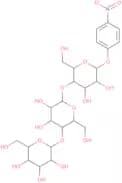
CAS :4-Nitrophenyl beta-D-cellotrioside is a chromogenic substrate for cellulase. Upon hydrolysis, para-nitrophenol is released yielding a yellowish colour. 4-Nitrophenyl beta-D-cellotrioside is used in different applications such as the Biomass conversion research, paper industry applications
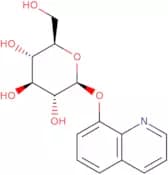
Formule :C24H35NO18Degré de pureté :Min. 95%Couleur et forme :PowderMasse moléculaire :625.53 g/mol8-Hydroxyquinoline b-D-glucopyranoside
CAS :8-Hydroxyquinoline b-D-glucopyranoside (8-OHG-glu) is a chromogenic enzyme substrate commonly used to detect the presence of beta-glucosidase in biological samples. When hydrolyzed by beta-glucosidase, 8-OHG-glu produces a yellow-orange color, indicating the presence of the enzyme. This substrate is particularly useful for measuring beta-glucosidase activity in soil and plant samples.
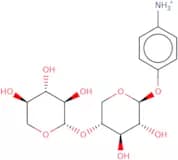
Formule :C15H17NO6Degré de pureté :Min. 95%Couleur et forme :PowderMasse moléculaire :307.3 g/mol4-Nitrophenyl β-D-xylobioside
CAS :4-Nitrophenyl beta-D-xylobioside is a chromogenic substrate for xylanase. Upon hydrolysis, para-nitrophenol is released yielding a yellowish colour. 4-Nitrophenyl beta-D-xylobioside is used in different applications such as the Xylan degradation studies, paper/pulp industry applicationsFormule :C16H21NO11Degré de pureté :Min. 95%Couleur et forme :White PowderMasse moléculaire :403.34 g/mol6-Chloro-3-indoxyl palmitate
CAS :6-Chloro-3-indoxyl palmitate is a high quality, pure chemical reagent that can be used as a substrate for enzyme activity. It is a chromogenic substrate that is used in the detection of esterase activity. 6-Chloro-3-indoxyl palmitate is also used as a fluorogenic substrate in the presence of horseradish peroxidase and hydrogen peroxide to produce chemiluminescence. 6-Chloro-3-indoxyl palmitate has been shown to be an effective bioluminescent substrate for luciferase enzymes, such as firefly luciferase and Renilla luciferase.
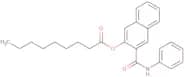
Formule :C24H36ClNO2Degré de pureté :Min. 98 Area-%Masse moléculaire :406.01 g/molNaphthol AS nonanoate
CAS :Modified naphtol AS substrate used in histochemical and cytochemical staining
Formule :C26H29NO3Degré de pureté :Min. 95%Couleur et forme :PowderMasse moléculaire :403.51 g/molAldol® 455 β-D-galactopyranoside, Biosynth Patent: EP 2427431 and US 8940909
CAS :Aldol® 455 beta-D-galactopyranoside is a chromogenic substrate for the enzyme β-galactosidase. It is used to detect the activity of β-galactosidase in cell culture, and has been shown to be highly purified and of high quality. This product can be used as a ligand for receptor binding studies or as an agent in enzyme substrates in fluorescence and chemiluminescence reactions.
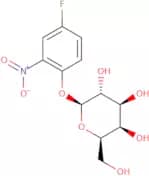
Formule :C27H24ClNO7Degré de pureté :Min. 93.0 Area-%Masse moléculaire :509.94 g/mol4-Fluoro-2-nitrophenyl b-D-galactopyranoside
CAS :4-Fluoro-2-nitrophenyl beta-D-galactopyranoside, a fluorinated analog of ONPG, is a chromogenic enzyme substrate specifically used to detect beta-galactosidase in bacterial media. 4-Fluoro-2-nitrophenyl beta-D-galactopyranoside is used in Lactose intolerance screening, bacterial beta-galactosidase detection (E. coli)
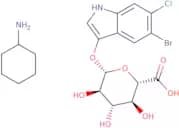
Degré de pureté :Min. 95%Couleur et forme :PowderMasse moléculaire :319.24 g/mol5-Bromo-6-chloro-3-indolyl b-D-glucuronide cyclohexylammonium salt
CAS :5-Bromo-6-chloro-3-indolyl b-D-glucuronide cyclohexylammonium salt is a magenta enzyme substrate commonly used in biochemical assays. This compound is a derivative of indole, containing bromine and chlorine atoms at positions 5 and 6, respectively. The glucuronide moiety is attached to the indolyl ring, and the cyclohexylammonium cation serves as a counterion to balance the charge. This substrate is often utilized in the detection and quantification of β-glucuronidase activity, an enzyme involved in the metabolism of glucuronides. Upon cleavage by β-glucuronidase, the substrate produces a magenta-colored product, allowing for easy visualization and measurement of enzyme activity.
Formule :C14H13BrClNO7·C6H13NDegré de pureté :Min. 98 Area-%Couleur et forme :PowderMasse moléculaire :521.79 g/mol