Monosaccharides
Sous-catégories appartenant à la catégorie "Monosaccharides"
- Alloses(11 produits)
- Arabinoses(21 produits)
- Erythroses(11 produits)
- Fructoses(9 produits)
- Fucoses(36 produits)
- Galactosamine(41 produits)
- Galactoses(261 produits)
- Glucoses(365 produits)
- Acides glucuroniques(52 produits)
- Glyco-substrats pour l'enzyme(78 produits)
- Guloses(6 produits)
- Idoses(4 produits)
- Inositols(15 produits)
- Lyxoses(4 produits)
- Mannoses(65 produits)
- O-Glycanes(48 produits)
- Psicoses(3 produits)
- Rhamnoses(10 produits)
- Ribos(61 produits)
- Acides sialiques(100 produits)
- Sorboses(4 produits)
- Sucres(173 produits)
- Tagatoses(4 produits)
- Taloses(8 produits)
- Xyloses(20 produits)
6088 produits trouvés pour "Monosaccharides"
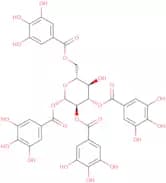
1,2,3,6-Tetra-O-galloylglucose
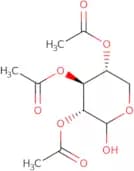
CAS :1,2,3,6-Tetra-O-galloylglucose is a biologically active compound that has been shown to have inhibitory effects on influenza virus and human pathogenic bacteria. It has also been shown to have anticomplementary activity and anti-infective properties against human pathogens. This molecule also exhibits anion radical scavenging activities and can be utilized as a natural antioxidant in food products. The ellagitannins found in this molecule are responsible for its antioxidant properties. 1) 6-Fluoro-3-indoxyl-beta-D-galactopyranoside (Rifapentine) Rifapentine is an antituberculosis drug that belongs to the class of rifamycins. It is the most active of the rifamycins for the treatment of tuberculosis. Rifapentine inhibits bacterial growth by binding to DNA-dependent RNA polymerase, thereby preventingFormule :C34H28O22Degré de pureté :Min. 95%Masse moléculaire :788.57 g/mol2,3,4-Tri-O-acetyl-D-xylopyranose
CAS :2,3,4-Tri-O-acetyl-D-xylopyranose is a lactide sugar that is found in the cell walls of many plants. It is synthesized from D-xylose by enzymatic condensation with acetylated L-malic acid and has been shown to be biodegradable. 2,3,4-Tri-O-acetyl-D-xylopyranose has been shown to have physical properties that are similar to those of cellulose, such as crystallization and solubility in water. The compound also has an NMR spectrum that contains peaks at δ = 0.8 (triplet), 1.1 (singlet) and 1.5 ppm (doublet). The hydrophobic group on the molecule is thought to contribute to its hydrophilicity.Formule :C11H16O8Degré de pureté :Min. 95%Masse moléculaire :276.24 g/mol9,10-Dimethoxy-pterocarpane-3-O-b-D-glucoside
9,10-Dimethoxy-pterocarpane-3-O-b-D-glucoside is a custom synthesis that is a polysaccharide with a complex carbohydrate structure. The chemical name for this compound is 9,10-dimethoxy-pterocarpane-3-O-[4′″-(1″″′′)-b′″'-D-glucopyranosyl]-3′′′,4′″’,6′"’] bibenzyl. This compound has been modified by methylation and glycosylation. It can be used in the treatment of cancer and diabetes due to its high purity and fluorination. 9,10-Dimethoxy pterocarpane 3β O glucoside is a sugar or saccharide that can be found in plants such as the roots of tobacco plants. The modification of this sugar by methylation and glycosylation makes it more
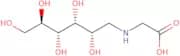
Degré de pureté :Min. 95%N-Glycinyl-1-deoxy-D-glucitol
CAS :N-Glycinyl-1-deoxy-D-glucitol is a custom synthesis product. It is an oligosaccharide that can be modified to produce polysaccharides or saccharides. The chemical name of this product is methyl 2,6-anhydro-2,6-dideoxyglucitol and the molecular weight is 242.17 g/mol. The CAS number for this compound is 57195-13-8 and it has a purity level of >99%. This compound can be used in a wide variety of applications such as Methylation, Click modification, Carbohydrate chemistry, Oligosaccharide chemistry, Polysaccharide chemistry, saccharide chemistry, Fluorination chemistry, complex carbohydrate chemistry and Monosaccharide chemistry.Formule :C8H17NO7Degré de pureté :Min. 95%Masse moléculaire :239.22 g/molMethyl 4-chloro-4-deoxy-a-D-glucopyranoside
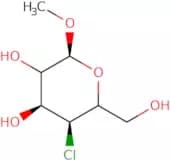
Methyl 4-chloro-4-deoxy-a-D-glucopyranoside is a custom synthesis of an oligosaccharide with a sugar. It is synthesized by the reaction between methyl 4-chloro-4-deoxybenzoate and sodium cyanoborohydride in methanol. The product can be used to modify complex carbohydrates, such as glycosylation, which is the process of adding sugars to proteins or polysaccharides. Methyl 4-chloro-4-deoxyglucopyranoside has a high purity level of 99% and a CAS number of 3126991.Formule :C7H13ClO5Degré de pureté :Min. 95%Masse moléculaire :212.63 g/molPhenyl a-L-thioglucopyranoside
Phenyl a-L-thioglucopyranoside is an intermediate in the synthesis of glycosides. It is used as a fluorinating or methylating agent, and as a glycosylating or modifying agent. Phenyl a-L-thioglucopyranoside can be synthesized by the click modification of thioglycolic acid with phenol, followed by glycination. It has been shown to react with monosaccharides to form oligosaccharides and polysaccharides. Phenyl a-L-thioglucopyranoside can also react with saccharides to form complex carbohydrates.Degré de pureté :Min. 95%Masse moléculaire :272.32 g/mol(+)-Casuarine
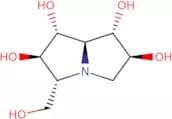
CAS :(+)-Casuarine is a chiral biomolecule that is structurally related to (+)-cinchonine. It has been shown to be an inhibitor of glycosidase, an enzyme that hydrolyzes glycosides, and as such it has potential use in the development of drugs for the treatment of diabetes mellitus. The enolate form of (+)-casuarine can undergo cycloadditions with oxygenated functional groups. This reaction is stereoselective and leads to polyhydroxylated products.Formule :C8H15NO5Degré de pureté :Min. 95%Masse moléculaire :205.21 g/molPerindopril acyl-a-D-glucuronide
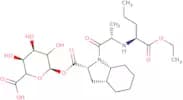
Perindopril acyl-a-D-glucuronide is a synthetic small molecule that has been modified with fluorination, methylation, and click modification. It can be used for the synthesis of oligosaccharides and saccharides. Perindopril acyl-a-D-glucuronide is a highly reactive compound that is useful in glycosylation reactions, including Click chemistry. The CAS number for this compound is 217917-05-8. The molecular weight of perindopril acyl-a-D-glucuronide is 284.36 g/mol and the molecular formula is C14H24N2O6•C2H3O2•1/2 H2O.Formule :C25H40N2O11Degré de pureté :Min. 95%Masse moléculaire :544.6 g/mol3,4-O-Isopropylidene-D-galactal
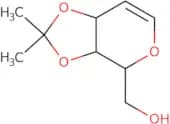
CAS :3,4-O-Isopropylidene-D-galactal is a modified form of galactal. This compound is a methylated derivative of D-galactal that has been synthesized by the click reaction. It can be used in the synthesis of oligosaccharides and polysaccharides. 3,4-O-Isopropylidene-D-galactal is a high purity compound with a CAS number of 124477-12-9.
Degré de pureté :Min. 95%2-Acetamido-2-deoxy-b-D-glucopyranosyl L-asparagine
CAS :Acetamido-2-deoxy-b-D-glucopyranosyl L-asparagine is used in studies of Aspartylglycosaminuria (AGU) which is a rare, inherited lysosomal storage disease caused by a deficiency in the enzyme aspartylglucosaminidase.Formule :C12H21N3O8Degré de pureté :Min. 98 Area-%Couleur et forme :White PowderMasse moléculaire :335.31 g/molMethyl 2,3,5-tri-O-benzyl-a-D-arabinofuranoside
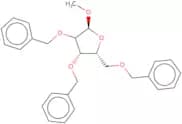
Methyl 2,3,5-tri-O-benzyl-a-D-arabinofuranoside is a methylated sugar that belongs to the group of saccharides. It is often used as a Click modification and in custom synthesis of oligosaccharides. This product is also used for glycosylation and high purity modifications. Methyl 2,3,5-tri-O-benzyl-a-D-arabinofuranoside can be synthesized from arabinose and benzaldehyde with fluorination. The CAS number for this product is 51469-61-1.Formule :C27H30O5Degré de pureté :Min. 95%Masse moléculaire :434.52 g/mol2-Deoxy-scyllo-inosose
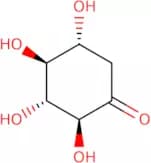
CAS :2-Deoxy-scyllo-inosose is a biochemical with an unknown function. It is not a substrate for any known enzyme, but has been shown to be a substrate for the synthesis of corynebacterium glutamicum. The reaction mechanism of 2-deoxy-scyllo-inosose is still unclear, but it has been proposed that this molecule undergoes dehydration and then undergoes an acid catalyzed aldol cyclization to form 3-aminohexanol. This reaction produces fluorescence resonance energy transfer in group p2 subtilisin.
2DOS is also an antimicrobial agent which exhibits activity against Gram positive bacteria such as Streptococcus pyogenes, Enterococcus faecalis, and Bacillus subtilis.Formule :C6H10O5Degré de pureté :Min. 95%Couleur et forme :White PowderMasse moléculaire :162.14 g/mol2-Deoxy-b-L-erythro-pentofuranose
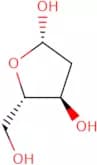
CAS :2-Deoxy-b-L-erythro-pentofuranose is an experimental drug that is a protonation product of 2,3-dideoxyproline. It is the result of conformational changes in the deoxyribose ring and puckering of the ribose units. The puckering motion also results in a change in the orientation of the hydrogen atoms on the carbons. This has led to analogous carbon configurations with different numbers of hydrogens, which can lead to different solutions. 2-Deoxy-b-L-erythro-pentofuranose binds to ribosomes and inhibits protein synthesis, which may be due to its pyrrolidine ring or membered ring structure.Formule :C5H10O4Degré de pureté :Min. 95%Masse moléculaire :134.13 g/mol1-Deoxy-L-idonojirimycin hydrochloride
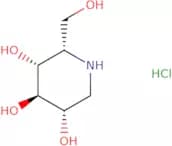
CAS :1-Deoxy-L-idonojirimycin hydrochloride is a chaperone that is structurally related to the natural substrate, L-idonojirimycin. It has been found to interact with recombinant human Hsp70 and Hsp90. 1-Deoxy-L-idonojirimycin hydrochloride enhances the kinetic and thermodynamic parameters of these chaperones in vitro. The structural analysis of this compound revealed that it binds to both Hsp70 and Hsp90, which may be due to its ability to mimic the natural substrate's binding site on these chaperones.
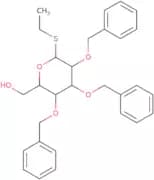
Formule :C6H14ClNO4Degré de pureté :Min. 95%Masse moléculaire :199.63 g/molEthyl 2,3,4-tri-O-benzyl-b-D-thiogalactopyranoside
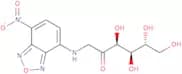
CAS :Ethyl 2,3,4-tri-O-benzyl-b-D-thiogalactopyranoside is a synthetically produced saccharide typically used as a building block in oligo-saccharide synthesis.Degré de pureté :Min. 95%NBD-Fructose
CAS :Fluorescent substrate used to monitor fructose uptakeFormule :C12H14N4O8Degré de pureté :Min. 95%Masse moléculaire :342.26 g/molMethyl b-D-altropyranoside
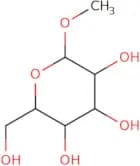
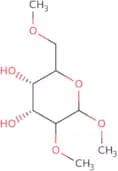
CAS :Methyl b-D-altropyranoside is a methylated saccharide that can be used as a sugar substitute. It has the same sweetness as sugar and is also resistant to browning. Methyl b-D-altropyranoside is synthesized by treating an aldose or ketose with formaldehyde in the presence of sulfuric acid and an alkali. This product is water soluble, heat stable, and free from impurities such as glucose or fructose. Methyl b-D-altropyranoside can be used to modify polysaccharides and oligosaccharides, adding a methyl group to the carbon 2 position. In addition, it has been shown to have antioxidant properties due to its ability to quench reactive oxygen species (ROS).Formule :C7H14O6Degré de pureté :Min. 95%Masse moléculaire :194.18 g/mol1,2,6-Tri-O-methyl-D-glucopyranoside
CAS :1,2,6-Tri-O-methyl-D-glucopyranoside is a synthetic sugar that has been modified by fluorination and glycosylation. This product is a white crystalline powder with a melting point of 185°C. The chemical formula for this product is C5H12O5.Formule :C9H18O6Degré de pureté :Min. 95%Masse moléculaire :222.24 g/molMannostatin A hydrochloride
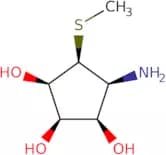
CAS :Mannostatin A is a prodrug that is activated in the body by cleavage of the ester linkage. It has been shown to be a specific inhibitor of feedback inhibition of protein synthesis and cleavage at the carboxyl-terminal end. Mannostatin A has also been shown to inhibit, selectively, the synthesis of proteins in bacteria. In addition, it is possible that this drug may be converted into an inactive form by conjugation with glucuronic acid or by oxidation.
Formule :C6H14ClNO3SDegré de pureté :Min. 95%Masse moléculaire :215.7 g/mol4-Deoxy-4-fluoro-D-galactopyranose
CAS :4-Deoxy-4-fluoro-D-galactopyranose is a custom synthesis that is an oligosaccharide, polysaccharide, saccharide, and carbohydrate. It is fluorinated with a methyl group on the 4th carbon atom and has been modified to include a fluoro group at the 4th position of the molecule. 4-Deoxy-4-fluoro-D-galactopyranose can be used in research as it is high purity and has been modified into a monosaccharide sugar.Degré de pureté :Min. 95%