Étalons de l'industrie alimentaire
Les standards de l'industrie alimentaire sont des matériaux de référence critiques utilisés pour garantir la sécurité, la qualité et la cohérence des produits alimentaires. Ces standards sont utilisés dans l'analyse et les tests des denrées alimentaires, y compris les contaminants, les additifs et les composants nutritionnels. Chez CymitQuimica, nous proposons des standards de haute qualité pour l'industrie alimentaire afin de soutenir la conformité aux réglementations en matière de sécurité alimentaire et les mesures de contrôle de la qualité.
Sous-catégories appartenant à la catégorie "Étalons de l'industrie alimentaire"
- Étalons relatives aux boissons(7 produits)
- Étalons laitières(39 produits)
- Matériaux en contact avec les aliments(1.075 produits)
- Étalons pour le vin(47 produits)
7937 produits trouvés pour "Étalons de l'industrie alimentaire"
Trier par
Degré de pureté (%)
0
100
|
0
|
50
|
90
|
95
|
100
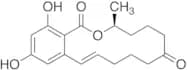
Zearalenone
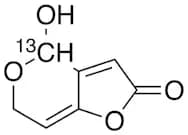
CAS :<p>Applications Estrogenic mycotoxin produced by Fusarium fungi commonly found in grains. One of a group of compounds known as resorcylic acid lactones.Environmental contaminants; Food contaminants<br> Not a dangerous good if item is equal to or less than 1g/ml and there is less than 100g/ml in the package<br>References Tanaka, T., et al.: J. Agric. Food Chem., 36, 979 (1988), Hamilton, S., et al.: Anticancer Res., 16, 3597 (1996), Hecht, S., et al.: Cancer Lett., 150, 49 (2000), Hussein, H., et al.: Toxicology, 167, 101 (2001), Lim, H., et al.: J. Immunol., 175, 4180 (2005),<br></p>Formule :C18H22O5Couleur et forme :White To Light BrownMasse moléculaire :318.36Patulin-13C3
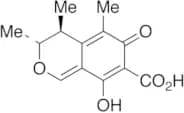
CAS :Produit contrôléFormule :C3C4H6O4Couleur et forme :White To BeigeMasse moléculaire :157.10(-)-Citrinin
CAS :<p>Stability Hygroscopic<br>Applications Antibiotic substance produced by a white spore aspergilus which has been placed under the species name Aspergillus niveus. Also produced in small quantities by Penicillium citrinum.<br> Not a dangerous good if item is equal to or less than 1g/ml and there is less than 100g/ml in the package<br>References Ciegler, A., et al.: Appl. Microbiol., 26, 271 (1973), Creppy, E., et al.: Toxicol. Lett., 28, 29 (1985), DeGroene, E., et al.: Cancer Res., 56, 299 (1996),<br></p>Formule :C13H14O5Couleur et forme :YellowMasse moléculaire :250.25Fusarenon X
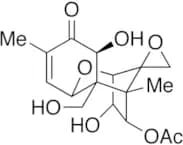
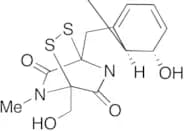
CAS :<p>Applications A mycotoxin produced by Fusarium, having immunosuppressive and carcinogenic properties.<br> Not a dangerous good if item is equal to or less than 1g/ml and there is less than 100g/ml in the package<br>References Alvarez, C., et al.: Int. J. Food Microbiol., 135, 131 (2009), Steinmetz, W., et al.: Eur. J. Med. Chem., 44, 4485 (2009), Tanaka, H., et al.: J. Health Sci., 56, 188 (2010), Monbaliu, S., et al.: J. Agric. Food Chem., 58, 66 (2010),<br></p>Formule :C17H22O8Couleur et forme :Off White SolidMasse moléculaire :354.35Gliotoxin
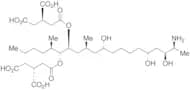
CAS :<p>Applications Gliotoxin is a sulfur-containing mycotoxin produced by species of fungi and pathogens of humans. Gliotoxin exhibits inhibitory activities against histone H3K9 methyltransferase, a key enzyme in the regulation of transcriptional activity by writing epigenetic marks. Gliotoxin also exhibits immunosuppressive properties by causing apoptosis of cells of the immune system. In addition, various studies suggests Gliotoxin may also be a potential anti-inflammatory, antibiotic, antifungal and antiviral agent.<br> Not a dangerous good if item is equal to or less than 1g/ml and there is less than 100g/ml in the package<br>References Takahashi, M., et al.: J. Antibiotics., 65, 263 (2012); Li., Y.G., et al.: Biochem. Biophy. Rsch. Commun., 422, 85 (2012); Zhang, H.C., et al.: Applied, Mech. Mater., 178, 783 (2012); Scharf, D.H., et al.: Appl. Microbiol. Biotechnol., 93, 467 (2012);<br></p>Formule :C13H14N2O4S2Couleur et forme :NeatMasse moléculaire :326.39Fumonisin B1
CAS :<p>Stability Hygroscopic<br>Applications A mycotoxin produced by mold associated with corn. Fungal metabolite believed to cause leukoencephalomalacia in horses.Environmental contaminants; Food contaminants<br>References Monbaliu, S., et al.: J. Agric. Food Chem., 58, 10475 (2010), Klosowski, G., et al.: Biores. Technol., 101, 9723 (2010), Soerensen, L., et al.: Anal. Bioanal. Chem., 398, 1535 (2010),<br></p>Formule :C34H59NO15Couleur et forme :NeatMasse moléculaire :721.833-epi-Ochratoxin A
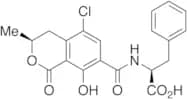
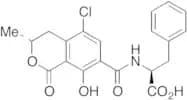
CAS :Produit contrôlé<p>Applications Epimer of Ochratoxin A (O148490), an toxic metabolites from Aspergillus orchraceus.<br> Not a dangerous good if item is equal to or less than 1g/ml and there is less than 100g/ml in the package<br>References Belli, N., et al.: Int. J. Food Microb., 96, 19 ( 2004), Pardo, E., et al.: Food Microb., 23, 35 (2006),<br></p>Formule :C20H18ClNO6Couleur et forme :Off-White To Light YellowMasse moléculaire :403.81T-2 Toxin
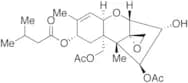
CAS :Produit contrôlé<p>Applications T-2 Toxin is a tricothecene mycotoxin produced by fungi of the genus Fusarium. T-2 Toxin induces DNA damage and cell death on prolonged administration.Environmental contaminants; Food contaminants<br> Not a dangerous good if item is equal to or less than 1g/ml and there is less than 100g/ml in the package<br>References Kim, C., et al.: Cancer Res., 57, 3115 (1997), Bottrel, R., et al.: Antimicrob. Agents Chemother., 1999, 43, 856 (1999), Murray, P., et al.: J. Immunol., 178, 2623 (2007), Choi, H., et al.: Toxicol. Appl. Pharmacol., 240, 46 (2009), Amuzie, C., et al.: Toxicol. Sci., 113, 412 (2010),<br></p>Formule :C24H34O9Couleur et forme :White SolidMasse moléculaire :466.52β-Zearalenol-d4 (Major)
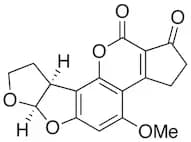
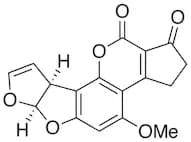
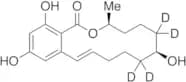
CAS :Produit contrôlé<p>Stability Light Sensitive<br>Applications Isotope labelled β-Zearalenol is an more active metabolite of Zearalenone (Z270500), a estrogenic mycotoxin produced by Fusarium fungi commonly found in grains.<br> Not a dangerous good if item is equal to or less than 1g/ml and there is less than 100g/ml in the package<br>References Olsen, M., et al.: Acta Pharmacol. Toxicol., 48, 15 (1981), Chang, W., et al.: Food Chem. Toxicol., 22, 887 (1984), El Golli, E., et al.: Toxicol Lett., 166, 122 (2006), Hassen, W., et al.: Toxicology, 232, 294 (2007), Benzoni, E., et al.: Reprod. Toxicol., 25, 461 (2008),<br></p>Formule :C18H20D4O5Couleur et forme :NeatMasse moléculaire :324.4Aflatoxin G2
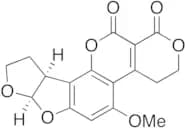
CAS :Produit contrôléFormule :C17H14O7Couleur et forme :Off-WhiteMasse moléculaire :330.29Piperonyl Butoxide
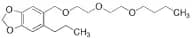
CAS :Produit contrôlé<p>Applications Insecticide synergist, especially for pyrethroids and rotenone. Useful in cannabis testing kits as a component of pesticide mixes (P698230).<br> Not a dangerous good if item is equal to or less than 1g/ml and there is less than 100g/ml in the package<br>References Gaines, T. B., et al.; Toxicol. Appl. Pharmacol., 14, 515 (1969),<br></p>Formule :C19H30O5Couleur et forme :Light Yellow To Light BrownMasse moléculaire :338.442-Propen-1,1,2,3,3-d5-1-ol
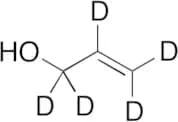
CAS :Formule :C32H5HOCouleur et forme :Clear Colourless OilMasse moléculaire :63.11Dihydro Artemisinin-d3
CAS :<p>Stability Unstable in Solution<br>Applications The main labelled metabolite of Artemisinin, Arteether, Artemether, Artesunate. An active antimalarial metabolite.<br>References e Vries, P., et al.: Drugs, 52, 818 (1996), Kamolrat, S., et al.: Antimicrob. Agents Chemother., 47, 3795 (2003), Mithwani, S., et al.: Br. J. Clin. Pharmacol., 57, 146 (2004),<br></p>Formule :C152H3H21O5Couleur et forme :White to Off-White SolidMasse moléculaire :287.37Hexahydrocoumarin
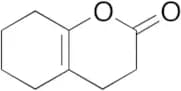
CAS :Produit contrôlé<p>Applications Hexahydrocoumarin,is the derivative of Coumarin (C755380). It was formerly used as a fragrance ingredient.<br> Not a dangerous good if item is equal to or less than 1g/ml and there is less than 100g/ml in the package<br>References Letizia, C. S., et al.: Food and Chemical Toxicology, 38, S115 (2000);<br></p>Formule :C9H12O2Couleur et forme :NeatMasse moléculaire :152.1915-Acetoxyscirpenol
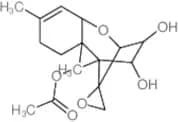
CAS :Produit contrôléFormule :C17H24O6Couleur et forme :NeatMasse moléculaire :324.37Ochratoxin A (10 μg/mL in Acetonitrile)
CAS :Formule :C20H18ClNO6Couleur et forme :Single SolutionMasse moléculaire :403.81Isosorbide-13C6 5-Mononitrate, 90%
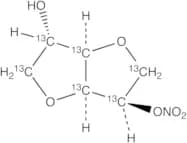
CAS :Formule :C6H9NO6Degré de pureté :90%Couleur et forme :White to Light Green SolidMasse moléculaire :197.0915-Acetyl Deoxynivalenol (~90%)
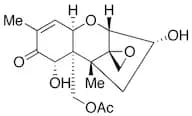
CAS :Produit contrôlé<p>Applications A mycotoxin produced by the fungi Fusarium culmorum and Fusarium graminearum, inhibits protein synthesis.Environmental contaminants; Food contaminants<br> Not a dangerous good if item is equal to or less than 1g/ml and there is less than 100g/ml in the package<br>References Ashraf, A.; et al.: Int. J. Biol. Biotechnol., 4, 391 (2007), Burlakoti, R., et al.: App. Environ. Microbiol., 74, 6513 (2008), Steinmetz, W., et al.: Eur. J. Med. Chem., 44, 4485 (2009), Zhang, Y., et al.: Phytopathol., 99, 95 (2009),<br></p>Formule :C17H22O7Degré de pureté :~90%Couleur et forme :WhiteMasse moléculaire :338.35Neosolaniol
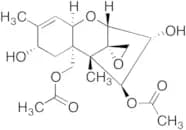
CAS :Produit contrôlé<p>Applications Neosolaniol is a mycotoxin produced by Fusarium species commonly found in wheat and maize.<br>References Thrane, U., et al.: Int J Food Microbiol, 95, 257 (2004); Sulyok, M., et al.: Rapid Commun. Mass Spectrom., 20, 2649 (2006);<br></p>Formule :C19H26O8Couleur et forme :WhiteMasse moléculaire :382.40Chlorfenvinphos (E/Z mixture)
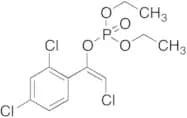
CAS :Produit contrôlé<p>Stability Moisture Sensitive<br>Applications Chlorfenvinphos is derived from α,2,4-Trichloroacetophenone (T774315), which is a reagent used in the synthesis of isoconazole, a potent anti-fungal agent. Pesticide.<br> Not a dangerous good if item is equal to or less than 1g/ml and there is less than 100g/ml in the package<br>References Dulcevscaia, G. et al.: Polyhed., 52, 106 (2013); Wang, Y. et al.: Bioorg. Med. Chem. Lett., 22, 5363 (2012); Olivieira, B. R., et al.: Environ. Sci. Pollut. R., 22, 11781-11791 (2015)<br></p>Formule :C12H14Cl3O4PCouleur et forme :NeatMasse moléculaire :359.57Amobam (>90%)
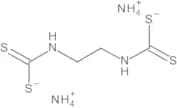
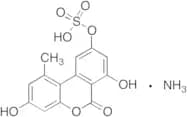
CAS :Formule :C4H6N2S4·2H4NDegré de pureté :>90%Couleur et forme :NeatMasse moléculaire :246.44Alternariol 9-Sulfate Ammonium Salt
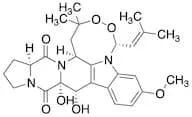
CAS :Produit contrôléFormule :C14H10O8S(NH3)Couleur et forme :NeatMasse moléculaire :355.03619Verruculogen
CAS :<p>Applications Verruculogen is a mycotoxin and novel mammalian cell cycle inhibitors produced by Aspergillus fumigatus.<br> Not a dangerous good if item is equal to or less than 1g/ml and there is less than 100g/ml in the package<br>References Cui, C. et al.: Jour. of Ant., 49(6), 527-533, (1996)<br></p>Formule :C27H33N3O7Couleur et forme :NeatMasse moléculaire :511.572-Chloroethanol-1,1,2,2-d4
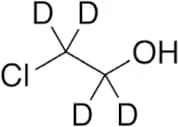
CAS :Produit contrôlé<p>Applications 2-Chloroethanol is used in the preparation of TTFTT (tetrathiafulvalene-2,3,6,7-tetrathiolate) and important building block in TTF syntheis. In addition, it is used in the synthesis of vinyltriazoles. This is the labeled analog.<br>Dangerous Goods Info This compound is forbidden to ship by air under IATA regulations.<br>References Svenstrup, N. et al.: Synthesis, 8, 809 (1994); Thibault, R. et al.: J. Am. Chem. Soc., 128, 12084 (2006);<br></p>Formule :C22H4ClOHCouleur et forme :Colourless OilMasse moléculaire :84.542,4-Dimethyl-2-methylol-1,3-dioxolane
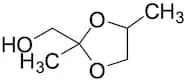
CAS :Produit contrôléFormule :C6H12O3Couleur et forme :NeatMasse moléculaire :132.07864Ochratoxin B-d5
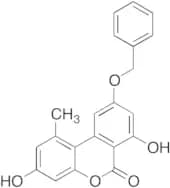
CAS :Produit contrôléFormule :C20H14D5NO6Couleur et forme :NeatMasse moléculaire :374.4Alternariol 3-Sulfate Ammonium Salt
CAS :Produit contrôléFormule :C14H10O8S(NH3)Couleur et forme :NeatMasse moléculaire :355.03619Diazald-d3
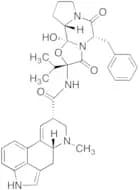
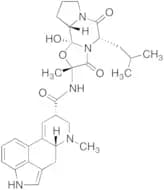
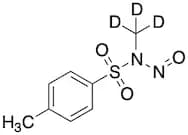
CAS :<p>Applications N-Methyl-d3-N-nitroso-p-toluenesulfonamide is the labeled version of Diazald; Diazomethane precursor.<br>References Takizawa, et al.: J. Pharm. Soc. Jpn., 70, 490 (1950)<br></p>Formule :C8D3H7N2O3SCouleur et forme :Pale Yellow to Light Yellow SolidMasse moléculaire :217.060048-Isoergocornine
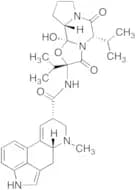
CAS :<p>Applications 8-Isoergocornine is an ergot fungus alkaloid related to Ergocornine (E597350). It is a mycotoxin found in moldy food products.<br>References Sulyok, M., et al.: Anal. Bioanal. Chem., 389, 1505 (2007); Krska, R., et al.: Anal. Bioanal. Chem., 391, 563 (2008); Sulyok, M., et al.: Food Chem., 119, 408 (2009);<br></p>Formule :C31H39N5O5Couleur et forme :NeatMasse moléculaire :561.673-Acetyldeoxynivalenol
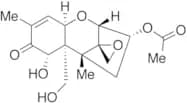
CAS :Produit contrôlé<p>Stability Appears to decompose in DMSO<br>Applications 3-Acetyldeoxynivalenol is a trichothecene mycotoxin that is produced in a plant-pathogenic fungus, Fusarium graminearum Schwabe.Environmental contaminants; Food contaminants<br> Not a dangerous good if item is equal to or less than 1g/ml and there is less than 100g/ml in the package<br>References Beyer, M., et al.: Int. J. Food. Microbiol., 119, 153 (2007); Schiefer, H.B., et al.: Can. J. Comp. Med., 49, 315 (1985); Mirocha, C.J., et al.: App. Enviro.Microbiol., 55, 1315 (1989);<br></p>Formule :C17H22O7Couleur et forme :WhiteMasse moléculaire :338.35