Substrati fluorogenici
Trovati 297 prodotti di "Substrati fluorogenici"
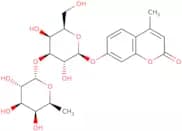
4-Methylumbelliferyl 2-O-(a-L-fucopyranosyl)-b-D-galactopyranoside
CAS:4-Methylumbelliferyl 2-O-(a-L-fucopyranosyl)-b-D-galactopyranoside is an enzyme substrate used in chromogenic assays of alpha-fucosidases. It is also used for glycoprocessing enzymes in synthesis.Purezza:Min. 95%Peso molecolare:484.45 g/molResorufin oleate
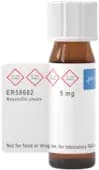
Resorufin oleate is a fluorogenic lipase substrate.Purezza:Min. 95%Colore e forma:PowderPeso molecolare:477.64 g/molMaltotetraose 2-aminobenzamide
Maltotetraose 2-aminobenzamide is a chemiluminescent substrate that emits light in the presence of certain oxidizing agents. It provides high quality and environmental testing, as well as staining and ligand capability. Maltotetraose 2-aminobenzamide is used in diagnostics to identify bacteria and other microorganisms. Maltotetraose 2-aminobenzamide can be used for the detection of bacterial colonies on agar plates using a fluorogenic substrate, or for the detection of fungi using a chromogenic substrate. Maltotetraose 2-aminobenzamide is also used as an enzyme substrate in food testing or conjugate with enzymes for bioluminescence.
Purezza:Min. 95%6-Chloro-4-(trifluoromethyl)umbelliferyl b-D-cellotetraoside
6-Chloro-4-(trifluoromethyl)umbelliferyl b-D-cellotetraoside is a fluorescent substrate that is used to measure the activity of the enzyme beta-glucuronidase. It is a chemiluminescent compound that emits light when hydrolyzed by an enzyme. 6-Chloro-4-(trifluoromethyl)umbelliferyl b-D-cellotetraoside has been shown to be a high quality and environmentally friendly product, as it does not cause any significant change in pH or turbidity in water samples. It has also been shown to be nontoxic and nonmutagenic at concentrations up to 400 ppm. This product can be used for a variety of purposes, including diagnostic tests for bacterial infections or food testing.
Purezza:Min. 95%Peso molecolare:913.15 g/mol4-Methylumbelliferyl 3-O-(a-L-fucopyranosyl)-b-D-galactopyranoside
CAS:4-Methylumbelliferyl 3-O-(α-L-fucopyranosyl)-β-D-galactopyranoside is an organic compound that is used as a radioactive marker for DNA. It can be synthesized in the laboratory and its use allows for the tracking of DNA molecules. The production of this marker is achieved by recombinant expression of the gene encoding the enzyme β-D-galactosidase, which hydrolyzes 4-methylumbelliferyl β-D-galactopyranoside to release 4-methylumbelliferone and α-L-fucopyranose. The enzyme uses UDP glucose as a cofactor to catalyse the reaction. This product has been isolated from Corynebacterium glutamicum, with recombinant expression vectors used to produce it in host cells such as Escherichia coli or Corynebacterium glutamicum. It has been found that
Formula:C22H28O12Purezza:Min. 95%Colore e forma:PowderPeso molecolare:484.45 g/molRef: 3D-EM06429
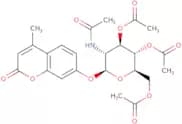
1mgPrezzo su richiesta2mgPrezzo su richiesta5mgPrezzo su richiesta10mgPrezzo su richiesta500µgPrezzo su richiesta4-Methylumbelliferyl 2-acetamido-3,4,6-tri-O-acetyl-2-deoxy-b-D-glucopyranoside
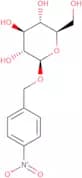
CAS:4-Methylumbelliferyl 2-acetamido-3,4,6-tri-O-acetyl-2-deoxy--bDglucopyranoside is a compound that has been shown to interact with glutamicum and casein kinase. It is also a test compound for corynebacterium glutamicum and interacts with it by functional theory. The compound has been shown to inhibit inflammatory diseases and may be used as a potential treatment for these diseases.Purezza:Min. 95%Peso molecolare:505.47 g/mol(4-Nitrophenyl)methyl-b-D-glucopyranoside
CAS:This product is a fluorogenic substrate that is used in the detection of enzymes in biological systems. It is also used as a ligand to study enzyme activity and can be used to quantify enzyme activity. This product is made from high-purity, high-quality reagents and is often used as an enzyme substrate in diagnostic kits for food testing, environmental testing, and detection of bacteria with the help of chemiluminescence. The CAS number for this product is 700368-52-1. This product can be used for fluorescence staining and bioluminescence.Purezza:Min. 95%Peso molecolare:315.28 g/molResorufin benzyl ether
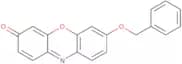
CAS:Resorufin benzyl ether is a chemical compound that can be used as a substrate for cytochrome P450. It has been shown to inhibit the activity of epoxide hydrolase, an enzyme involved in the metabolism of endoperoxides. Resorufin benzyl ether has also been found to inhibit cytochrome P450 enzymes, which are responsible for oxidative metabolism of xenobiotics. This compound has been shown to have a high affinity for mouse monoclonal antibody and is used in immunoassays to detect mouse antibodies. Resorufin benzyl ether is used in biochemical assays and polymerase chain reactions (PCRs) as a fluorescence marker. In addition, this compound is used in model systems to study enzyme activities such as recombinant cytochrome p450 and protein oxidation by reactive oxygen species (ROS).
Purezza:Min. 95%Peso molecolare:303.31 g/molN-Succinyl-Ala-Phe-Lys 7-amido-4-methylcumarin acetate (salt)
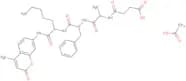
CAS:Prodotto controllatoFluorogenic substrate targeting plasminFormula:C34H43N5O10Purezza:Min. 95%Peso molecolare:681.7 g/mol4-Methylumbelliferyl a-L-idopyranoside
CAS:4-Methylumbelliferyl alpha-L-idopyranoside is a fluorogenic substrate for alpha-L-iduronidase. After enzymatic cleaveage, free 4-methylumbelliferone (also known as hymecromone) is released, exhibiting blue fluorescence upon excitation with UV light. The strongest fluorescence of 4-methylumbelliferone requires deprotonation of the hydroxyl group (thus requires alkaline pH), with a maximal fluorescence intensity obtained with excitation at 350 to 370 nm and emission at 440 to 470 nm. The use of 4-methylumbelliferyl alpha-L-idopyranosideas a substrate for measuring the alpha-L-iduronidase activity is used for Mucopolysaccharidosis I diagnosis and Hurler syndrome screening.
Formula:C16H18O8Purezza:Min. 98 Area-%Colore e forma:White PowderPeso molecolare:338.31 g/mol5-Octanoylaminofluoroscein di-b-D-glactopyranoside
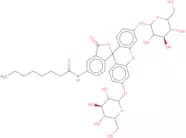
5-Octanoylaminofluoroscein di-b-D-glactopyranoside is a chemiluminescent substrate that can be used for the detection of peroxidase activity. It is a bifunctional substrate, which means it has two reactive groups: one at the 5 position and one at the 8 position. The 5-octanoylaminofluorescein reacts with hydrogen peroxide in a 1:1 ratio, emitting light at 490 nm. The 8-position amine reacts with 2,2'-azino-bis(3-ethylbenzthiazoline)6 sulphonic acid (ABTS) to produce an orange color product that acts as a chromogen. The substrate can be used in diagnostics, food testing, and enzyme substrates.
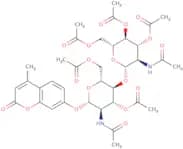
Purezza:Min. 95%Peso molecolare:797.8 g/mol4-Methylumbelliferyl-b-D-cellobiose heptaacetate
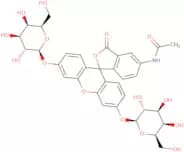
CAS:4-Methylumbelliferyl-beta-D-cellobioside heptaacetate is a fluorogenic substrate for beta-D-glucosidase and can be used to detect this enzyme in the presence of other glycosidases. It is also used as a chromogenic substrate for beta-galactosidase, alpha-mannosidase, alpha-fucosidase, and alpha-N-acetylgalactosaminidase. 4MMB Cellobiose Haptaacetate is a conjugate that can be used to measure the activity of beta-glucuronidase and beta-xylosidase. This product is suitable for use in diagnostics, ligands, food testing, environmental testing, and culture media.Purezza:Min. 95%Peso molecolare:794.71 g/mol5-Acetamidofluorescein-di-(b-D-galactopyranoside)
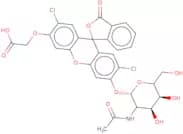
CAS:5-Acetamidofluorescein-di-(b-D-galactopyranoside), also known as C2FDG, is a fluorogenic substrate for beta-galactosidase that generates a green fluorescence after cleavage (Em ~520 nm). It is used in enzyme activity assays and in flow cytometry in animal, bacterial, and yeast cells.Formula:C34H35NO16Purezza:Min. 95%Colore e forma:Yellow PowderPeso molecolare:713.65 g/mol6'-(O-(Carboxymethyl))-2',7'-dichlorofluoroscein 3'-(O-(N-acetyl-b-D-glucosamide))
6'-(O-(Carboxymethyl))-2',7'-dichlorofluoroscein 3'-(O-(N-acetyl-b-D-glucosamide)) is a chemiluminescent substrate that can be used in the detection of ligands. This product has a CAS number of 44636-76-8 and is available at a purity level of 98%. It has been tested for bacterial contamination, as well as for adverse effects on culture media and environmental testing. 6'-(O-(Carboxymethyl))-2',7'-dichlorofluoroscein 3'-(O-(N-acetyl-b-D-glucosamide)) is an enzymatic substrate that can be used in diagnostic applications such as the detection of fluorescence, staining, and bioluminescence. It has also been shown to be useful in food testing.Purezza:Min. 95%Peso molecolare:662.44 g/mol4-Methylumbelliferyl 2,3,4-tri-O-benzoyl-b-D-galactopyranoside-6-sulfate
4-Methylumbelliferyl 2,3,4-tri-O-benzoyl-b-D-galactopyranoside-6-sulfate is a fluorogenic substrate for β-galactosidase and a chromogenic substrate for β-glucuronidase. It is used in food testing, environmental testing, and diagnostics.
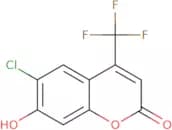
Purezza:Min. 95%Peso molecolare:730.69 g/mol6-Chloro-7-hydroxy-4-(trifluoromethyl)coumarin
CAS:6-Chloro-7-hydroxy-4-(trifluoromethyl)coumarin is a fungicide that inhibits the growth of fungi by interfering with their DNA synthesis. It does this by inhibiting the activity of two enzymes: the fungal enzyme oxime and the enzyme cinerea, which is found in many fungi. 6-Chloro-7-hydroxy-4-(trifluoromethyl)coumarin has been shown to be effective against Alternaria and Botrytis cinerea. The compound also has an antifungal effect against other types of fungi, such as Penicillium roqueforti, when used in combination with a solvent such as ether.
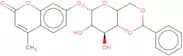
Purezza:Min. 95%Peso molecolare:264.58 g/mol4-Methylumbelliferyl 4,6-O-benzylidene-b-D-galactopyranoside
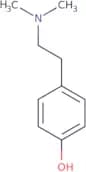
4-Methylumbelliferyl 4,6-O-benzylidene-b-D-galactopyranoside is a fluorogenic substrate that is used in the detection of galactosidases. It has been shown to be a potent inhibitor of these enzymes and can be used to study the activity of various galactosidases. This substrate is used in the measurement of carbohydrate metabolism, including glycolysis and glycogenolysis. 4-Methylumbelliferyl 4,6-O-benzylidene-b-D-galactopyranoside has been shown to produce chemiluminescence when reacted with horseradish peroxidase and hydrogen peroxide. It also produces bioluminescence when exposed to luciferase and adenosine triphosphate (ATP).Purezza:Min. 95%Peso molecolare:426.42 g/molHordenine
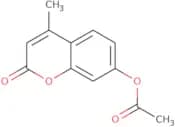
CAS:Produces a fluorogenic signal in the presence of peroxidaseFormula:C10H15NOPurezza:Min. 95%Colore e forma:Brown PowderPeso molecolare:165.23 g/mol4-Methylumbelliferyl acetate - 95%
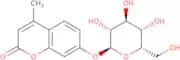
CAS:4-Methylumbelliferyl acetate is a fluorescent compound that can be used to measure the activity of cytochrome P450 enzymes. The fluorescence intensity of 4-methylumbelliferyl acetate increases when it reacts with substrates and inhibitors in vitro. This chemical has been shown to inhibit the enzyme cyclooxygenase in rat liver microsomes, which may lead to blood disorders. It also inhibits coumarin derivatives and human pathogens, such as erythromycin-resistant Staphylococcus aureus (MRSA). 4-Methylumbelliferyl acetate is used as a substrate for polymerase chain reaction (PCR) analysis because it is not susceptible to hydrolysis by esterases.Formula:C12H10O4Purezza:Min. 95%Colore e forma:PowderPeso molecolare:218.21 g/mol6,8-Difluoro-4-methylumbelliferyl 2-acetamido-3-O-(b-D-galactopyranosyl)-a-D-galactopyranoside
6,8-Difluoro-4-methylumbelliferyl 2-acetamido-3-O-(b-D-galactopyranosyl)-a-D-galactopyranoside is a chemiluminescent substrate that reacts with oxygen in the presence of luciferase to produce light. This product is an excellent replacement for luminol, especially in applications where aqueous solvents are not suitable. 6,8-Difluoro-4-methylumbelliferyl 2-acetamido-3-O-(b-D-galactopyranosyl)-a-D-galactopyranoside has been extensively tested and shown to be nonhazardous in a variety of different culture media. It is also nonhazardous to the environment, as it can be easily degraded by microorganisms.
Purezza:Min. 95%