Oligosaccaridi
Sottocategorie di "Oligosaccaridi"
- Glicosidi aminoetilici, glicosidi amminopropilici(14 prodotti)
- Glicani leganti Asn(33 prodotti)
- Oligosaccaridi biotinati(13 prodotti)
- Gruppi sanguigni e antigeni di Lewis(11 prodotti)
- Oligosaccaridi del gruppo sanguigno(13 prodotti)
- Cellooligosaccaridi(1 prodotti)
- Ciclodestrine(183 prodotti)
- Disaccaridi(190 prodotti)
- Oligosaccaridi dell'epitopo(19 prodotti)
- Fruttoligosaccaridi(2 prodotti)
- Oligosaccaridi funzionali(556 prodotti)
- Oligosaccaridi funzionalizzati(1 prodotti)
- Galactosamina(41 prodotti)
- Galattosio(261 prodotti)
- Galb (1-3) GalNAc(21 prodotti)
- Serie ganglio(11 prodotti)
- Serie Globo e Isoglobo(17 prodotti)
- Glucosamina(128 prodotti)
- Acidi glucuronici(52 prodotti)
- Glicoproteine, glicopeptidi(59 prodotti)
- Glicosaminoglicani(26 prodotti)
- Oligosaccaridi del latte umano(22 prodotti)
- O-Glicani etichettati(9 prodotti)
- Oligosaccaridi etichettati(36 prodotti)
- LacNAc(53 prodotti)
- Serie Lacto e Neolacto(14 prodotti)
- Latto-N-biosio(10 prodotti)
- Lattooligosaccaridi(7 prodotti)
- Oligosaccaridi fissati con linker(19 prodotti)
- Maltooligosaccaridi(6 prodotti)
- Oligosaccaridi del latte(31 prodotti)
- N-Glicani(149 prodotti)
- Glicosidi naturali(177 prodotti)
- Oligosaccaridi naturali(103 prodotti)
- O-Glicano(18 prodotti)
- Building Blocks di Oligosaccaridi(7 prodotti)
- Sostituzione di oligosaccaridi(2 prodotti)
- Oligosaccaridi per componente zucchero(225 prodotti)
- Oligose(24 prodotti)
- Altri Oligosaccaridi(14 prodotti)
- Oligomeri PEG(33 prodotti)
- Zuccheri fosfatati(17 prodotti)
- Zuccheri protetti(526 prodotti)
- Reagenti per la sintesi degli oligosaccaridi(254 prodotti)
- Glicani leganti Ser, Thr(9 prodotti)
- Oligosaccaridi sialilati(3 prodotti)
- Sfingoglicolipidi(42 prodotti)
- Aminoacidi dello zucchero, peptidi dello zucchero(20 prodotti)
- Antigeni dello zucchero(31 prodotti)
- Building Blocks Zuccherini per Oligosaccaridi Bersaglio(225 prodotti)
- Coniugati di zucchero(100 prodotti)
- Zuccheri solforati(16 prodotti)
- Tetrasaccaridi(34 prodotti)
- Trisaccaridi e oltre(95 prodotti)
- Xilooligosaccaridi(5 prodotti)
Trovati 2309 prodotti di "Oligosaccaridi"
GD1b-ganglioside sodium
CAS:GD1b (shown as sodium salt) is one of the major gangliosides in neuronal and glial membranes. It has a core tetrasaccharide structure (Galβ1,3GalNAcβ1,4Galβ1,4Glc) with itâs two sialic acids linked α2,3/α2,8 to the inner galactose residue and ceramide linked β to position 1 on the reducing terminal glucose residue (Ledeen, 2009). GD1b acts as a receptor for BK virus as well as for heat-labile LTII-a toxin, produced by enteropathogenicâ¯E. coli. GD1b ganglioside also interacts with tetanus neurotoxin (TeNT) and is crucial for its entry into cells (Kolter, 2012).Purezza:Min. 95%Colore e forma:PowderHexa-guluronic acid sodium
CAS:Hexa-guluronic acid sodium salt (1,4-linked α-L-sodium guluronohexaose) is one of a number of oligosaccharides obtained from alginate which is a polysaccharide in brown seaweeds containing: blocks of repeating mannuronic acid sequences (M-M-M-M etc), repeating guluronic acid sequences (G-G-G-G etc), and alternating M-G-M-G sequences. This oligosaccharide can be released by acid hydrolysis (Shimokawa, 1996) and a number of biological activities have been discussed in a recent review (Xing, 2020).
Formula:C36H44O37Na6Purezza:Min. 95%Colore e forma:White PowderPeso molecolare:1,206.65 g/molLactitol monohydrate
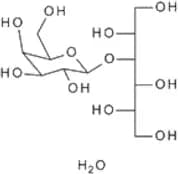
CAS:Lactitol is a sugar alcohol that is used in the food industry as a low-calorie sweetener and preservative. Lactitol has physiological effects such as increasing the glomerular filtration rate and decreasing serum cholesterol levels. It also inhibits inflammatory bowel disease by suppressing the production of proinflammatory cytokines, such as TNF-α, IL-1β, IL-6, and IL-8, which are associated with intestinal inflammation. Lactitol is used as an excipient for tablets or capsules to improve their dissolution properties and to provide bulk. Lactitol does not show any significant toxicity in animal studies and has been shown to be safe for human consumption at up to 15g/day.Formula:C12H24O11·H2OPurezza:Min. 95%Colore e forma:White PowderPeso molecolare:362.33 g/molBlood Group H type I trisaccharide
CAS:Core antigen fragment in ABO blood group systemFormula:C20H35NO15Purezza:Min. 90%Colore e forma:PowderPeso molecolare:529.49 g/molGalactinol hydrate
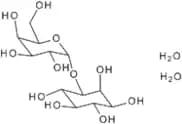
CAS:Galactinol is a diterpene that belongs to the group of phytochemicals. It is synthesized in plants and bacteria from raffinose, an oligosaccharide that is present in high concentrations in beans. Galactinol has been shown to be involved in plant physiology, with its optimum concentration at a pH of 5-7. Galactinol reacts with ascorbic acid to form galactono-1,4-lactone in a reaction mechanism similar to the one for the synthesis of raffinose. It also regulates transcriptional activity by binding to DNA and altering its conformation. This compound has been used as an experimental model for biochemical studies on polymerase chain reactions (PCR).Formula:C12H22O11•H2OxPurezza:Min. 98 Area-%Colore e forma:PowderPeso molecolare:342.3 g/mol2-Acetamido-2-deoxy-4-O-(6-sulfo-β-D-galactopyranosyl)-β-D-glucopyranose sodium
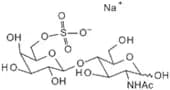
2-Acetamido-2-deoxy-4-O-(6-sulfo-b-D-galactopyranosyl)-b-D-glucopyranose sodium salt (6F3G) is a synthetic, fluorinated monosaccharide that has been used as a probe for the study of glycosylation and polysaccharide synthesis. 6F3G has been shown to be an effective inhibitor of the enzyme D-glycerate kinase, which catalyzes the conversion of D-glycerate to phosphoenolpyruvate. This inhibition leads to a decrease in the formation of ATP and NADH, which provides evidence that 6F3G binds to the active site of this enzyme.
Formula:C14H25NO14S•NaPurezza:Min. 95%Colore e forma:White PowderPeso molecolare:486.39 g/molFucosyl-GM1 ganglioside
CAS:Monosialylated glycosphingolipid with an α1,2-fucosylated galactose at the nonreducing end. The moluecule is minimally expressed in healthy tissues but has high prevalence in some tumours such as small cell lung cancer (SCLC). Fucosyl-GM1 ganglioside is a potential tumour marker for SCLC and a potential antigen target for immunotherapy.
Formula:C79H141N3O35Purezza:Min. 98 Area-%Colore e forma:White Off-White PowderPeso molecolare:1691.93456N-Acetylneuraminic acid dimer 1-O-propylamine
N-Acetylneuraminic acid dimer 1-O-propylamine is a synthetic N-acetylneuraminic acid (NANA) derivative that has been modified with an alkyl amine. This modification prevents the formation of NANA oligosaccharides and is used in the synthesis of complex carbohydrates. It is also used as a fluorinated building block for various saccharides, including monosaccharides, disaccharides, and polysaccharides. The purity of this product is greater than 99%.Purezza:Min. 95%Lacto-N-difucohexaose IV
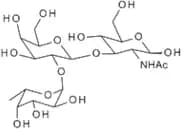
Lacto-N-difucohexaose IV is a pentasaccharide with a lacto-n-difucohexaose backbone that has been shown to have inhibitory activities against human red blood cells. This pentasaccharide is a glycosaminoglycan, which is a type of carbohydrate that consists of an oligosaccharide and protein. Lacto-N-difucohexaose IV specifically binds to the antigen on the surface of human red blood cells, inhibiting their proliferation. The pentasaccharide is also known as Hansson's hapten or Hapten IV. The pentasaccharides are found in group O blood and are not found in groups A, B, or AB.
Formula:C38H65NO29Purezza:Min. 95%Peso molecolare:999.91 g/mol4-Aminophenyl 2-O-(a-D-mannopyranosyl)-a-D-mannopyranoside
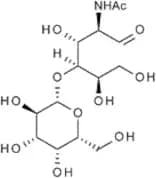
4-Aminophenyl 2-O-(a-D-mannopyranosyl)-a-D-mannopyranoside is a fluorinated mannoside that is modified with methyl and glycosyl groups. It is used as a fluorescent probe for the detection of saccharides in organic solvents. The molecular weight of this compound is 687.Purezza:Min. 95%3-O-[2-(Acetamino)-2-deoxy-D-galactopyranosyl]-D-mannopyranose
CAS:3-O-[2-(Acetamino)-2-deoxy-D-galactopyranosyl]-D-mannopyranose is a synthetic, fluorinated, methylated, monosaccharide that is used in the synthesis of complex carbohydrates.Formula:C14H25NO11Purezza:Min. 95%Peso molecolare:383.35 g/mol2-Acetamido-2-deoxy-3-O-(a-L-fucopyranosyl)-D-glucopyranose
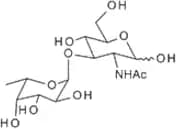
CAS:2-Acetamido-2-deoxy-3-O-(a-L-fucopyranosyl)-D-glucopyranose is a carbohydrate that has been found in leaves of camellia plants. It can be used as a marker for the identification of camellia plants. 2-Acetamido-2-deoxy-3-O-(a-L-fucopyranosyl)-D-glucopyranose is also thought to be involved in the developmental and metabolic mechanisms of camellia plants, which are still being studied. This carbohydrate is synthesized from l -glutamine and epigallocatechin in the presence of d -proline.Formula:C14H25NO10Purezza:Min. 96 Area-%Colore e forma:White PowderPeso molecolare:367.35 g/molParomamine 3HCl
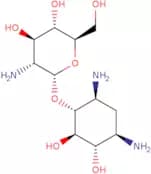
CAS:Paromamine is a chemical compound that inhibits protein synthesis by enzymatic inactivation. It has been shown to have a broad spectrum of antibacterial activity against Gram-positive and Gram-negative bacteria. Paromamine also has the ability to inhibit bacterial growth at high salt concentrations, making it an attractive candidate for development as an oral antibiotic drug. Paromamine is synthesized from natural products, such as salicylaldehyde or phenylhydrazine, which are readily available and inexpensive. The reaction mechanism for the formation of paromamine starts with dehydration of the hydroxyl group on the hydrazine to form a carbonyl group. This carbonyl group reacts with sephadex g-100 to form a cyanohydrin. The cyanohydrin reacts with ammonia to form an amide bond between the two nitrogen atoms in the molecule, which forms paromamine.Formula:C12H25N3O7·3HClPurezza:Min. 95%Peso molecolare:323.34 g/molN-Acetyl-D-lactosamine - 200mM solution in water
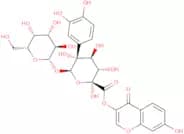
CAS:A natural structural element in a variety of glycoconjugates. Substrate for galactosidases, fucosyltransferases, and sialyltransferases. Useful as a lectin inhibitory sugar and for characterizing lectins.Formula:C14H25NO11Purezza:Min. 95%Colore e forma:PowderPeso molecolare:383.35 g/mol2-(3,4-Dihydroxyphenyl)-5,7-dihydroxy-4-oxo-4H-1-benzopyran-3-yl O-b-D-galactopyranosyl-b-D-glucopyranosiduronic acid
CAS:This is a custom synthesis that is a complex carbohydrate. It has been modified, glycosylated, and methylated to create a saccharide with an Oligosaccharide and Polysaccharide. This product is fluorinated, custom synthesized, and has high purity. The CAS number for this product is 77154-70-2.Formula:C27H28O18Purezza:Min. 95%Peso molecolare:640.5 g/mol2-Acetamido-2-deoxy-4-O-(a-D-galactopyranosyl)-D-glucopyranose
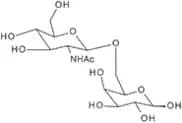
The 2-acetamido-2-deoxy-4-O-(a-D-galactopyranosyl)-D-glucopyranose is a carbohydrate. It is an oligosaccharide, which is a sugar with more than two monosaccharides. The CAS number of this compound is 9077-98-0. The molecular weight of this compound is 450.01 g/mol and the purity level is 99%. This compound can be custom synthesized to meet your needs. This product can be methylated, glycosylated, or click modified to create products with different properties.Formula:C14H25NO11Purezza:Min. 95%Colore e forma:PowderPeso molecolare:383.35 g/mol6-O-(2-Acetamido-2-deoxy-β-D-glucopyranosyl)-D-galactopyranose
CAS:6-O-(2-Acetamido-2-deoxy-b-D-glucopyranosyl)-D-galactopyranose is a disaccharide that has been shown to have anti-inflammatory activities. It contains an acetamide group and a hydroxy group. The acetamide group is substituted by a hydroxy group, which may be responsible for its anti-inflammatory activity. 6-O-(2-Acetamido-2-deoxy-b-D-glucopyranosyl)-D-galactopyranose has also been shown to inhibit the production of proinflammatory cytokines such as tumor necrosis factor alpha (TNFα) and interleukin beta (ILβ).Formula:C14H25NO11Purezza:Min. 95%Colore e forma:White PowderPeso molecolare:383.36 g/mol4'-(D-[UL-13C6]Galactosyl)lactose
CAS:Galactosyllactose attenuated NF-κB inflammatory signaling in human intestinal epithelial cells and in human immature intestine. Thus, galactosyllactoses are strong anti-inflammatory agents in human colostrum and early milk, contributing to innate immune modulation. The potential clinical utility of galactosyllactose warrants investigation.
Formula:C6C12H32O16Purezza:Min. 95%Colore e forma:PowderPeso molecolare:510.39 g/molGlobotriaosylceramide
CAS:It is one of the few clusters of differentiation that is not a protein and structurally contains a galactose moiety linked α to lactosylceramide. Defects in the enzyme α-galactosidase lead to the buildup of globotriaosylceramide, causing Fabry's disease. The pharmaceutical drug migalastat enhances the function of α-galactosidase and is used to treat Fabry's. Globotriaosylceramide is also one of the targets of Shiga toxin, which is responsible for pathogenicity of enterohemorrhagic E. coli.Formula:C60H113NO18Purezza:Min. 95%Colore e forma:PowderPeso molecolare:1135.79577Galactooligosaccharides
Galactooligosaccharides (GOS) have a sweetness of 30–60 % relative to sucrose. They have applications in a wide range of food products such as sweeteners, bulking agents, and sugar substitutes and are found in a range of product types including bread, ‘sports’ drinks, jams, fermented milk, confectionary and desserts. In Europe they are incorporated into infant formula foods.Colore e forma:Powder





![3-O-[2-(Acetamino)-2-deoxy-D-galactopyranosyl]-D-mannopyranose](/_next/image/?url=https%3A%2Fstatic.cymitquimica.com%2Fproducts%2F3D%2Fthumb-webp%2FOA139084.webp&w=3840&q=75)

![4'-(D-[UL-13C6]Galactosyl)lactose](/_next/image/?url=https%3A%2Fstatic.cymitquimica.com%2Fproducts%2F3D%2Fthumb-webp%2FOG159775.webp&w=3840&q=75)