Oligosaccaridi
Sottocategorie di "Oligosaccaridi"
- Glicosidi aminoetilici, glicosidi amminopropilici(14 prodotti)
- Glicani leganti Asn(33 prodotti)
- Oligosaccaridi biotinati(13 prodotti)
- Gruppi sanguigni e antigeni di Lewis(11 prodotti)
- Oligosaccaridi del gruppo sanguigno(13 prodotti)
- Cellooligosaccaridi(1 prodotti)
- Ciclodestrine(183 prodotti)
- Disaccaridi(189 prodotti)
- Oligosaccaridi dell'epitopo(19 prodotti)
- Fruttoligosaccaridi(2 prodotti)
- Oligosaccaridi funzionali(554 prodotti)
- Oligosaccaridi funzionalizzati(1 prodotti)
- Galactosamina(41 prodotti)
- Galattosio(261 prodotti)
- Galb (1-3) GalNAc(21 prodotti)
- Serie ganglio(11 prodotti)
- Serie Globo e Isoglobo(17 prodotti)
- Glucosamina(128 prodotti)
- Acidi glucuronici(51 prodotti)
- Glicoproteine, glicopeptidi(59 prodotti)
- Glicosaminoglicani(26 prodotti)
- Oligosaccaridi del latte umano(22 prodotti)
- O-Glicani etichettati(9 prodotti)
- Oligosaccaridi etichettati(36 prodotti)
- LacNAc(53 prodotti)
- Serie Lacto e Neolacto(14 prodotti)
- Latto-N-biosio(10 prodotti)
- Lattooligosaccaridi(7 prodotti)
- Oligosaccaridi fissati con linker(19 prodotti)
- Maltooligosaccaridi(6 prodotti)
- Oligosaccaridi del latte(31 prodotti)
- N-Glicani(149 prodotti)
- Glicosidi naturali(177 prodotti)
- Oligosaccaridi naturali(103 prodotti)
- O-Glicano(18 prodotti)
- Building Blocks di Oligosaccaridi(7 prodotti)
- Sostituzione di oligosaccaridi(2 prodotti)
- Oligosaccaridi per componente zucchero(225 prodotti)
- Oligose(24 prodotti)
- Altri Oligosaccaridi(14 prodotti)
- Oligomeri PEG(33 prodotti)
- Zuccheri fosfatati(17 prodotti)
- Zuccheri protetti(526 prodotti)
- Reagenti per la sintesi degli oligosaccaridi(254 prodotti)
- Glicani leganti Ser, Thr(9 prodotti)
- Oligosaccaridi sialilati(3 prodotti)
- Sfingoglicolipidi(42 prodotti)
- Aminoacidi dello zucchero, peptidi dello zucchero(20 prodotti)
- Antigeni dello zucchero(31 prodotti)
- Building Blocks Zuccherini per Oligosaccaridi Bersaglio(225 prodotti)
- Coniugati di zucchero(100 prodotti)
- Zuccheri solforati(16 prodotti)
- Tetrasaccaridi(34 prodotti)
- Trisaccaridi e oltre(95 prodotti)
- Xilooligosaccaridi(5 prodotti)
Trovati 2317 prodotti di "Oligosaccaridi"
b-Lactose - min 70% b-anomer
CAS:70% β-D-Lactose is used in the pharmaceutical industry to produce tablets. It acts as a nutrient and as a filler in pills. It is also utilized in the dilution of heroin and to sweeten some beers.Formula:C12H22O11Colore e forma:White PowderPeso molecolare:342.3 g/molLewis Y-PAA-biotin
Lewis Y-PAA-biotin is a complex carbohydrate which is synthesized using Click chemistry. This compound has been modified to include a biotin moiety. Lewis Y-PAA-biotin has been shown to be resistant to enzymatic degradation and can be used as a saccharide in the synthesis of polysaccharides. Lewis Y-PAA-biotin is synthesized by attaching poly(acrylamide) (PAA) chains to the sugar moieties of Lewis Y. The carbonyl group on the PAA chains can be fluorinated, which makes it useful for click modification reactions with fluorinated compounds.Purezza:Min. 95 Area-%Colore e forma:White PowderPeso molecolare:732.7 g/molGD1b-Ganglioside ammonium
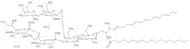
CAS:GD1b ganglioside (shown as ammonium salt) is one of the major gangliosides in neuronal and glial membranes. It has a core tetrasaccharide structure (Galβ1,3GalNAcβ1,4Galβ1,4Glc) with its two sialic acids linked α2,3/α2,8 to the inner galactose residue, and ceramide linked β to position 1 on the reducing terminal glucose residue (Ledeen, 2009). GD1b ganglioside acts as a receptor for BK virus, as well as for heat-labile LTII-a toxin, produced by enteropathogenicâ¯E. coli. GD1b ganglioside also interacts with tetanus neurotoxin (TeNT) and is crucial for its entry into cells (Kolter, 2012). The functional significance of ammonia in the brain is not yet fully understood: see (Modi 1994).
Purezza:Min. 95%N-Acetylneuraminic acid tetramer sodium salt
N-Acetylneuraminic acid tetramer sodium salt is a synthetic carbohydrate that belongs to the group of complex carbohydrates. It is a glycosylation product of N-acetylneuraminic acid and has been modified with fluorine, methylation, and click chemistry. N-Acetylneuraminic acid tetramer sodium salt is used as a reagent in the synthesis of oligosaccharides and has been shown to be useful for structural analysis. The CAS number for this compound is:Formula:C44H66N4O33Na4Purezza:Min. 95%Colore e forma:PowderPeso molecolare:1,270.96 g/mol2-Hydroxypropyl-b-cyclodextrin - Endotoxin level below 20 EU/g
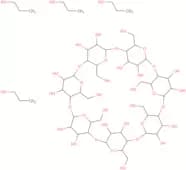
CAS:2-Hydroxypropyl-b-cyclodextrin is a water-soluble drug that is chemically stable in aqueous media. It has been shown to be safe for use in the eye, with no significant side effects. 2-Hydroxypropyl-b-cyclodextrin has been shown to have anti-inflammatory properties and will not cause hemolytic activity. 2-Hydroxypropyl-b-cyclodextrin binds to retinoic acid receptors, which are found on cells of the corneal surface and in human spermatozoa. The binding of retinoic acid inhibits the production of enzymes that break down retinoids and prevents cell proliferation. This agent also interacts with other cellular components such as proteins, lipids, carbohydrates, nucleic acids, and hormones.
Formula:C42•(H)70n•O35•(C3H7)nPurezza:Min. 95%Lipopolysaccharides - from Escherichia coli O55:B5
CAS:Lipopolysaccharides are a heterogeneous group of molecules that include endotoxins, lipid A, and core oligosaccharide. They are released from the cell wall of gram-negative bacteria as a result of bacterial lysis. Lipopolysaccharides are potent activators of immune cells, inducing the secretion of pro-inflammatory cytokines such as tumor necrosis factor-α (TNF-α) and interleukin-1β (IL-1β). TNF-α is also known to induce the production of other pro-inflammatory cytokines including IL-6, IL-8, IL-10, and IL-12. Lipopolysaccharides have been shown to cause liver damage in animals by increasing plasma alanine aminotransferase levels. This may also be due to their ability to induce the production of malondialdehyde and c-reactive protein.Colore e forma:Off-White PowderMonofucosyl-para-lacto-N-hexaose IV
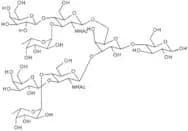
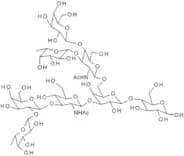
CAS:Monofucosyl-para-lacto-N-hexaose IV is a trisaccharide that belongs to the group of blood group antigens. It is found in human milk and can be used as an indicator for infant nutrition. Monofucosyl-para-lacto-N-hexaose IV is found in the cells of streptococcus, lactobacillus, and clostridium. It has been shown to be a potential biomarker for inflammatory bowel disease (IBD). This molecule has been used as an antigen in immunological assays. The sequences of monofucosyl-para-lacto-N-hexaose IV have been determined using chromatograms and profiles.Formula:C46H78N2O35Purezza:Min. 95%Colore e forma:PowderPeso molecolare:1,219.11 g/molDifucosyllacto-N-hexaose (b)
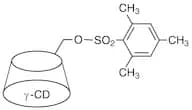
CAS:Neutral octasasaccharide naturally present in human breast milk.Formula:C52H88N2O39Purezza:Min. 90 Area-%Colore e forma:PowderPeso molecolare:1,365.25 g/molMono-6-O-mesitylenesulfonyl-γ-cyclodextrin
CAS:Formula:C57H90O42SPurezza:>90.0%(HPLC)Colore e forma:White to Almost white powder to crystalPeso molecolare:1,479.37α-D-Lactose 1-phosphate barium salt
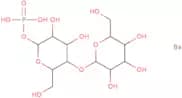
CAS:a-D-Lactose 1-phosphate barium salt is a modification of a D-lactose monosaccharide. It is a complex carbohydrate that has been synthesized using the polyol method. The CAS number for this product is 103404-65-5. This product is available in high purity and the molecular weight of this compound is 576. a-D-Lactose 1-phosphate barium salt can be used as an ingredient in pharmaceuticals, food products, and cosmetics. It has been shown to have anticariogenic activities and may be used as a substitute for sucrose in food products.
Formula:C12H21O14P·BaPurezza:Min. 95%Colore e forma:PowderPeso molecolare:557.59 g/molLactose-6'-phosphate
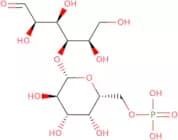
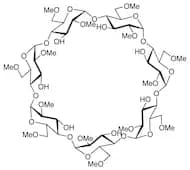
CAS:Lactose-6'-phosphate is a sugar phosphateFormula:C12H23O14PPurezza:Min. 95%Peso molecolare:422.28 g/mol2,6-Di-O-methyl-β-cyclodextrin
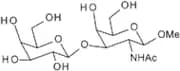
CAS:Formula:C56H98O35Purezza:>95.0%(HPLC)Colore e forma:White to Light yellow powder to crystalPeso molecolare:1,331.37Methyl 2-acetamido-2-deoxy-3-O-(b-D-galactopyranosyl)-b-D-galactopyranoside
CAS:Methyl 2-acetamido-2-deoxy-3-O-(b-D-galactopyranosyl)-b-D-galactopyranoside is a carbohydrate that is modified by the addition of fluorine at the 3 position. It has CAS number 88274-25-3 and belongs to the group of oligosaccharides. Methyl 2-acetamido-2-deoxy-3-(b, b'-D, galactopyranosyl)-b, D galactopyranoside is a synthetic polymer that is glycosylated with methyl groups. This product can be custom synthesized for your needs.
Formula:C15H27NO11Purezza:Min. 95%Colore e forma:PowderPeso molecolare:397.38 g/molD-Maltitol
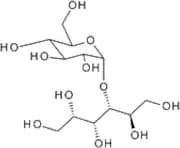
CAS:Bulk sweetener; viscosity/bodying agent; humectant; cryoprotectantFormula:C12H24O11Purezza:Min. 95%Colore e forma:White PowderPeso molecolare:344.31 g/molDifucosyllacto-N-hexaose (a)
CAS:Neutral octasasaccharide naturally present in human breast milk
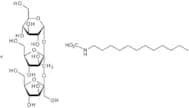
Formula:C52H88N2O39Purezza:Min. 95%Colore e forma:PowderPeso molecolare:1,365.25 g/molInulin lauryl carbamate - 25% in glycerol
CAS:Emulsifier used in the cosmetic industryColore e forma:PowderHyaluronic acid octasaccharide ammonium salt
Hyaluronic acid is a polysaccharide containing repeating disaccharide units of β-1,3-N-acetyl glucosamine and β-1, 4-glucuronicâ¯acid. A series of unsaturated oligosaccharides (oligouronic acids) are released from hyaluronic acid by the action of hyaluronidase on the umbilical cord (Weissman, 1954). This octasaccharide ammonium salt and other enzymatically produced polymer homologs have been of value in the study of hyaluronic acid metabolism in both healthy and diseased tissues (Hascall, 2019).Formula:C56H86N4O45Purezza:Min. 95 Area-%Colore e forma:PowderPeso molecolare:1,535.3 g/molMaltooctaose hexacosaacetate
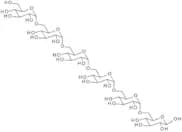
CAS:CO2-philic compound; used in pharmaceuticals and CO2-based processesFormula:C100H134O67Purezza:Min. 95%Colore e forma:PowderPeso molecolare:2,408.09 g/molIsomaltohexaose
CAS:Produced from high maltose syrup by treatment with transglucosidaseFormula:C36H62O31Purezza:Min. 90 Area-%Colore e forma:White PowderPeso molecolare:990.9 g/molGM2-Ganglioside
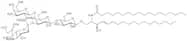
CAS:GM2 ganglioside (sodium salt) has a core trisaccharide structure (GalNAcβ1,4Galβ1,4Glc) with sialic acid linked α2,3 to the central galactose residue and ceramide linked β to position 1 on the reducing terminal glucose residue (Ledeen, 2009). GM2 ganglioside is present on neuronal cells and plays a key role in the regulation of dendritogenesis in cortical pyramidal neurons. In lysosomal storage disorders, such as, Tay-Sachs and Sandhoff disease, where hexosaminases A and B are deficient, GM2 ganglioside accumulates in the nervous system (Cachon-Gonzalez, 2018). GM2 ganglioside is also overexpressed in melanomas and other tumours of neuro-ecto origin (Yoshida, 2020). Moreover, the sugar moiety of the GM2 ganglioside is a receptor allowing the viral infection of cells with reovirus and rotavirus (Zhu, 2018).Purezza:Min. 96%Colore e forma:Powder