Zuccheri e nucleobasi della spina dorsale
Trovati 1000 prodotti di "Zuccheri e nucleobasi della spina dorsale"
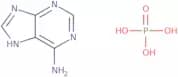
Adenine phosphate
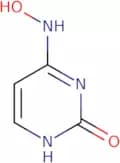
CAS:Prodotto controllatoAdenine phosphate is a molecule that acts as a regulator of endogenous adenosine. It has been shown to inhibit the growth of skin cells in tissue culture and to be effective against influenza virus and other viruses when used in combination with pyridoxine hydrochloride. The molecular weight of adenine phosphate is 314.2 g/mol, corresponding to two nitrogen atoms and four phosphorus atoms. Adenine phosphate is an oxidized form of adenosine triphosphate (ATP) with one phosphate group removed from the molecule. This irreversible oxidation occurs when ATP is exposed to the environment, for example, during tissue culture or viral infection. The effective dose for treating cancer has not yet been determined; however, doses of up to 5 mg/kg are not toxic to mice.Formula:C5H5N5•H3PO4Purezza:Min. 95%Colore e forma:SolidPeso molecolare:233.12 g/molN4-Hydroxycytosine
CAS:N4-Hydroxycytosine is an intramolecular hydrogen that inhibits the replication of viruses by inhibiting their DNA polymerase. It is a structural analogue of cytosine and can be found in both left- and right-handed forms, which are termed isomers. The chemical study of N4-hydroxycytosine has shown it to have inhibitory effects on human immunodeficiency virus and hepatitis C virus. 13C-NMR spectroscopy has been used to identify the chemical structure of N4-hydroxycytosine and its reactivity with other molecules. N4-Hydroxycytosine can be synthesized by the reaction between formaldehyde and 2,3,5,6-tetrafluorocytosine.Formula:C4H5N3O2Purezza:Min. 95%Colore e forma:PowderPeso molecolare:127.1 g/mol5,6-Diaminouracil sulfate
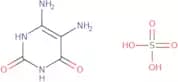
CAS:5,6-Diaminouracil sulfate is an amine that is used as a precursor in the production of the anti-cancer drug 5-fluorouracil. It can be synthesized from diaminopyrimidine and uracil. This compound has two amino groups, which are both substituted with hydrogens. The aminouracile group is substituted with a hydrogen and an amino group. 5,6-Diaminouracil sulfate has pyrimidone rings that are fused together to form a six-membered ring.
Formula:C4H6N4O2·xH2SO4Purezza:Min. 95%Colore e forma:PowderPeso molecolare:142.12 g/molAdenine sulphate
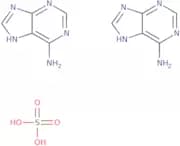
CAS:Adenine sulphate is a nucleotide that is involved in the formation of DNA and RNA. Adenine sulphate is synthesized from adenosine triphosphate and sulfuric acid. It has been shown to be an important component of DNA polymerase, which is responsible for the production of RNA and DNA. Adenine sulphate also plays a role in the development of insect resistance in plants and tissue culture cells. Adenine sulphate levels have been found to be reduced in patients with orotic aciduria, a condition characterized by high levels of orotic acid in the urine. The decreased adenine sulfate levels are thought to be due to an imbalance between adenosine diphosphate, which inhibits adenylosuccinate lyase (ADSL), and sulfite oxidase (SOX) activity. ADSL converts adenosine diphosphate into adenosinethiol disulfide, while SOX converts sulfite into hydrogen sulfide
Formula:C5H5N5•(H2O4S)0Purezza:Min. 95%Colore e forma:White PowderPeso molecolare:184.17 g/mol6-Chloro-9-(tetrahydro-2H-pyran-2-yl)purine
CAS:6-Chloro-9-(tetrahydro-2H-pyran-2-yl)purine is a nucleoside analog that is used to treat various types of cancer. It is a c–h bond regiospecific nucleophile that forms the 6-chloro 9-(tetrahydro-2H-pyran-2-yl)purine intermediate. The chloride ion acts as a nucleophile in the first step of this process, which results in the formation of an organocuprate and glyoxylate. 6CPP binds to DNA and inhibits RNA synthesis, leading to cell death by apoptosis or necrosis. This drug has been shown to be effective for treating human cell lines. 6CPP is also known for its antitumor effects, which may be due to its ability to inhibit phosphonates and cross-coupling reactions.Formula:C10H11ClN4OPurezza:Min. 95%Colore e forma:SolidPeso molecolare:238.67 g/mol5-Methylcytosine hydrochloride salt
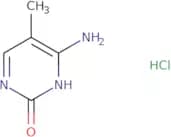
CAS:5-Methylcytosine hydrochloride salt is a metabolite of cytosine that occurs naturally in the body. It is used as an inhibitor of DNA methylation to study the effect of this process on gene expression. 5-Methylcytosine hydrochloride salt has been shown to inhibit the production of growth factors, such as insulin-like growth factor 1, and radiation energy. It also causes oxidative damage to DNA and inhibits the oxidation of urea nitrogen in lettuce. The matrix effect may interfere with the analysis of 5-methylcytosine hydrochloride salt by spectrometry.
Formula:C5H7N3O·HClPurezza:Min. 95%Colore e forma:PowderPeso molecolare:161.59 g/mol3’,5’-Di-O-benzoyl-2’-deoxy-2’-fluoro-5-trifluoromethyl-arabinouridine
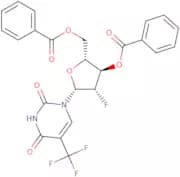
CAS:Please enquire for more information about 3’,5’-Di-O-benzoyl-2’-deoxy-2’-fluoro-5-trifluoromethyl-arabinouridine including the price, delivery time and more detailed product information at the technical inquiry form on this pagePurezza:Min. 95%6-Chloro-7-deazaguanine
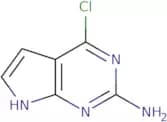
CAS:6-Chloro-7-deazaguanine (6CDG) is a pyrimidine nucleoside that is used in the treatment of hepatoblastoma and hepatitis. 6CDG is an alkylating agent that binds to DNA and causes strand breakage by forming covalent bonds with the N-7 position of guanine. It can also be used as an antiviral agent against herpes simplex virus, as it inhibits viral replication by inhibiting the viral DNA polymerase. 6CDG does not inhibit human DNA polymerase. The drug has been shown to be cytotoxic to MRC5 cells, which are resistant to pyrimidine analogs.
Formula:C6H5ClN4Purezza:Min. 95%Colore e forma:PowderPeso molecolare:168.58 g/mol8-Hydroxyguanine
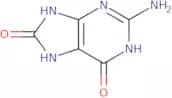
CAS:8-Hydroxyguanine is a purine derivative that is found in DNA. It is a byproduct of oxidative damage to DNA and can cause mutations. 8-Hydroxyguanine binds to the α1 subunit of DNA polymerase, inhibiting the polymerization of nucleotides. This prevents the synthesis of new DNA, resulting in cell death. In humans, 8-hydroxyguanine appears to be repaired at a higher rate than other organisms such as bacteria. A study has shown that human cells are able to repair 8-hydroxyguanine by using an enzyme called O6-alkylguanine transferase (AGT). The AGT protein removes the alkyl group from the guanine base and replaces it with an amino group during repair. This process results in the formation of O6-methylguanine, which can be eliminated by methylation or excreted through urine.Formula:C5H5N5O2Purezza:Min. 98 Area-%Colore e forma:White PowderPeso molecolare:167.13 g/mol3,7-Dimethyl-1-propargylxanthine
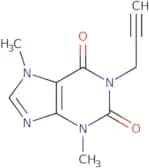
CAS:Prodotto controllato3,7-Dimethyl-1-propargylxanthine is a cyclase inhibitor that has been shown to have pharmacological effects. It has been shown to be effective in vivo models of Parkinson's disease and has reduced locomotor activity. This drug also inhibits the production of adenosine and dopamine, leading to neuronal death. The 3,7-dimethyl-1-propargylxanthine shows high selectivity for adenosine A3 receptors and is an antagonist at these receptors. It prevents mitochondrial membrane potential from decreasing, which may be due to inhibition of the production of reactive oxygen species by mitochondria. 3,7-Dimethyl-1-propargylxanthine also inhibits platelet aggregation by blocking the activation of phospholipase C and enhances platelet aggregation by inhibiting phosphodiesterase activity.Formula:C10H10N4O2Purezza:Min. 95%Colore e forma:PowderPeso molecolare:218.21 g/mol3’,5’-Di-O-acetyl-2’-azido-2’-deoxy-5-methyluridine
CAS:Please enquire for more information about 3’,5’-Di-O-acetyl-2’-azido-2’-deoxy-5-methyluridine including the price, delivery time and more detailed product information at the technical inquiry form on this pagePurezza:Min. 95%1,3-Dimethyluracil
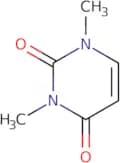
CAS:1,3-Dimethyluracil is a uracil derivative that is used as a hydrogen-bond donor, which helps to repair DNA. It has been shown to have a kinetic isotope effect in the deuterium isotope effect studies. The carbonyl group of 1,3-dimethyluracil can form hydrogen bonds with the guanine base in DNA and lead to the formation of an adduct. This adduct can be repaired by nucleotide excision repair when it forms a dimer with another 1,3-dimethyluracol molecule or by base excision repair when it forms a dimer with another purine or pyrimidine base. Aqueous solutions of 1,3-dimethyluracil are stable for short periods of time but decompose rapidly on heating. X-ray crystal structures show that 1,3-dimethyluracil binds to hydrochloric acid and x-ray crystallographic analysisFormula:C6H8N2O2Purezza:Min. 95%Colore e forma:Off-White Slightly Brown PowderPeso molecolare:140.14 g/molHypoxanthine monosodium salt
CAS:Hypoxanthine is a nucleotide, which is a building block of DNA and RNA. It is a useful intermediate for the production of other chemicals and drugs. Hypoxanthine can be used as a reagent in biochemical research, to study the effects of hypoxia on cells, or as a catalyst in organic synthesis. Hypoxanthine monosodium salt is an important building block for complex compounds with many uses. It is also used as a reaction component in many chemical reactions as well as being a versatile scaffold for drug design.Formula:C5H4N4NaOPurezza:Min. 97 Area-%Colore e forma:White PowderPeso molecolare:159.1 g/molNb-N-(benzhydryloxycarbonyl)cytosine)-1-acetic acid
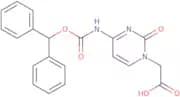
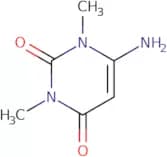
CAS:Nb-N-(benzhydryloxycarbonyl)cytosine)-1-acetic acid is a speciality chemical that is used as a reagent, building block, and scaffold for organic synthesis. This compound can be used in various reactions to produce complex compounds with high purity. Nb-N-(benzhydryloxycarbonyl)cytosine)-1-acetic acid is an excellent starting material for the production of fine chemicals, research chemicals, and versatile building blocks. It is also a useful intermediate for the production of pharmaceuticals and other useful compounds.Formula:C20H17N3O5Purezza:Min. 98 Area-%Colore e forma:White PowderPeso molecolare:379.37 g/mol6-Amino-1,3-dimethyluracil
CAS:6-Amino-1,3-dimethyluracil is a synthetic compound that has been shown to have antiinflammatory activity. This drug was synthesized from recycled methylene biphenyls and quinoline derivatives. 6-Amino-1,3-dimethyluracil inhibits the synthesis of proteins in cells by inhibiting the production of amino acids such as methionine through an attack on the amino group of methionine. 6-Amino-1,3-dimethyluracil also has apoptotic activity, which may be due to its ability to inhibit protein synthesis and increase the levels of active methylene.Formula:C6H9N3O2Purezza:Min. 95%Colore e forma:PowderPeso molecolare:155.15 g/mol4-[2'-(7''-Deazaguanine)ethyl]benzoic acid N-hydroxysuccinimide ester
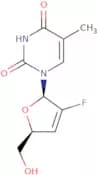
CAS:4-[2'-(7''-Deazaguanine)ethyl]benzoic acid N-hydroxysuccinimide ester is a useful intermediate in the synthesis of 7''-deazaguanine, which is a key building block in the synthesis of DNA. 4-[2'-(7''-Deazaguanine)ethyl]benzoic acid N-hydroxysuccinimide ester is a versatile building block that can be used in the synthesis of complex compounds. It has been shown to react with amines, sulfonyl chlorides, and epoxides to form amides, sulfonamides, and epoxy amines respectively. The CAS number for this compound is 204257-65-8.Formula:C19H17N5O5Purezza:Min. 95%Peso molecolare:395.37 g/mol3'-Deoxy-2',3'-Didehydro-2'Fluorothymidine
CAS:3'-Deoxy-2',3'-Didehydro-2'Fluorothymidine (3DFT) is a nucleoside analogue of thymidine. It has been shown to be an efficient inhibitor of HIV replication in vitro and in vivo. 3DFT is able to inhibit virus production by blocking the viral reverse transcriptase enzyme, which is responsible for copying the viral genomic RNA into DNA. This drug also inhibits the activity of human immunodeficiency virus type 1 integrase, which is an enzyme that catalyses the integration of proviral DNA into host cell chromosomes. 3DFT is a potent inhibitor of HIV infection in vitro and in vivo and has also been shown to inhibit other viruses such as cytomegalovirus, herpes simplex virus types 1 and 2, varicella zoster virus, influenza A virus, coxsackie B4 virus, echovirus 7, and erythrovirus 9.Formula:C10H11FN2O4Purezza:Min. 95%Peso molecolare:242.2 g/mol3’-Deoxy-5-fluorouridine
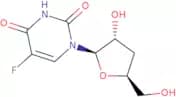
CAS:3’-Deoxy-5-fluorouridine is a synthetic compound that is used as an anticancer drug. It has been shown to induce apoptosis in cancer cells through the modulation of polymerase, synthetase and other enzymes involved in DNA synthesis. 3’-Deoxy-5-fluorouridine also inhibits the activity of viral thymidylate synthase, which prevents the conversion of deoxyuridine triphosphate (dUTP) to thymidylate monophosphate (dTMP), preventing DNA replication and cell division. This chemical can be synthesized by reacting uracil with trifluoroacetic acid followed by saponification.
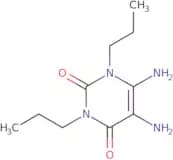
Purezza:Min. 95%5,6-Diamino-1,3-dipropyluracil
CAS:5,6-Diamino-1,3-dipropyluracil (DAU) is a synthetic drug that acts as an adenosine receptor antagonist. DAU binds to the adenosine receptors in the brain and inhibits the binding of adenosine, which may result in an anti-congestive effect. DAU has been found to be a potent inhibitor of the A2A adenosine receptor at nanomolar concentrations. This inhibition may be due to its ability to form covalent bonds with the receptor or its affinity for or blocking of agonist binding sites on the receptor. It also has been shown to have affinity for dopamine receptors, although it is not yet known if this activity contributes to its anti-congestive effects.Formula:C10H18N4O2Purezza:Area-% Min. 95 Area-%Colore e forma:PowderPeso molecolare:226.28 g/mol2,6-Diaminopurine hemisulfate
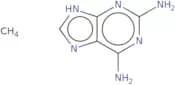
CAS:2,6-Diaminopurine hemisulfate salt is a fine chemical that can be used as a building block for research chemicals, reagents, and specialty chemicals. It has been shown to be useful in the synthesis of various types of complex compounds. 2,6-Diaminopurine hemisulfate salt is also versatile in the sense that it can be used as an intermediate in reactions or as a scaffold for chemical synthesis. This product has CAS number 69369-16-0.Formula:C5H6N6•(H2O4S)0Purezza:Min. 95%Colore e forma:PowderPeso molecolare:398.36 g/mol



![4-[2'-(7''-Deazaguanine)ethyl]benzoic acid N-hydroxysuccinimide ester](/_next/image/?url=https%3A%2Fstatic.cymitquimica.com%2Fproducts%2F3D%2Fthumb-webp%2FFD20837.webp&w=3840&q=75)