Nucleotidi
I nucleotidi sono composti organici che fungono da mattoni per la costruzione degli acidi nucleici, essenziali per la formazione del DNA e dell'RNA. Ogni nucleotide è composto da una base azotata, una molecola di zucchero e uno o più gruppi fosfato. Questi nucleotidi si uniscono per formare lunghe catene, creando il materiale genetico che porta e trasmette informazioni genetiche in tutti gli organismi viventi. In questa sezione, troverai una vasta gamma di nucleotidi cruciali per la ricerca in genetica, biologia molecolare e biochimica. Sono fondamentali per studiare i processi genetici, sintetizzare acidi nucleici e sviluppare strumenti diagnostici e terapeutici. Da CymitQuimica, offriamo nucleotidi di alta qualità per supportare la tua ricerca scientifica e applicazioni, garantendo precisione e affidabilità nei tuoi esperimenti.
Sottocategorie di "Nucleotidi"
Trovati 2634 prodotti di "Nucleotidi"
Ordinare per
Purezza (%)
0
100
|
0
|
50
|
90
|
95
|
100
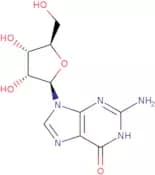
Guanosine hydrate
CAS:<p>Blocks glutamatergic activity; neuroprotective</p>Formula:C10H13N5O5·xH2OPurezza:Min. 98 Area-%Colore e forma:PowderPeso molecolare:283.24 g/molAdenosine 5'-monophosphate monohydrate
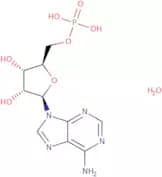
CAS:Adenosine 5'-monophosphate monohydrate (AMP) is a nucleotide that is released by cells in response to various stimuli. It is involved in the regulation of metabolic rate, cell death, and inflammatory responses. AMP may also act as a mediator of opioid-induced analgesia. AMP has been shown to inhibit the production of pro-inflammatory cytokines in activated macrophages and to reduce nociception at high doses. This drug also has an effect on blood pressure and may be used for the treatment of hypertension.Formula:C10H14N5O7P•H2OPurezza:Min. 98 Area-%Colore e forma:White PowderPeso molecolare:365.24 g/molAllopurinol riboside
CAS:<p>Allopurinol riboside is a hydroxyl analog of allopurinol. Allopurinol riboside has minimal toxicity in tissue culture and exhibits no cytotoxicity in human serum. It is a potent inhibitor of microbial infection, including infections caused by Hepatitis C virus (HCV), Leishmania amazonensis, and Mycobacterium tuberculosis. Allopurinol riboside binds to adenine nucleotide and inhibits the synthesis of purines, which are necessary for DNA replication. This binding also inhibits the production of ATP, leading to cell death. In addition, allopurinol riboside inhibits the growth of human macrophages in vitro by inhibiting protein synthesis. Allopurinol riboside may be useful for treating HCV-induced liver disease or leishmaniasis.</p>Formula:C10H12N4O5Purezza:Min. 97 Area-%Colore e forma:White PowderPeso molecolare:268.23 g/mol8-Aza-7-deaza-2'-deoxyadenosine
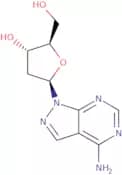
CAS:<p>8-Aza-7-deaza-2'-deoxyadenosine is a single-stranded DNA analogue that is used as a conjugate to deliver drugs to cells. It has been shown to be effective in the treatment of HIV by suppressing viral replication and the production of infectious virions. The drug is photolabile, which means it can be activated with light and then delivered to cells. 8-Aza-7-deaza-2'-deoxyadenosine has also been shown to inhibit the growth of human immunodeficiency virus (HIV) in vitro, but does not inhibit the growth of other viruses such as herpes simplex virus type 1 or adenovirus.</p>Formula:C10H13N5O3Purezza:Min. 95%Colore e forma:PowderPeso molecolare:251.24 g/mol2,2'-Anhydrothymidine
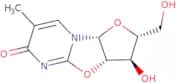
CAS:<p>2,2'-Anhydrothymidine is an anhydro version of thymidine. As 2,2'-Anhydrothymidine is a modified version of thymidine it can help researchers understand what happens when DNA is changed or damaged. Other possible uses as in research related to antiviral drug creation.</p>Formula:C10H12N2O5Purezza:Min. 95%Colore e forma:White Off-White PowderPeso molecolare:240.21 g/mola-Adenosine
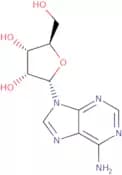
CAS:<p>a-Adenosine is a nucleoside that has been shown to have anti-cancer properties. It inhibits the proliferation of squamous carcinoma cells by irreversibly inhibiting adenosine deaminase, which converts adenosine to inosine, as well as other enzymes such as DNA polymerase and ribonucleotide reductase. The reaction mechanism for this inhibition is not yet fully understood, but it may be related to the inhibition of camp levels or receptor activity. a-Adenosine has also been shown to have anti-microbial properties against bacteria, fungi and yeast. It inhibits the growth of these microorganisms by binding to their cell walls and preventing protein synthesis. This drug is rapidly hydrolyzed in vivo and has an antimicrobial effect at physiological concentrations.<br>A more potent analog of a-adenosine (a-adenosinium) has been developed that can inhibit epidermal growth factor (EGF).</p>Formula:C10H13N5O4Purezza:Min. 95 Area-%Colore e forma:PowderPeso molecolare:267.24 g/mol2'-O-Allyluridine
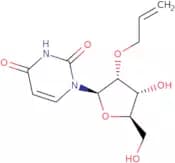
CAS:2'-O-Allyluridine is a nucleoside analogue that contains a 2'-hydroxyl group and an allyl group. It is synthesized from the nucleoside uridine by the process of allylation. The regiospecificity of the allylation reaction has been analysed and it has been found that the amino function on the uridine reacts with an allylic hydrogen bond to form 2'-O-allyluridine. The synthesis of 2'-O-allyluridine was successful in laboratory conditions, but not under physiological conditions. Research into this compound is still ongoing as it may have potential applications in the treatment of various diseases, such as cancer.Formula:C12H16N2O6Purezza:Min. 95%Colore e forma:White PowderPeso molecolare:284.27 g/mol2,2'-Anhydro-L-uridine
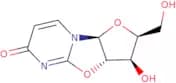
CAS:<p>2,2'-Anhydro-L-uridine is a nucleoside used in for research purposes. It is of particular interest due to it being an L-isomer which is different from the D-form sugars used by the human body. It is useful to study these kinds of molecules for their use in medicine, especially as antivirals</p>Formula:C9H10N2O5Purezza:Min. 95%Colore e forma:PowderPeso molecolare:226.19 g/mol2'-Deoxyguanosine monohydrate
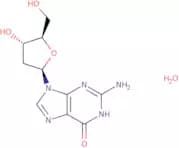
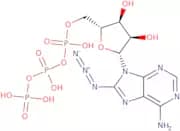
CAS:<p>2'-Deoxyguanosine monohydrate is a nucleoside that has been shown to inhibit the synthesis of DNA in human cells. It has also been shown to have a role in the regulation of energy metabolism and mitochondrial functions. 2'-Deoxyguanosine monohydrate binds to the enzyme polymerase chain reaction, which prevents the reverse transcription process from occurring. This nucleoside is involved in the biological studies of cytokine production, such as IL-2 receptor binding and calcium pantothenate-dependent activation of nuclear DNA replication.</p>Formula:C10H13N5O4·H2OPurezza:Min. 98 Area-%Colore e forma:White PowderPeso molecolare:285.26 g/mol8-azido-ATP sodium salt - 10mM aqueous solution
CAS:<p>8-Azidoadenosine 3',5'-cyclic monophosphosphate is used for nucleotide labelling via a click reaction involving the azide moiety and a terminal alkyne conjugated to a label. The reaction generates a stable nucleotide labelled adduct containing a triazole link.</p>Formula:C10H12N8O13P3·Na3Purezza:Min. 95 Area-%Colore e forma:PowderPeso molecolare:614.14 g/mol3'-Amino-2',3'-dideoxyadenosine
CAS:<p>3'-Amino-2',3'-dideoxyadenosine's lack of a 3'-hydroxyl group makes it a chain terminator for DNA polymerase, a key application in Sanger sequencing. Additionally, the 3'-amino group serves as a functional handle for modifying the 3' end of oligonucleotides with various labels or conjugates, expanding their utility in research and diagnostics.</p>Formula:C10H14N6O2Purezza:Min. 98.0 Area-%Colore e forma:White PowderPeso molecolare:250.26 g/mol3'-O-tert-Butyldimethylsilyl-5'-O-DMT-N2-isobutyrylguanosine
CAS:3'-O-tert-Butyldimethylsilyl-5'-O-DMT-N2-isobutyrylguanosine is a deoxyribonucleoside that is chemically modified to be resistant to nucleases. It is used as an antiviral agent and activates the immune system by inducing cytokines, chemokines, and interferons. 3'-O-tert-Butyldimethylsilyl-5'-O-DMT-N2-isobutyrylguanosine has been shown to have antidepressant effects in mice and rats. This drug also has been shown to inhibit the production of HIV viral particles in vitro.Formula:C41H51N5O8SiPurezza:Min. 95%Colore e forma:PowderPeso molecolare:769.96 g/mol2'-Deoxy-8-oxoguanosine
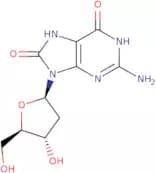
CAS:<p>2'-Deoxy-8-oxoguanosine (8-OHdG) is a product of oxidative DNA damage. The presence of 8-OHdG in urine has been used to detect and measure the degree of oxidative DNA damage in humans and animals, which may be linked to cancer and aging. When 8-OHdG is excreted into urine, it can react with other molecules such as protein or inorganic phosphorus, causing more oxidative DNA damage. 2'-Deoxy-8-oxoguanosine has also been shown to cause cell toxicity by damaging the cell's squamous epithelium, leading to cancer.For the 15N5 labelled version please check ND09970.</p>Formula:C10H13N5O5Purezza:Min. 95 Area-%Colore e forma:White PowderPeso molecolare:283.25 g/mol1-(2’-Deoxy-2’-fluoro-arabinofuranosyl)-5-hydroxymethyluracil
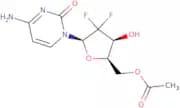
CAS:<p>1-(2’-Deoxy-2’-fluoro-arabinofuranosyl)-5-hydroxymethyluracil (also abbreviated as FMAU-OH) is a modified nucleoside analog. It consists of a fluorinated sugar moiety (2’-deoxy-2’-fluoro-arabinofuranose) attached to a uracil base with a hydroxymethyl (-CH₂OH) group at the 5-position. The 2’-fluoro substitution and arabinose sugar configuration can enhance its stability and affect its incorporation into DNA or RNA. It has the potential to be used as an inhibitor of viral polymerases and can be used in research.</p>Formula:C10H13FN2O6Purezza:Min. 95%Colore e forma:PowderPeso molecolare:276.22 g/mol5'-O-Acetyl-2'-deoxy-2',2'-difluorocytidine
<p>5'-O-Acetyl-2'-deoxy-2',2'-difluorocytidine is a novel nucleoside that can be used as an antiviral and anticancer agent. It has shown to be more potent than other nucleosides in inhibiting the synthesis of viral DNA and RNA, which makes it a potential candidate for treating HIV infection and cancer. This drug can also act as an activator by stimulating the production of deoxyribonucleotides and ribonucleotides. 5'-O-Acetyl-2'-deoxy-2',2'-difluorocytidine has been shown to have high purity and quality, making it a good candidate for use in various fields of research.</p>Formula:C11H13F2N3O5Purezza:Min. 98 Area-%Colore e forma:PowderPeso molecolare:305.23 g/molIsoguanosine hydrate
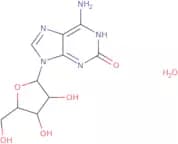
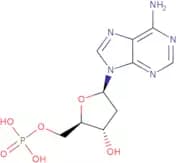
CAS:<p>An isomer of guanosine, used as a synthesis intermediate.</p>Formula:C10H13N5O5·xH2OPurezza:Min. 95%Colore e forma:White PowderPeso molecolare:283.24 g/mol2'-Deoxyadenosine-5'-monophosphate free acid
CAS:2'-Deoxyadenosine-5'-monophosphate free acid (2DAMP) is a nucleoside analogue that can be used as a fluorescent probe for detecting water vapor. 2DAMP has been shown to have cytotoxic activity against solid tumours in vitro, and may act by hydrogen bonding interactions with the active site of the enzyme form. 2DAMP is also an important cofactor in the polymerase chain reaction, and can inhibit cellular proliferation by inhibiting nuclear DNA synthesis. This drug has been used as an active antiretroviral therapy, where it inhibits HIV-1 reverse transcriptase. 2DAMP's mechanism of action involves the inhibition of p-nitrophenyl phosphate reductase (PNPPR), which is responsible for converting p-nitrophenyl phosphate into p-nitrophenol.Formula:C10H14N5O6PPurezza:Min. 95%Colore e forma:White PowderPeso molecolare:331.23 g/molN6-Isopentenyladenosine-5'-monophosphate disodium
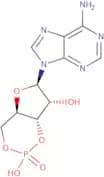
CAS:<p>N6-Isopentenyladenosine-5'-monophosphate sodium salt is an adenosine conjugate acid. It is a monomer of polyribonucleotide chain, which is necessary for the formation of ribonucleic acid (RNA) and deoxyribonucleic acid (DNA). N6-Isopentenyladenosine-5'-monophosphate sodium salt is a conjugate base that has the ability to bind to DNA. This binding prevents the formation of a complex with RNA polymerase, thereby inhibiting transcription and replication.</p>Formula:C15H22N5O7P•Na2Purezza:Min. 95 Area-%Colore e forma:PowderPeso molecolare:461.32 g/molAdenosine 3',5'-cyclic monophosphate
CAS:<p>Second messenger in intracellular signal transduction</p>Formula:C10H12N5O6PPurezza:(%) Min. 95%Colore e forma:White PowderPeso molecolare:329.21 g/molClevudine
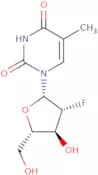
CAS:<p>Clevudine is a synthetic pyrimidine analogue effective against the hepatitis B virus (HBV). Once inside the cell, it is converted into its active forms, clevudine monophosphate and clevudine triphosphate. The triphosphate form competes with thymidine to be incorporated into viral DNA, leading to DNA chain termination and inhibition of the HBV DNA polymerase (reverse transcriptase). Due to its long half-life, clevudine significantly reduces covalently closed circular DNA (cccDNA), making relapse less likely after treatment ends.</p>Formula:C10H13FN2O5Purezza:Min. 95%Colore e forma:White PowderPeso molecolare:260.22 g/mol