Nucleosidi
Trovati 3569 prodotti di "Nucleosidi"
Cyclopentenyl cytosine 5'-triphosphate sodium salt
Cyclopentenyl cytosine 5'-triphosphate sodium salt is a synthetic, activator diphosphate. It is used as a phosphoramidite in the synthesis of DNA and RNA. Cyclopentenyl cytosine 5'-triphosphate sodium salt has been shown to have anticancer and antiviral properties.Purezza:Min. 95%2'-C-Methylguanosine 5'-diphosphate triethylammonium salt
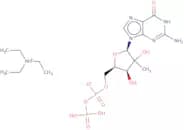
2'-C-Methylguanosine 5'-diphosphate triethylammonium salt is a synthetic nucleotide analog for use in researchFormula:C11H16N5O11P2·C18H45N3Purezza:Min. 95%Colore e forma:PowderPeso molecolare:759.79 g/molN4-Acetyl-2'-O-tert-butyldimethylsilyl-5'-O-DMT-cytidine 3'-CE phosphoramidite
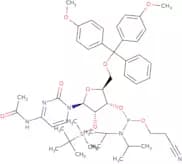
CAS:N4-Acetyl-2'-O-tert-butyldimethylsilyl-5'-O-DMT-cytidine 3'-CE phosphoramidite is a novel nucleoside analogue with antiviral and anticancer potential. It is a modified nucleoside that contains an acetyl group at the 4' position. The 3'-OH group has been replaced by a tertiary butyldimethylsilyl group, which renders the compound resistant to deamination by nucleases. N4-Acetyl-2'-O-tert-butyldimethylsilyl-5'-O-DMT-cytidine 3'-CE phosphoramidite also shows high purity and high quality.Formula:C47H64N5O9PSiPurezza:Min. 98 Area-%Colore e forma:White PowderPeso molecolare:902.11 g/molE-5-(2-Carbomethoxyvinyl)-2'-deoxyuridine
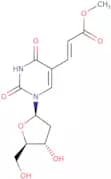
CAS:E-5-(2-Carbomethoxyvinyl)-2'-deoxyuridine is a nucleoside that is a modified form of uridine. It is a nucleotide analog that inhibits the synthesis of DNA and RNA and can be used to treat cancer. E-5-(2-Carbomethoxyvinyl)-2'-deoxyuridine is an activator that activates the phosphoramidites in the synthesis of DNA and RNA. This drug can also be used as antiviral therapy for herpes simplex virus type 1, influenza virus, and HIV. E-5-(2-Carbomethoxyvinyl)-2'-deoxyuridine has been shown to have anti-inflammatory properties by inhibiting prostaglandin synthesis.Formula:C13H16N2O7Purezza:Min. 95%Colore e forma:White to off-white solid.Peso molecolare:312.28 g/mol1-(3',5'-Di-O-benzoyl-2'-deoxy-2'-fluoro-β-D-arabinofuranosyl)thymine
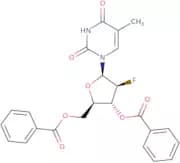
CAS:1-(3',5'-Di-O-benzoyl-2'-deoxy-2'-fluoro-b-D-arabinofuranosyl)thymine is a chemically modified nucleoside analog. This compound contains a thymine base, a 2'-fluoro-β-D-arabinofuranose sugar, which alters biological stability and function and benzoyl protecting groups at the 3' and 5' positions, commonly used in nucleoside synthesis to control selective modifications.Formula:C24H21FN2O7Purezza:Min. 95%Colore e forma:White To Off-White SolidPeso molecolare:468.43 g/mol2’-Deoxy-8-methylthioguanosine
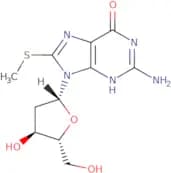
CAS:2’-Deoxy-8-methylthioguanosine is a synthetic nucleoside, which is an activator of DNA polymerase. It has shown anticancer and antiviral properties in vitro. 2’-Deoxy-8-methylthioguanosine is a modified nucleotide with high quality and novel structures for use as a potential anticancer and antiviral drug. This compound has not been tested in vivo, but its mechanism of action suggests that it may be safe for human use.
Purezza:Min. 95%2’,3’-Bis-O-tert-butyldimethylsilyl-5’-deoxy-4’,5’-Didehydrouridine
CAS:2’,3’-Bis-O-tert-butyldimethylsilyl-5’-deoxy-4’,5’-Didehydrouridine is a phosphoramidite that is used in the synthesis of DNA, RNA and nucleotide analogues. It has antiviral and antitumor properties and can be used for the treatment of leukemia. 2’,3’-Bis-O-tert-butyldimethylsilyl-5’-deoxyuridine is an activator for ribonucleotides and deoxyribonucleotides. It also has anticancer properties due to its ability to inhibit DNA replication, which may lead to apoptosis or cell death.Purezza:Min. 95%3'-Azido-3'-deoxy-5-fluoro-b-L-cytidine
CAS:3'-Azido-3'-deoxy-5-fluoro-b-L-cytidine is an antiviral drug. It is a modified nucleoside with phosphoramidite and azido groups. This product can be used as an activator for DNA synthesis, in anticancer drug development, as well as in the treatment of HIV. 3'-Azido-3'-deoxy-5-fluoro-b-L-cytidine has been shown to inhibit the growth of human tumor cells by inhibiting protein synthesis and enhancing the production of reactive oxygen species (ROS). It also inhibits the activity of ribonucleotide reductase, which is a critical enzyme for DNA synthesis.Purezza:Min. 95%Adenosine 5'-O-(3-thiotriphosphate), BODIPY FL thioester sodium salt - 5mM buffered aqueous solution
Adenosine 5'-O-(3-thiotriphosphate), BODIPY FL thioester sodium salt - 5mM buffered aqueous solution is a novel nucleoside that is synthesized from the corresponding phosphoramidites. This compound is an activator of DNA synthesis in mammalian cells and a potent inhibitor of viral replication. It has antiviral activity against HIV, herpes, and influenza viruses. The molecule can be modified to include different substituents such as fluoro, bromo, or chloro groups and has been shown to have anticancer activity.Formula:C24H27BF2N8Na3O13P3SPurezza:Min. 95%Peso molecolare:878.28 g/molAcetoacetyl coenzyme A lithium salt
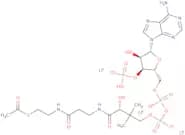
CAS:Acetoacetyl coenzyme A lithium salt is a novel phosphoramidite building block. It's a modified nucleoside that can be used in the synthesis of oligonucleotides and DNA. Acetoacetyl coenzyme A lithium salt has antiviral, anticancer, and antifungal activities.Formula:C25H36N7O18P3SLi4·5H2OPurezza:Min. 96 Area-%Colore e forma:PowderPeso molecolare:965.42 g/mol5-Fluorocytosine
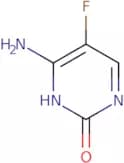
CAS:Flucytosine is an antifungal agent that inhibits the synthesis of DNA by preventing the conversion of deoxyuridine monophosphate to uracil monophosphate. It is used as an antiretroviral therapy in combination with other drugs, such as zidovudine and dideoxyinosine, to treat HIV infections. Flucytosine has been shown to have a strong antitumor response in a model system involving mice with sarcoma 180. This drug can cause serious side effects, including drug interactions and resistance mutations in microorganisms. These side effects are often observed in patients undergoing cancer chemotherapy or immunosuppressive therapy.Formula:C4H4FN3OPurezza:Min. 95%Colore e forma:White PowderPeso molecolare:129.09 g/molInosine 5'-diphosphate disodium salt
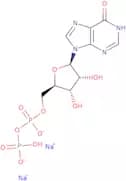
CAS:Inosine-5'-diphosphate disodium salt (IDPS) is a nitro compound that is used in the synthesis of antibacterial drugs. It is also used in the production of polymers and as a precursor to other organic compounds. IDPS has been shown to have antibacterial activity against halogeno bacteria, such as buprestidae, and many Gram-positive bacteria, including encapsulated strains. IDPS has been shown to be effective against both damaged cells and healthy cells in culture. The mechanism of action may involve inhibition of protein synthesis by blocking the ribosomes or by interfering with DNA replication. This drug also inhibits growth rate of japonica rice and heterocycles.Formula:C10H12N4Na2O11P2Purezza:Min. 90.0 Area-%Colore e forma:White PowderPeso molecolare:472.15 g/mol1-Methyl-2'-O-methylinosine
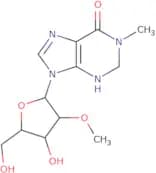
CAS:1-Methyl-2'-O-methylinosine is a nucleoside that is naturally found in RNA. It is the methylated form of inosine, which is a nonessential amino acid and purine nucleotide. 1-Methyl-2'-O-methylinosine's chemical name is β--D--ribofuranosyl-(1'→2')--N--(6-fluoro-3-indoxyl)glycinamide monohydrochloride. This nucleoside has been researched for its potential use as an indexing tool for phylogenetic research of DNA and RNA. 1-Methyl-2'-O-methylinosine has also been shown to be structurally similar to other nucleic acids and has been classified as a nucleoside.Formula:C12H16N4O5Purezza:Min. 95%Peso molecolare:296.28 g/molAdenosine 5′-phosphosulfate triethylammonium salt
Adenosine 5′-phosphosulfate triethylammonium salt serves as a donor of sulfate groups in biochemical processes, such as in the synthesis of sulfate esters. The triethylammonium salt form improves the solubility and stability of the compound, making it useful in laboratory applications involving enzymatic assays and the synthesis of sulfated biomolecules.
Formula:C10H14N5O10PS·xC6H15NPurezza:Min. 98.0 Area-%Colore e forma:PowderPeso molecolare:427.29 g/mol8-(4-Chlorophenylthio)-2'-O-methyladenosine 3',5'-cyclic monophosphate sodium salt
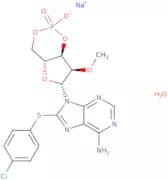
CAS:8-(4-Chlorophenylthio)-2'-O-methyladenosine 3',5'-cyclic monophosphate sodium salt (8-CPT-cAMP) is a cyclic nucleotide that activates adenyl cyclase, which increases intracellular levels of the second messenger cAMP. It also inhibits P2Y receptors and other ion channels. 8-CPT-cAMP has been shown to be effective in activating cells expressing the enzyme camp levels, such as those found in heart muscle cells. This drug is used clinically to lower blood pressure, as it has been shown to activate amp-activated protein kinase and calcium chelator. 8-CPT-cAMP may have clinical applications for the treatment of cancer due to its ability to induce cell cycle arrest and apoptosis.Formula:C17H16ClN5O6PS·NaPurezza:Min. 95%Colore e forma:PowderPeso molecolare:507.82 g/mol5'-Azido-5'-deoxythymidine
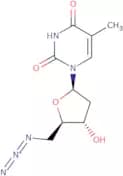
CAS:5'-Azido-5'-deoxythymidine is a synthetic analogue of thymidine. The compound has been synthesised and fluorescently labelled with ferrocene. 5'-Azido-5'-deoxythymidine is not cytotoxic to cancer cells, but it is shown to be an effective inhibitor of DNA synthesis by binding to the enzyme DNA polymerase. This causes a decrease in the rate of DNA synthesis and thus inhibits cancer cell growth.Formula:C10H13N5O4Purezza:Min. 95%Colore e forma:White PowderPeso molecolare:267.24 g/mol3'-Azido-N4-benzoyl-2',3'-dideoxycytidine
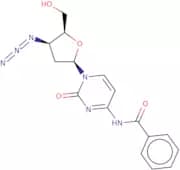
CAS:3'-Azido-N4-benzoyl-2',3'-dideoxycytidine is a novel nucleoside analog with antiviral and anticancer activities. It is used for the treatment of HIV, hepatitis B and C, herpes, and influenza. 3'-Azido-N4-benzoyl-2',3'-dideoxycytidine has been shown to inhibit the proliferation of cells in culture and to induce apoptosis in various cancer cell lines.
The synthesis of 3'-azido-N4-benzoyl-2',3'-dideoxycytidine starts with the condensation of 4-(hydroxymethyl)phenylacetic acid (1) with 2,6-dichloroisonicotinic acid chloride (2) in the presence of triethylamine to give 4-(hydroxymethyl)phenylacetic acid chloride (3). The N4 benzoylFormula:C16H16N6O4Purezza:Min. 95%Colore e forma:Off-White PowderPeso molecolare:356.34 g/molN3-Methyl-2’-O-(2-methoxyethyl)uridine
CAS:N3-Methyl-2’-O-(2-methoxyethyl)uridine is a modified nucleoside that is synthesized from deoxyribonucleosides and ribonucleosides. It has antiviral, anticancer, and antifungal properties. N3-Methyl-2’-O-(2-methoxyethyl)uridine has been shown to be an effective inhibitor of HIV replication in vitro and in vivo. This drug also inhibits the growth of human cancer cells in vitro and has been shown to be active against breast cancer cells. N3-Methyl-2’-O-(2-methoxyethyl)uridine is phosphorylated by cellular enzymes to form its active form, which binds to the viral reverse transcriptase enzyme and prevents DNA synthesis.Formula:C13H20N2O7Purezza:Min. 95%Peso molecolare:316.31 g/mol5-Fluorocytidine
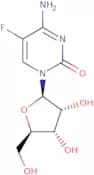
CAS:5-Fluorocytidine (5FC) is an antiviral drug that inhibits the synthesis of DNA. 5FC is a prodrug that is converted to cytosine in vivo, and then incorporated into viral DNA by polymerase chain reactions. The incorporation of 5FC into viral DNA prevents replication and transcription, which can lead to the death of cells infected with HIV. In addition, 5FC has been shown to be effective in treating chronic viral hepatitis and bowel diseases such as Crohn's disease. It also has potential use as a drug target for cancer treatments. 5FC has been shown to inhibit transcription activators in murine hepatoma cells and inhibit the growth of tumors in transfection experiments using human colon cancer cells. This antiviral agent has also been shown to have antimicrobial activity against Gram-positive bacteria, including Clostridium difficile, Staphylococcus aureus, Streptococcus pyogenes and Enterococcus faecFormula:C9H12FN3O5Purezza:Min. 99 Area-%Colore e forma:White PowderPeso molecolare:261.21 g/mol2'-O-tert-Butyldimethylsilyl-5'-O-DMT-N2-isobutyrylguanosine 3'-CE phosphoramidite
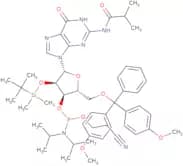
CAS:The 2'-O-tert-Butyldimethylsilyl-5'-O-DMT-N2-isobutyrylguanosine 3'-CE phosphoramidite is an oligomer with a modified nucleoside. The modification of the nucleoside has been shown to be more efficient than other modifications, such as fluorine or bromine substitutions. This product is used in the synthesis of DNA and RNA oligomers. The coupling efficiency is high and can be used for ligand binding studies.Formula:C50H68N7O9PSiPurezza:Min. 98 Area-%Colore e forma:White PowderPeso molecolare:970.18 g/mol