CAS 1006376-60-8
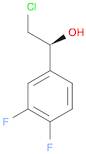
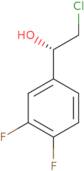
:(αS)-α-(Clorometil)-3,4-difluorobenzenometanol
Descrição:
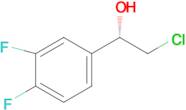
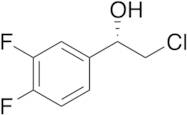
(αS)-α-(Clorometil)-3,4-difluorobenzenometanol é um composto químico caracterizado por suas características estruturais únicas, incluindo um grupo clorometilo e dois átomos de flúor ligados a um anel de benzeno. A presença do grupo hidroximetilo indica que é um álcool, que pode participar de ligações de hidrogênio, influenciando sua solubilidade e reatividade. A quiralidade do composto, denotada pela configuração (αS), sugere que ele existe como um enantiômero específico, que pode ter propriedades biológicas e químicas distintas em comparação com sua imagem especular. A porção difluorobenzeno contribui para as propriedades eletrônicas do composto, potencialmente aumentando sua reatividade em reações de substituição nucleofílica. Além disso, o grupo clorometilo pode servir como um local reativo para modificações químicas adicionais. No geral, este composto pode encontrar aplicações em produtos farmacêuticos ou agroquímicos, onde a estereoespecificidade e os grupos funcionais específicos são cruciais para a atividade. Sua segurança e manuseio exigiriam consideração dos substituintes clorometilo e flúor, que podem representar riscos à saúde e ao meio ambiente.
Fórmula:C8H7ClF2O
InChI:InChI=1S/C8H7ClF2O/c9-4-8(12)5-1-2-6(10)7(11)3-5/h1-3,8,12H,4H2/t8-/m1/s1
Chave InChI:InChIKey=RYOLLNVCYSUXCP-MRVPVSSYSA-N
SMILES:[C@H](CCl)(O)C1=CC(F)=C(F)C=C1
Sinónimos:- (1S)-2-Chloro-1-(3,4-difluorophenyl)ethan-1-ol
- (1S)-2-Chloro-1-(3,4-difluorophenyl)ethanol
- (αS)-α-(Chloromethyl)-3,4-difluorobenzenemethanol
- Benzenemethanol, α-(chloromethyl)-3,4-difluoro-, (αS)-
- (S)-2-Chloro-1-(3,4-difluorophenyl)ethanol
Filtrar por
Percentagem de pureza
0
100
|
0
|
50
|
90
|
95
|
100
Foram encontrados 8 produtos.
- Preços em ordem crescente
- Preços em ordem decrescente
- Menor grau de pureza
- Maior grau de pureza
- Estimativa de entrega mais rápida
(S)-2-Chloro-1-(3,4-difluorophenyl)ethanol
CAS:(S)-2-Chloro-1-(3,4-difluorophenyl)ethanolFórmula:C8H7ClF2OPureza:99%Cor e Forma:LiquidPeso molecular:192.59038(S)-2-Chloro-1-(3,4-difluorophenyl)ethanol
CAS:Fórmula:C8H7ClF2OPureza:97%Cor e Forma:LiquidPeso molecular:192.5904(S)-2-Chloro-1-(3,4-difluorophenyl)ethanol
CAS:(S)-2-Chloro-1-(3,4-difluorophenyl)ethanolFórmula:C8H7ClF2OPureza:98%Peso molecular:192.59(S)-2-Chloro-1-(3,4-difluorophenyl)ethanol
CAS:Produto ControladoApplications (S)-2-Chloro-1-(3,4-difluorophenyl)ethanol is a building block used in organic synthesis including bein an intermediate in the synthesis of Ticagrelor (T437700), the first reversible oral P2Y12 receptor antagonist, provides faster, greater, and more consistent ADP-receptor inhibition than Clopidogrel.
References Matetzky, S., et al.: Circulation, 109, 3171 (2004), Bassand, J., et al.: Eur. Heart J., 28, 1598 (2007), Jakubowski, J., et al.: Cardiovasc. Drug Rev., 25, 357 (2007),Fórmula:C8H7ClF2OCor e Forma:NeatPeso molecular:192.59(S)-2-Chloro-1-(3,4-difluorophenyl)ethanol
CAS:Ticagrelor is an antiplatelet drug that prevents the formation of blood clots. It belongs to the class of ADP-receptor antagonists and is a prodrug that is metabolized in vivo to its active form, (S)-2-chloro-1-(3,4-difluorophenyl)ethanol. Ticagrelor inhibits platelet aggregation by binding to the P2Y12 receptor on the surface of activated platelets. Ticagrelor has been shown to be effective in reducing thrombotic events in patients with acute coronary syndrome and stable atherosclerotic disease. It also inhibits cell growth and induces apoptosis in E. coli cells. Ticagrelor binds to choline residues on the cell membrane and reacts with chlorine ions present in water, forming a catalytic system that causes a reaction at the cell membrane level. This reaction leads to inhibition of protein synthesis and death of E. coli cells via chlorideFórmula:C8H7ClF2OPureza:Min. 95%Peso molecular:192.59 g/mol