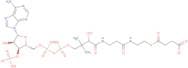
CAS 108347-97-3
:succinil coenzima A sódio
Descrição:
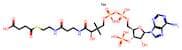
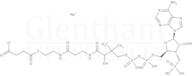
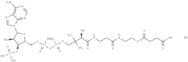
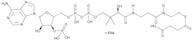
succinil coenzima A sódio, com o número CAS 108347-97-3, é um composto bioquímico que desempenha um papel crucial nas vias metabólicas, particularmente no ciclo do ácido cítrico (ciclo de Krebs) e na síntese de ácidos graxos. É um derivado da coenzima A, que é essencial para a ativação e transporte de grupos acilo em várias reações bioquímicas. A forma de sal de sódio melhora sua solubilidade em soluções aquosas, tornando-o mais acessível para processos biológicos. Succinil CoA está envolvido na síntese de heme e é um intermediário chave no metabolismo de certos aminoácidos. Sua estrutura apresenta um grupo succinil ligado à coenzima A, que contém um componente de ácido pantotênico, um grupo fosfato e um componente de adenosina difosfato (ADP). Este composto é tipicamente utilizado em ambientes de pesquisa e clínicos para estudar funções metabólicas e atividades enzimáticas. Devido ao seu papel no metabolismo energético, também é de interesse no contexto de vários distúrbios metabólicos e aplicações terapêuticas potenciais.
Fórmula:C25H39N7NaO19P3S
InChI:InChI=1/C25H40N7O19P3S.2Na/c1-25(2,20(38)23(39)28-6-5-14(33)27-7-8-55-16(36)4-3-15(34)35)10-48-54(45,46)51-53(43,44)47-9-13-19(50-52(40,41)42)18(37)24(49-13)32-12-31-17-21(26)29-11-30-22(17)32;;/h11-13,18-20,24,37-38H,3-10H2,1-2H3,(H,27,33)(H,28,39)(H,34,35)(H,43,44)(H,45,46)(H2,26,29,30)(H2,40,41,42);;/q;2*+1/p-2/t13-,18-,19-,20?,24-;;/m1../s1
Chave InChI:InChIKey=MZSOFLIDFHDGAA-YXKORUMSSA-N
SMILES:O[C@H]1[C@H](N2C=3C(N=C2)=C(N)N=CN3)O[C@H](COP(OP(OCC([C@H](C(NCCC(NCCSC(CCC(O)=O)=O)=O)=O)O)(C)C)(=O)O)(=O)O)[C@H]1OP(=O)(O)O.[Na]
Sinónimos:- Coenzyme A, S-(hydrogen butanedioate), sodium salt
- disodium 1-{(2R,3S,4R,5R)-5-(6-amino-9H-purin-9-yl)-4-hydroxy-3-[(hydroxyphosphinato)oxy]tetrahydrofuran-2-yl}-3,5,9-trihydroxy-8,8-dimethyl-10,14,19-trioxo-2,4,6-trioxa-18-thia-11,15-diaza-3,5-diphosphadocosan-22-oate 3,5-dioxide (non-preferred name)
- coenzyme A succinyl derivative, trisodium salt
- SUCCINYL COENZYME A SODIUM SALT
- succinyl coenzyme A sodium
- Succinyl coenzyme A sodium salt >=85%
- Succinyl CoA, Li-salt
Ordenar por
Pureza (%)
0
100
|
0
|
50
|
90
|
95
|
100
Foram encontrados 8 produtos.
Succinyl-Coenzyme A sodium salt
CAS:Succinyl-Coenzyme A sodium saltFórmula:C25H40N7NaO19P3SPureza:≥80%Peso molecular:890.6Succinyl coenzyme A sodium salt
CAS:Fórmula:C25H40N7O19P3SPureza:≥ 90.0%Cor e Forma:White to pale yellow powderPeso molecular:867.61Succinyl-Coenzyme A sodium salt
CAS:Succinyl-Coenzyme A sodium salt(Succinyl-CoA sodium salt) participates in the citric acid cycle, where it is converted to succinic acid.Succinyl-Coenzyme A (Fórmula:C25H40N7NaO19P3SPureza:88%Cor e Forma:White SolidPeso molecular:890.60Succinyl-Coenzyme A Na salt
CAS:Fórmula:C25H40N7O19P3S.NaPureza:>95%Cor e Forma:SolidPeso molecular:867.61Succinyl-Coenzyme A sodium salt (Standard)
CAS:Succinyl-Coenzyme A sodium salt (Standard) is a reference standard for research and analysis in studies involving Succinyl-Coenzyme A sodium salt. Succinyl-Coenzyme A sodium salt(Succinyl-CoA sodium salt) participates in the citric acid cycle, where it is converted to succinic acid.Succinyl-Coenzyme A (sodium salt) is involved in a variety of metabolic reactions in living organisms, and plays an important role in the body.Succinyl-Coenzyme A (sodium salt) is involved in heme synthesis. Succinyl-Coenzyme A (sodium salt) is involved in the synthesis of hemoglobin and is used in the study of metabolic, neurological, and hematological disorders caused by nutritional vitamin B12 deficiency, which results in a deficiency in Succinyl-Coenzyme A synthesis.Fórmula:C25H40N7NaO19P3SPeso molecular:890.60Succinyl Coenzyme A Sodium
CAS:Produto ControladoFórmula:C25H39N7NaO19P3SCor e Forma:NeatPeso molecular:889.589Succinyl coenzyme A sodium
CAS:Succinyl coenzyme A sodium (SCCA) is a membrane-permeable probe that can be used to measure the mitochondrial membrane potential. SCCA is transported into mitochondria and reduced by dehydrogenase, resulting in an increase in the concentration of its oxidized form, succinic semialdehyde. This increase in extracellular concentrations of succinic semialdehyde can be detected using high performance liquid chromatography with fluorescence detection. The use of this probe has been shown to be useful for measuring mitochondrial function in live cells and tissues, and for investigating genetic disorders that affect mitochondrial function.
Fórmula:C25H40N7O19P3S•NaxPureza:Min. 95%Peso molecular:889.59 g/mol