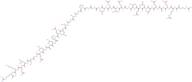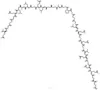
CAS 11097-48-6
:Peptídeo C humano
Descrição:
O péptido C, ou péptido de ligação, é um subproduto da síntese de insulina no pâncreas. É produzido quando a proinsulina é clivada em insulina e péptido C, que são liberados na corrente sanguínea em quantidades equimolares. O número CAS 11097-48-6 identifica especificamente o péptido C humano. Este péptido consiste em uma cadeia de aminoácidos e desempenha um papel crucial na regulação da secreção de insulina e no metabolismo da glicose. O péptido C é frequentemente utilizado como um biomarcador para avaliar a produção de insulina em indivíduos, particularmente no contexto do manejo do diabetes. Ao contrário da insulina, o péptido C tem uma meia-vida mais longa na circulação, tornando-se um indicador útil da secreção endógena de insulina. Geralmente é considerado não ativo em termos de efeitos metabólicos, mas pode ter alguns papéis fisiológicos, como promover a sobrevivência e regeneração celular. Os níveis de péptido C podem ser medidos por meio de exames de sangue, fornecendo informações valiosas sobre a função pancreática e as capacidades de produção de insulina do corpo.
Fórmula:C153H259N49O52
InChI:InChI=1S/C153H259N49O52/c1-71(2)55-94(193-134(237)91(40-48-119(222)223)189-148(251)122(78(15)16)200-135(238)86(33-41-105(156)205)179-112(212)67-175-147(250)121(77(13)14)199-136(239)88(35-43-107(158)207)188-139(242)97(58-74(7)8)194-142(245)100(61-120(224)225)197-133(236)90(39-47-118(220)221)182-124(227)80(18)177-129(232)89(38-46-117(218)219)186-130(233)84(29-23-51-167-152(162)163)183-126(229)82(155)27-22-50-166-151(160)161)128(231)172-63-110(210)169-62-109(209)170-68-115(215)201-53-25-31-103(201)145(248)174-64-111(211)176-79(17)123(226)171-65-113(213)180-101(69-203)144(247)196-99(60-76(11)12)141(244)190-92(36-44-108(159)208)149(252)202-54-26-32-104(202)146(249)198-95(56-72(3)4)137(240)178-81(19)125(228)192-96(57-73(5)6)138(241)185-85(37-45-116(216)217)127(230)173-66-114(214)181-102(70-204)143(246)195-98(59-75(9)10)140(243)187-87(34-42-106(157)206)132(235)184-83(28-20-21-49-154)131(234)191-93(150(253)254)30-24-52-168-153(164)165/h71-104,121-122,203-204H,20-70,154-155H2,1-19H3,(H2,156,205)(H2,157,206)(H2,158,207)(H2,159,208)(H,169,210)(H,170,209)(H,171,226)(H,172,231)(H,173,230)(H,174,248)(H,175,250)(H,176,211)(H,177,232)(H,178,240)(H,179,212)(H,180,213)(H,181,214)(H,182,227)(H,183,229)(H,184,235)(H,185,241)(H,186,233)(H,187,243)(H,188,242)(H,189,251)(H,190,244)(H,191,234)(H,192,228)(H,193,237)(H,194,245)(H,195,246)(H,196,247)(H,197,236)(H,198,249)(H,199,239)(H,200,238)(H,216,217)(H,218,219)(H,220,221)(H,222,223)(H,224,225)(H,253,254)(H4,160,161,166)(H4,162,163,167)(H4,164,165,168)/t79-,80-,81-,82-,83-,84-,85-,86-,87-,88-,89-,90-,91-,92-,93-,94-,95-,96-,97-,98-,99-,100-,101-,102-,103-,104-,121-,122-/m0/s1
Chave InChI:JEPNOJXFZHBCTB-ZCUALFGZSA-N
SMILES:C[C@@H](C(=O)NCC(=O)N[C@@H](CO)C(=O)N[C@@H](CC(C)C)C(=O)N[C@@H](CCC(=O)N)C(=O)N1CCC[C@H]1C(=O)N[C@@H](CC(C)C)C(=O)N[C@@H](C)C(=O)N[C@@H](CC(C)C)C(=O)N[C@@H](CCC(=O)O)C(=O)NCC(=O)N[C@@H](CO)C(=O)N[C@@H](CC(C)C)C(=O)N[C@@H](CCC(=O)N)C(=O)N[C@@H](CCCCN)C(=O)N[C@@H](CCCNC(=N)N)C(=O)O)NC(=O)CNC(=O)[C@@H]2CCCN2C(=O)CNC(=O)CNC(=O)CNC(=O)[C@H](CC(C)C)NC(=O)[C@H](CCC(=O)O)NC(=O)[C@H](C(C)C)NC(=O)[C@H](CCC(=O)N)NC(=O)CNC(=O)[C@H](C(C)C)NC(=O)[C@H](CCC(=O)N)NC(=O)[C@H](CC(C)C)NC(=O)[C@H](CC(=O)O)NC(=O)[C@H](CCC(=O)O)NC(=O)[C@H](C)NC(=O)[C@H](CCC(=O)O)NC(=O)[C@H](CCCNC(=N)N)NC(=O)[C@H](CCCNC(=N)N)N
Sinónimos:- Proinsulin C-Peptide (55-89) (human)
- H-Arg-Arg-Glu-Ala-Glu-Asp-Leu-Gln-Val-Gly-Gln-Val-Glu-Leu-Gly-Gly-Gly-Pro-Gly-Ala-Gly-Ser-Leu-Gln-Pro-Leu-Ala-Leu-Glu-Gly-Ser-Leu-Gln-Lys-Arg-OH
- H-Glu-Ala-Glu-Asp-Leu-Gln-Val-Gly-Gln-Val-Glu-Leu-Gly-Gly-Gly-Pro-Gly-Ala-Gly-Ser-Leu-Gln-Pro-Leu-Ala-Leu-Glu-Gly-Ser-Leu-Gln-OH
- C-Peptide (1-35) (Human)
- C-Peptide (human)
- Proinsulin connectingpeptide (human) (9CI)
- C-Peptide huManC-Peptide
- Proinsulin connecting peptide (Pan troglodytes)
- PROINSULIN C-PEPTIDE (55-89) HUMAN;INSULIN C CHAIN;PROINSULIN CONNECTING PEPTIDE; C-PEPTIDE HUMAN
- PROINSULIN C-PEPTIDE (31-65) (HUMAN)
- arg-arg-glu-ala-glu-asp-leu-gln-val-gly-gln-val-glu-leu-gly-gly-gly-pro-gly-ala-gly-ser-leu-gln-pro-leu-ala-leu-glu-gly-ser-leu-gln-lys-arg
- PROINSULIN C-PEPTIDE (55-89) HUMAN;C-PEPTIDE HUMAN
- PROINSULIN (31-65), HUMAN
- Proinsulin connecting peptide (human)
- Proinsulin connecting peptide
- Insulin C chain
- Ver mais sinónimos
Filtrar por
Percentagem de pureza
0
100
|
0
|
50
|
90
|
95
|
100
Foram encontrados 6 produtos.
- Preços em ordem crescente
- Preços em ordem decrescente
- Menor grau de pureza
- Maior grau de pureza
- Estimativa de entrega mais rápida
Proinsulin C-Peptide (55-89), Human
CAS:For cellular and molecular biology applicationsFórmula:C153H259N49O52Peso molecular:3616.98Proinsulin C-Peptide (55-89) (human)
CAS:Bachem ID: 4011662.
Fórmula:C153H259N49O52Pureza:94.1%Cor e Forma:White LyophilisatePeso molecular:3617.04Proinsulin C-Peptide (55-89), human
CAS:Proinsulin, insulin's precursor, has A and B chains linked by a 31 amino acid C-peptide. Enzymes cleave it, yielding insulin and C-peptide.Fórmula:C153H259N49O52Pureza:98%Cor e Forma:SolidPeso molecular:3616.9907Proinsulin C-Peptide (55-89) (human)
CAS:Proinsulin C-Peptide is a subunit of insulin. It is produced by proteolytic cleavage of proinsulin and has been used as a diagnostic agent for pancreatic beta cell function. Proinsulin C-Peptide encompasses the amino acids from 55 to 89 in the sequence of insulin. It can be used as a diagnostic agent for type 1 diabetes mellitus, which is characterized by an autoimmune destruction of beta cells, and other diseases such as multiple myeloma and non-Hodgkin's lymphoma that are associated with decreased levels of proinsulin C-Peptide.
Fórmula:C153H259N49O52Pureza:Min. 95%Peso molecular:3,616.99 g/molProinsulin C-peptide (55-89) trifluoroacetate
CAS:Please enquire for more information about Proinsulin C-peptide (55-89) trifluoroacetate including the price, delivery time and more detailed product information at the technical inquiry form on this pageFórmula:C153H259N49O52•(C2HF3O2)xPureza:Min. 95%