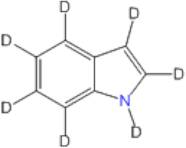
CAS 120-72-9
:índole
Descrição:
índole é um composto orgânico heterocíclico aromático caracterizado por uma estrutura bicíclica que consiste em um anel de benzeno de seis membros fundido a um anel de pirrol de cinco membros que contém nitrogênio. Sua fórmula molecular é C8H7N, e é conhecido por seu odor distinto e agradável que lembra o jasmim. índole é um sólido incolorido a amarelo pálido à temperatura ambiente, com um ponto de fusão que varia dependendo da pureza. É solúvel em solventes orgânicos como etanol e éter, mas tem solubilidade limitada em água. índole é um bloco de construção chave na síntese de vários fármacos, agroquímicos e produtos naturais, incluindo o aminoácido triptofano, que é um precursor da serotonina. Além disso, índole exibe atividades biológicas interessantes, incluindo propriedades antimicrobianas e anticancerígenas. Sua reatividade é influenciada pelo átomo de nitrogênio, permitindo que participe de várias reações químicas, como substituição eletrofílica e reações de condensação. No geral, índole é significativo tanto na química sintética quanto na natural, contribuindo para uma ampla gama de processos químicos e biológicos.
Fórmula:C8H7N
InChI:InChI=1S/C8H7N/c1-2-4-8-7(3-1)5-6-9-8/h1-6,9H
Chave InChI:InChIKey=SIKJAQJRHWYJAI-UHFFFAOYSA-N
SMILES:C1=2C(NC=C1)=CC=CC2
Sinónimos:- 1-Azaindene
- 1-Benzazole
- 1H-Indole
- 2,3-Benzopyrrole
- Benzo[b]pyrrole
- Indol
- Indole, (1-Benzazole)
- Ketole
- Nsc 1964
- Indole
Filtrar por
Percentagem de pureza
0
100
|
0
|
50
|
90
|
95
|
100
- Preços em ordem crescente
- Preços em ordem decrescente
- Menor grau de pureza
- Maior grau de pureza
- Estimativa de entrega mais rápida
Indole
CAS:Fórmula:C8H7NPureza:>99.0%(GC)Cor e Forma:White to Almost white powder to crystalPeso molecular:117.15Indole, 99%
CAS:Indole is used in the preparation of gramine, which is obtained by Mannich reaction dimethylamine and formaldehyde. It is used as a starting material for the preparation of oxindole and indole-3-carboxaldehyde. In Diels-Alder reaction, it acts as dienophile and reacts with 2-aminofuran to get strychFórmula:C8H7NPureza:99%Cor e Forma:Crystals or powder or crystalline powder or flakes, White to pale creamPeso molecular:117.15Indole
CAS:Acridine (10-azaanthracene) and indole (2,3-benzopyrrole)Fórmula:C8H7NCor e Forma:White Crystalline PowderPeso molecular:117.05785Indole
CAS:Fórmula:C8H7NPureza:(GC) ≥ 99.0%Cor e Forma:White to beige powder or crystalsPeso molecular:117.15Indole (Standard)
CAS:Indole (Standard) is a reference standard for research and analysis in studies involving Indole. Indole has a bicyclic structure, consisting of a six-membered benzene ring fused to a five-membered nitrogen-containing pyrrole ring. It can be produced by bacteria as a degradation product of the amino acid tryptophan. It occurs naturally in human feces and has an intense fecal smell. At very low concentrations, however, it has a flowery smell, and is a constituent of many flower scents (such as orange blossoms) and perfumes.Fórmula:C8H7NPeso molecular:117.1479Indole
CAS:Produto ControladoApplications Indole can be used in perfumes and in the synthesis of tryptophan. This compound is a contaminant of emerging concern (CECs).
Not a dangerous good if item is equal to or less than 1g/ml and there is less than 100g/ml in the packageFórmula:C8H7NCor e Forma:NeatPeso molecular:117.15Indole
CAS:Indole: aromatic compound with a fused benzene and pyrrole structure, byproduct of tryptophan, found in feces, smells flowery at low concentrations.Fórmula:C8H7NPureza:99.86%Cor e Forma:Transparent LiquidPeso molecular:117.1479Indole
CAS:Indole is a nitrogen-containing heterocyclic aromatic organic compound. Copper chloride in the presence of trifluoroacetic acid and indole gives rise to an indolenine derivative, which reacts with nitrogen atoms to form a copper nitride. This reaction is used as a model system for biological properties of indole. Indolenine has been shown to have bone cancer prevention and treatment effects in mice, and may also be beneficial in autoimmune diseases and metabolic disorders, due to its ability to inhibit toll-like receptor signaling pathways. The wild-type strain has shown resistance to antibiotics, which can be overcome by using mutant strains that are resistant to antibiotic treatments.Fórmula:C8H7NPureza:Min. 95 Area-%Cor e Forma:Off-White PowderPeso molecular:117.15 g/mol