![N-[(Phenylmethoxy)carbonyl]glycyl-L-leucine](/_next/image/?url=https%3A%2Fstatic.cymitquimica.com%2Fcas-image%2Fthumb-webp%2F406193-n-phenylmethoxy-carbonyl-glycyl-l-leucine.webp&w=3840&q=75)
CAS 1421-69-8
:N-[(Fenilmetoxi)carbonil]glicil-L-leucina
Descrição:
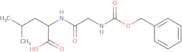
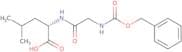
N-[(Fenilmetoxi)carbonil]glicil-L-leucina, com o número CAS 1421-69-8, é um composto sintético que pertence à classe dos peptídeos. Apresenta um resíduo de glicina ligado a um aminoácido L-leucina, com um grupo protetor de fenilmetoxicarbonila (PMOC). Esta estrutura confere características específicas, incluindo seu uso potencial na síntese de peptídeos e como um bloco de construção na química medicinal. O grupo PMOC melhora a estabilidade e solubilidade do composto, tornando-o adequado para várias aplicações bioquímicas. A presença do grupo fenila contribui para suas propriedades hidrofóbicas, o que pode influenciar sua interação com membranas biológicas e proteínas. Além disso, o composto pode exibir atividades biológicas específicas, dependendo de sua conformação e da presença de grupos funcionais. Sua síntese geralmente envolve técnicas padrão de acoplamento de peptídeos, e pode ser analisada usando métodos como cromatografia líquida de alta eficiência (HPLC) ou espectrometria de massas para confirmar pureza e identidade. No geral, N-[(Fenilmetoxi)carbonil]glicil-L-leucina serve como um intermediário importante na química de peptídeos e no desenvolvimento de medicamentos.
Fórmula:C16H22N2O5
InChI:InChI=1S/C16H22N2O5/c1-11(2)8-13(15(20)21)18-14(19)9-17-16(22)23-10-12-6-4-3-5-7-12/h3-7,11,13H,8-10H2,1-2H3,(H,17,22)(H,18,19)(H,20,21)/t13-/m0/s1
Chave InChI:InChIKey=MRRLFGAIRAUOCS-ZDUSSCGKSA-N
SMILES:C(OC(NCC(N[C@@H](CC(C)C)C(O)=O)=O)=O)C1=CC=CC=C1
Sinónimos:- <span class="text-smallcaps">L</span>-Leucine, N-[(phenylmethoxy)carbonyl]glycyl-
- <span class="text-smallcaps">L</span>-Leucine, N-[N-[(phenylmethoxy)carbonyl]glycyl]-
- Leucine, N-(N-carboxyglycyl)-, N-benzyl ester
- Leucine, N-(N-carboxyglycyl)-, N-benzyl ester, <span class="text-smallcaps">L</span>-
- N-(Benzyloxycarbonyl)glycyl-<span class="text-smallcaps">L</span>-leucine
- N-(Benzyloxycarbonyl)glycylleucine
- N-Benzyloxycarbonylglycyl-L-leucine
- N-Carbobenzoxyglycyl-<span class="text-smallcaps">L</span>-leucine
- N-[(Phenylmethoxy)carbonyl]glycyl-<span class="text-smallcaps">L</span>-leucine
- N-[(benzyloxy)carbonyl]glycyl-D-leucine
- N-[(benzyloxy)carbonyl]glycylleucine
- NSC 89638
- Z-Gly-Leu-OH
- Leucine, N-(N-carboxyglycyl)-, N-benzyl ester, L-
- L-Leucine, N-[(phenylmethoxy)carbonyl]glycyl-
- L-Leucine, N-[N-[(phenylmethoxy)carbonyl]glycyl]-
- Ver mais sinónimos
Ordenar por
Pureza (%)
0
100
|
0
|
50
|
90
|
95
|
100
2 produtos.
Z-Gly-Leu
CAS:Z-Gly-Leu is a monoclonal antibody that inhibits the enzyme protease. It binds to the active site of the enzyme and prevents it from cleaving peptides into smaller fragments. The antibody also binds to casein, a protein found in milk, and soybean trypsin inhibitor. This prevents these enzymes from degrading other proteins in the body. The antibody is reactive at phase transition temperatures and has been shown to be effective on wild-type mice.Fórmula:C16H22N2O5Pureza:Min. 95%Peso molecular:322.36 g/molZ-Gly-Leu-OH
CAS:Z-Gly-Leu-OH is a synthetic peptide that is used as a substrate for proteases. It contains the amino acid sequence Gly-Leu-OH and has been shown to inhibit serine proteases with irreversible inhibition. Z-Gly-Leu-OH inhibits protease activity by binding to the enzyme's active site, which prevents it from catalyzing reactions and stabilizing the product of the reaction. The substrate can be cleaved by a protease in two ways: (1) hydrolysis of the amide bond between Gly and Leu or (2) protonation of the amide bond between Gly and Leu followed by elimination of water. These reactions are reversible because they are dependent on pH. In order to measure enzyme activity using this substrate, it must be conjugated with a fluorescent dye so that fluorescence can be detected following cleavage.Fórmula:C16H22N2O5Pureza:Min. 95%Peso molecular:322.36 g/mol