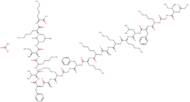
CAS 147664-63-9
:Pexiganan
- Pexiganan [INN]
- Glycyl-L-isoleucylglycyl-L-lysyl-L-phenylalanyl-L-leucyl-L-lysyl-L-lysyl-L-alanyl-L-lysyl-L-lysyl-L-phenylalanylglycyl-L-lysyl-L-alanyl-L-phenylalanyl-L-valyl-L-lysyl-L-isoleucyl-L-leucyl-L-lysyl-L-lysinamide
- Magainin I, 7-L-lysine-8-L-lysine-10-L-lysine-18-L-lysine-19-de-L-glutamic acid-21-L-leucine-23-L-lysinamide
- L-Lysinamide, glycyl-L-isoleucylglycyl-L-lysyl-L-phenylalanyl-L-leucyl-L-lysyl-L-lysyl-L-alanyl-L-lysyl-L-lysyl-L-phenylalanylglycyl-L-lysyl-L-alanyl-L-phenylaalanyl-L-valyl-L-lysyl-L-isoleucyl-L-leucyl-L-lysyl-
- Preços em ordem crescente
- Preços em ordem decrescente
- Menor grau de pureza
- Maior grau de pureza
- Estimativa de entrega mais rápida
Pexiganan
CAS:Pexiganan, a synthetic magainin 2 analog, is a broad-spectrum antimicrobial peptide for researching infections like diabetic foot ulcers.Fórmula:C122H210N32O22Cor e Forma:SolidPeso molecular:2477.17L-Lysinamide,glycyl-L-isoleucylglycyl-L-lysyl-L-phenylalanyl-L-leucyl-L-lysyl-L-lysyl-L-alanyl-L-lysyl-L-lysyl-L-phenylalanylglycyl-L-lysyl-L-alanyl-L-phenylalanyl-L-valyl-L-lysyl-L-isoleucyl-L-leucyl-L-lysyl-
CAS:Fórmula:C122H210N32O22Pureza:99.78%Peso molecular:2477.174Pexiganan acetate
CAS:Produto ControladoPexiganan acetate is the acetate salt form of a polymyxin B derivative that has potent antimicrobial activity against both Gram-positive and Gram-negative bacteria. It has been shown to be effective in the treatment of tissue infections, especially those caused by human pathogens such as Staphylococcus aureus, Pseudomonas aeruginosa, and Escherichia coli. Pexiganan also has significant activity against Mycobacterium tuberculosis and other mycobacteria. The mechanism of action for pexiganan is not fully understood but it may involve the inhibition of bacterial cell wall synthesis, or the disruption of bacterial membranes. Pexiganan was originally isolated from a marine sponge off the coast of Australia in 1961. It had been classified as an antimicrobial peptide (AMP) because of its chemical structure, which includes a polymyxin B moiety. Pexiganan’s AMP classification was later challenged when researchers found that it did
Fórmula:C122H210N32O22•(C2H4O2)xPureza:Min. 95%Cor e Forma:PowderPeso molecular:2,477.18 g/molPexiganan
CAS:Pexiganan is a polymyxin B derivative that has potent antimicrobial activity against both Gram-positive and Gram-negative bacteria. It has been shown to be effective in the treatment of tissue infections, especially those caused by human pathogens such as Staphylococcus aureus, Pseudomonas aeruginosa, and Escherichia coli. Pexiganan also has significant activity against Mycobacterium tuberculosis and other mycobacteria. The mechanism of action for pexiganan is not fully understood but it may involve the inhibition of bacterial cell wall synthesis, or the disruption of bacterial membranes. Pexiganan was originally isolated from a marine sponge off the coast of Australia in 1961. It had been classified as an antimicrobial peptide (AMP) because of its chemical structure, which includes a polymyxin B moiety. Pexiganan’s AMP classification was later challenged when researchers found that it did
Fórmula:C122H210N32O22Pureza:Min. 95%Peso molecular:2,477.18 g/mol