CymitQuimica logo

CAS 15450-76-7

:

8-Hidroxi-1H-quinolin-2-ona

Descrição:
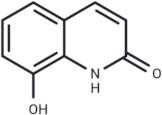
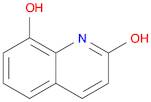
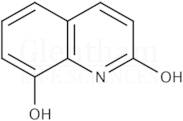
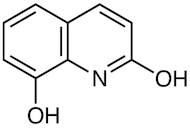
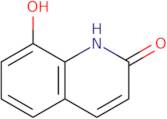
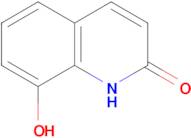
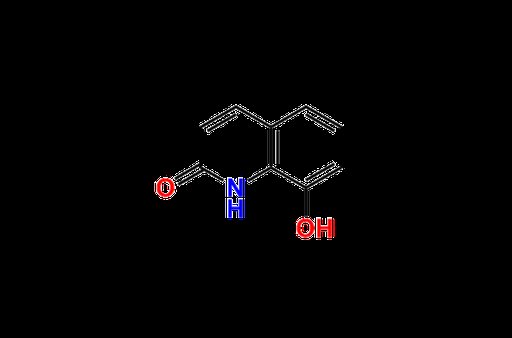
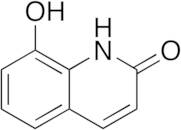
8-Hidroxi-1H-quinolin-2-ona, também conhecido como oxina, é um composto orgânico caracterizado por sua estrutura de quinolina, que apresenta um grupo hidroxila na posição 8 e um grupo carbonila na posição 2. Este composto é conhecido por suas propriedades quelantes, permitindo-lhe formar complexos estáveis com vários íons metálicos, tornando-o útil em química analítica e bioquímica para a detecção e extração de íons metálicos. A oxina é tipicamente um sólido cristalino amarelo pálido que é solúvel em solventes orgânicos, mas tem solubilidade limitada em água. Ela exibe fluorescência, que pode ser utilizada em várias aplicações, incluindo microscopia de fluorescência. Além disso, a oxina tem sido estudada por suas potenciais atividades biológicas, incluindo propriedades antimicrobianas e anticancerígenas. Sua capacidade de formar complexos com metais também a torna relevante na química ambiental para a análise de metais pesados em amostras. Considerações de segurança devem ser levadas em conta, pois pode representar riscos à saúde em caso de exposição ou ingestão.
Fórmula:C9H7NO2
InChI:InChI=1S/C9H7NO2/c11-7-3-1-2-6-4-5-8(12)10-9(6)7/h1-5,11H,(H,10,12)
Chave InChI:InChIKey=ZXZKYYHTWHJHFT-UHFFFAOYSA-N
SMILES:OC1=C2C(C=CC(=O)N2)=CC=C1
Sinónimos:
  • 2(1H)-Quinolinone, 8-hydroxy-
  • 2,8-Dihydroxylquinoline
  • 2,8-Dihydroxyquinoleine
  • 2,8-Dihydroxyquinoline
  • 8-Hydroxy-1H-quinolin-2-one
  • 8-Hydroxy-2(1H)-quinolinone
  • 8-Hydroxy-2-oxo-1,2-dihydroquinoline
  • 8-Hydroxycarbostyril
  • 8-Hydroxycarbostyryl
  • 8-Hydroxyquinolin-2-one
  • Ver mais sinónimos
Ordenar por

Pureza (%)
0
100
|
0
|
50
|
90
|
95
|
100
Foram encontrados 12 produtos.
  • 2,8-Quinolinediol

    CAS:
    2,8-Dihydroxyquinoline
    Fórmula:C9H7NO2
    Pureza:98%
    Peso molecular:161.16

    Ref: IN-DG11586

    1g
    15,00€
    5g
    18,00€
    10g
    28,00€
    25g
    35,00€
    100g
    93,00€
    500g
    403,00€
  • 2,8-Quinolinediol

    CAS:
    2,8-Quinolinediol is a useful organic compound for research related to life sciences. The catalog number is T2291 and the CAS number is 15450-76-7.
    Fórmula:C9H7NO2
    Pureza:99.62% - 99.77%
    Cor e Forma:Solid
    Peso molecular:161.16

    Ref: TM-T2291

    100mg
    33,00€
  • 2,8-Quinolinediol

    CAS:
    Fórmula:C9H7NO2
    Pureza:98%
    Cor e Forma:Solid
    Peso molecular:161.1574

    Ref: IN-DA00332D

    5g
    20,00€
    1g
    21,00€
    10g
    25,00€
    25g
    50,00€
    100g
    116,00€
    500g
    288,00€
    1kg
    541,00€
  • Quinoline-2,8-diol

    CAS:
    Quinoline-2,8-diol
    Fórmula:C9H7NO2
    Pureza:98%
    Cor e Forma:Solid-Powder
    Peso molecular:161.15737

    Ref: 54-OR8256

    5g
    30,00€
    25g
    38,00€
    100g
    95,00€
    500g
    409,00€
    2500g
    1.725,00€
  • 2,8-Quinolinediol

    CAS:
    2,8-Quinolinediol
    Fórmula:C9H7NO2
    Pureza:≥98%
    Peso molecular:161.16

    Ref: 54-BUP14000

    100mg
    52,00€
  • Procaterol Impurity 1

    CAS:
    Fórmula:C9H7NO2
    Cor e Forma:Light Yellowish Solid
    Peso molecular:161.16

    Ref: 4Z-P-188004

    5mg
    A consultar
    100mg
    A consultar
    10mg
    436,00€
    25mg
    623,00€
    50mg
    810,00€
  • 2,8-Dihydroxyquinoline

    CAS:
    Fórmula:C9H7NO2
    Pureza:>98.0%(GC)(T)
    Cor e Forma:White to Light yellow powder to crystal
    Peso molecular:161.16

    Ref: 3B-D3819

    5g
    47,00€
    25g
    129,00€
  • 8-Hydroxy-2(1H)-quinolinone

    CAS:

    Applications 8-Hydroxy-2(1H)-quinolinone is a substituted quinolinone derivative used in the preparation of pharmaceutical compounds.
    References Li, F. et al.: J. Proteome. Res., 12, 1369 (2013)

    Fórmula:C9H7NO2
    Cor e Forma:Neat
    Peso molecular:161.16

    Ref: TR-H953185

    100mg
    83,00€
    250mg
    89,00€
  • Quinoline-2,8-diol

    CAS:

    Quinoline-2,8-diol is a bacterial strain that can be used to remove fatty acids from wastewater. The recombinant cytochrome P450 in this strain can degrade fatty acids, which are carcinogenic and have been shown to cause hepatic steatosis. In addition, the quinoline-2,8-diol strain has shown an ability to inhibit xenograft tumor growth in mice by activating cytochrome P450 and inducing apoptosis. This bacterial strain also has the potential to produce xanthurenic acid from tyrosine. Xanthurenic acid is toxic and has been shown to inhibit polymerase chain reaction (PCR) amplification of DNA. Quinoline-2,8-diol may be used as a model for experimental studies of xanthurenic acid's effects on energy metabolism and DNA synthesis.

    Fórmula:C9H7NO2
    Pureza:Min. 95 Area-%
    Cor e Forma:Powder
    Peso molecular:161.16 g/mol
    Ref: 3D-FQ37177

    10g
    276,00€
    25g
    415,00€
    50g
    590,00€
    100g
    896,00€
  • Quinoline-2,8-diol

    CAS:
    Fórmula:C9H7NO2
    Pureza:97%
    Cor e Forma:Solid
    Peso molecular:161.16

    Ref: 10-F040217

    1g
    9,00€
    5g
    12,00€
    10g
    18,00€
    25g
    34,00€
    100g
    94,00€
    500g
    381,00€
  • Procaterol Impurity 1

    CAS:
    Fórmula:C9H7NO2
    Peso molecular:161.16

    Ref: ST-EA-CP-P193039

    10mg
    A consultar
    25mg
    A consultar
    50mg
    A consultar
    100mg
    A consultar