CAS 161748-29-4
:GLP-1 (9-36) AMIDA (HUMANO, BOVINO, PORQUINHO-DA-ÍNDIA, CAMUNDONGO, SUÍNO, RATO)
Descrição:
A amida GLP-1 (9-36) é um peptídeo derivado do peptídeo semelhante ao glucagon-1 (GLP-1), que desempenha um papel crucial no metabolismo da glicose e na regulação do apetite. Este fragmento específico, que é uma forma de amida, é produzido através da clivagem enzimática do GLP-1 de comprimento total. É caracterizado por sua capacidade de interagir com os receptores de GLP-1, embora com uma potência e eficácia diferentes em comparação com suas contrapartes mais longas. Sabe-se que o peptídeo exibe várias atividades biológicas, incluindo a modulação da secreção de insulina e a inibição da liberação de glucagon, contribuindo para suas potenciais aplicações terapêuticas no manejo do diabetes. O número CAS 161748-29-4 identifica exclusivamente este composto, que é relevante em ambientes de pesquisa em várias espécies, incluindo humanos, bovinos, porquinhos-da-índia, camundongos, suínos e ratos. Sua estabilidade, solubilidade e bioatividade fazem dele um assunto de interesse em estudos farmacológicos voltados para a compreensão de distúrbios metabólicos e o desenvolvimento de tratamentos relacionados.
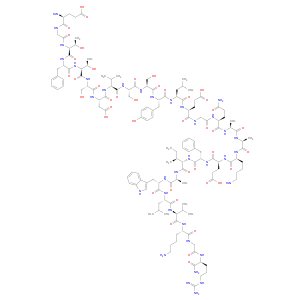
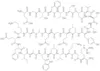
Fórmula:C140H214N36O43
InChI:InChI=1S/C140H214N36O43/c1-16-72(10)112(137(217)155-75(13)118(198)162-97(59-81-61-149-85-35-24-23-34-83(81)85)127(207)164-93(55-69(4)5)128(208)173-110(70(6)7)135(215)161-87(36-25-27-51-141)120(200)151-62-103(184)156-86(115(145)195)38-29-53-148-140(146)147)175-129(209)95(56-78-30-19-17-20-31-78)165-124(204)91(46-50-108(191)192)160-123(203)88(37-26-28-52-142)158-117(197)74(12)153-116(196)73(11)154-122(202)90(44-47-102(144)183)157-104(185)63-152-121(201)89(45-49-107(189)190)159-125(205)92(54-68(2)3)163-126(206)94(58-80-39-41-82(182)42-40-80)166-132(212)99(65-177)169-134(214)101(67-179)170-136(216)111(71(8)9)174-131(211)98(60-109(193)194)167-133(213)100(66-178)171-139(219)114(77(15)181)176-130(210)96(57-79-32-21-18-22-33-79)168-138(218)113(76(14)180)172-105(186)64-150-119(199)84(143)43-48-106(187)188/h17-24,30-35,39-42,61,68-77,84,86-101,110-114,149,177-182H,16,25-29,36-38,43-60,62-67,141-143H2,1-15H3,(H2,144,183)(H2,145,195)(H,150,199)(H,151,200)(H,152,201)(H,153,196)(H,154,202)(H,155,217)(H,156,184)(H,157,185)(H,158,197)(H,159,205)(H,160,203)(H,161,215)(H,162,198)(H,163,206)(H,164,207)(H,165,204)(H,166,212)(H,167,213)(H,168,218)(H,169,214)(H,170,216)(H,171,219)(H,172,186)(H,173,208)(H,174,211)(H,175,209)(H,176,210)(H,187,188)(H,189,190)(H,191,192)(H,193,194)(H4,146,147,148)/t72-,73-,74-,75-,76+,77+,84-,86-,87-,88-,89-,90-,91-,92-,93-,94-,95-,96-,97-,98-,99-,100-,101-,110-,111-,112-,113-,114-/m0/s1
Chave InChI:WPNGPBPCQMDAAD-WRFZDFFOSA-N
SMILES:CC[C@H](C)[C@@H](C(=O)N[C@@H](C)C(=O)N[C@@H](CC1=CNC2=CC=CC=C21)C(=O)N[C@@H](CC(C)C)C(=O)N[C@@H](C(C)C)C(=O)N[C@@H](CCCCN)C(=O)NCC(=O)N[C@@H](CCCNC(=N)N)C(=O)N)NC(=O)[C@H](CC3=CC=CC=C3)NC(=O)[C@H](CCC(=O)O)NC(=O)[C@H](CCCCN)NC(=O)[C@H](C)NC(=O)[C@H](C)NC(=O)[C@H](CCC(=O)N)NC(=O)CNC(=O)[C@H](CCC(=O)O)NC(=O)[C@H](CC(C)C)NC(=O)[C@H](CC4=CC=C(C=C4)O)NC(=O)[C@H](CO)NC(=O)[C@H](CO)NC(=O)[C@H](C(C)C)NC(=O)[C@H](CC(=O)O)NC(=O)[C@H](CO)NC(=O)[C@H]([C@@H](C)O)NC(=O)[C@H](CC5=CC=CC=C5)NC(=O)[C@H]([C@@H](C)O)NC(=O)CNC(=O)[C@H](CCC(=O)O)N
Sinónimos:- Proglucagon (80-107) Amide (Human, Bovine, Guinea Pig, Mouse, Porcine, Rat)
- Preproglucagon (100-127) Amide (Human, Bovine, Guinea Pig, Mouse, Porcine, Rat)
- H-Glu-Gly-Thr-Phe-Thr-Ser-Asp-Val-Ser-Ser-Tyr-Leu-Glu-Gly-Gln-Ala-Ala-Lys-Glu-Phe-Ile-Ala-Trp-Leu-Val-Lys-Gly-Arg-Nh2
- Glucagon-Like Peptide 1 (9-36) Amide (Human, Bovine, Guinea Pig, Mouse, Porcine, Rat)
Filtrar por
Percentagem de pureza
0
100
|
0
|
50
|
90
|
95
|
100
Foram encontrados 6 produtos.
- Preços em ordem crescente
- Preços em ordem decrescente
- Menor grau de pureza
- Maior grau de pureza
- Estimativa de entrega mais rápida
GLP-1 (9-36) amide (human, bovine, guinea pig, mouse, porcine, rat)
CAS:Glucagon-like peptide-1 (GLP-1) is efficiently degraded by the enzyme dipeptidyl peptidase IV (DPP IV), yielding the major metabolite GLP-1 (9-36) amide. GLP-1 (9-36) amide does not affect glucose disposal in mice either in the presence or absence of intact GLP-1 receptors or in the presence or absence of stimulated insulin levels. This suggests that the GLP-1 metabolite is not involved in the regulation of glucose homeostasis. Elahi et al. have shown that this GLP-1 metabolite acts as a weak insulinotropic agent and inhibits hepatic glucose production.Fórmula:C140H214N36O43Pureza:≥ 98%Cor e Forma:White PowderPeso molecular:3089.46GLP-1 (9-36) amide
CAS:GLP-1 (9-36) amide is an antagonist at the human GLP-1 receptor.Fórmula:C140H214N36O43Pureza:97%Cor e Forma:SolidPeso molecular:3089.41GLP-1 (9-36) AMIDE (HUMAN, BOVINE, GUINEA PIG, MOUSE, PORCINE, RAT)
CAS:Fórmula:C140H214N36O43Pureza:97.00%Peso molecular:3089.4126GLP-1 (9-36) amide trifluoroacetate
CAS:GLP-1 (9-36) amide trifluoroacetate is a bioactive peptide fragment derived from the full-length glucagon-like peptide-1 (GLP-1), an incretin hormone. It is typically obtained through enzymatic cleavage or synthetic processes involving solid-phase peptide synthesis. The mode of action of GLP-1 (9-36) amide involves binding to and modulating GLP-1 receptors, although it lacks the insulinotropic activity of its precursor GLP-1 (7-36) amide, making it a valuable tool for studying distinct signaling pathways and metabolic effects.Fórmula:C140H214N36O43Pureza:Min. 95%Cor e Forma:PowderPeso molecular:3,089.41 g/molGLP-1 (9-36) amide
CAS:Natural cleavage product of GLP-1 which, unlike GLP-1, does not affect either insulin secretion or glucose homeostasis. GLP-1(9-36) has low affinity for, and acts as an antagonist to, the GLP-1 receptor.GLP-1 (9-36) does however display unique biological activities such as beneficial cardiovascular effects and reducing the production of reactive oxygen species (ROS). GLP-1 (9-36) also exerts important physiological effects on neuronal plasticity in the hippocampus, and inhibits chemokine-induced migration of human CD4-positive lymphocytes.GLP-1 (9-36) is formed from the breakdown of biologically active but highly unstable GLP-1 (7-36) amide by the ubiquitous serine protease, dipeptidyl peptidase-IV (DPP-IV).
Cor e Forma:PowderPeso molecular:3,087.6 g/molGLP-1 (9-36) amide (human, bovine, guinea pig, mouse, porcine, rat)
CAS:Catalogue peptide; min. 95% purityFórmula:C140H214N36O43Peso molecular:3,089.48 g/mol