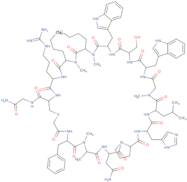
CAS 1629654-95-0
:Inibidor de PD-1/PD-L1 3
Descrição:
Inibidor de PD-1/PD-L1 3, com o número CAS 1629654-95-0, é uma pequena molécula que funciona como um inibidor de ponto de verificação imunológico, especificamente direcionado à proteína de morte celular programada 1 (PD-1) e seu ligante (PD-L1). Este composto faz parte de uma classe de agentes imunoterapêuticos projetados para aumentar a resposta imunológica contra células cancerosas, bloqueando a interação entre PD-1 e PD-L1, que é um mecanismo que os tumores exploram para evadir a detecção imunológica. As características deste inibidor geralmente incluem sua estrutura molecular, que é projetada para se encaixar nos locais de ligação de PD-1 ou PD-L1, impedindo assim sua interação. Pode apresentar propriedades como solubilidade em solventes orgânicos, estabilidade em condições fisiológicas e um perfil farmacocinético específico que influencia sua absorção, distribuição, metabolismo e excreção em sistemas biológicos. O desenvolvimento de inibidores de PD-1/PD-L1 como este composto representa um avanço significativo na imunoterapia do câncer, visando melhorar os resultados dos pacientes ao reativar a capacidade do sistema imunológico de atacar e destruir células tumorais.
Fórmula:C89H126N24O18S
Sinónimos:- PD-1/PD-L1-IN 3
- PD-1/PD-L1 Inhibitor 3 USP/EP/BP
- Glycinamide, N-(2-mercaptoacetyl)-L-phenylalanyl-N-methyl-L-alanyl-L-asparaginyl-L-prolyl-L-histidyl-L-leucyl-N-methylglycyl-L-tryptophyl-L-seryl-L-tryptophyl-N-methyl-L-norleucyl-N-methyl-L-norleucyl-L-arginyl-L-cysteinyl-, cyclic (1→14)-thioether
- PD-1/PD-L1 Inhibitor 3
Ordenar por
Pureza (%)
0
100
|
0
|
50
|
90
|
95
|
100
Foram encontrados 3 produtos.
PD-1/PD-L1 Inhibitor 3
CAS:PD-1/PD-L1 Inhibitor 3Fórmula:C89H126N24O18SPureza:98%Peso molecular:1852.17Pd-1/Pd-L1 inhibitor 3
CAS:PD-1/PD-L1 inhibitor 3 is an activating molecule that binds to PD-L1, inhibiting its interaction with the inhibitory receptor PD-1. This drug is a small molecule that blocks the binding of PD-L1 and PD-1, which prevents the inhibition of T cell proliferation and function. In this way, PD-L1 inhibitor 3 activates T cells and enhances anti-tumor activity by preventing tumor escape from immune surveillance. Approved in 2017, this drug has been shown to be safe in patients with non-small cell lung cancer (NSCLC) and other types of cancer. The most common side effects are fatigue, diarrhea, nausea, vomiting, rash, constipation, headache, fever, cough and decreased appetite.
Fórmula:C89H126N24O18SPureza:Min. 95%Peso molecular:1,852.2 g/mol