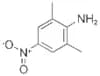
CAS 16947-63-0
:2,6-Dimetil-4-nitrobenzenamina
Descrição:
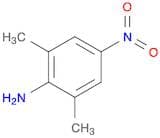
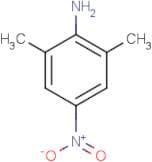
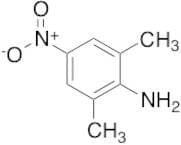
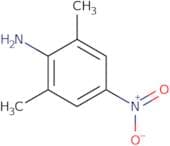
2,6-Dimetil-4-nitrobenzenamina, com o número CAS 16947-63-0, é um composto orgânico caracterizado por sua estrutura aromática, que inclui um anel de benzeno substituído por dois grupos metila e um grupo nitro, bem como um grupo amino. Este composto geralmente aparece como um sólido à temperatura ambiente e é conhecido por sua cor amarela a laranja. É um membro da família das anilinas, que são compostos que contêm um grupo amino ligado a um anel aromático. A presença do grupo nitro introduz polaridade significativa e pode influenciar a reatividade do composto, tornando-o útil em várias sínteses químicas e aplicações, incluindo corantes e pigmentos. Além disso, os grupos metila contribuem para suas características hidrofóbicas, afetando sua solubilidade em diferentes solventes. Considerações de segurança são importantes ao manusear este composto, pois pode apresentar riscos à saúde, incluindo toxicidade potencial e perigos ambientais. Protocolos de segurança adequados devem ser seguidos para mitigar quaisquer riscos associados ao seu uso.
Fórmula:C8H10N2O2
InChI:InChI=1S/C8H10N2O2/c1-5-3-7(10(11)12)4-6(2)8(5)9/h3-4H,9H2,1-2H3
Chave InChI:InChIKey=NSBSVUUVECHDDX-UHFFFAOYSA-N
SMILES:N(=O)(=O)C1=CC(C)=C(N)C(C)=C1
Sinónimos:- 2,6-Dimethyl-4-Nitroaniline
- 2,6-Dimethyl-4-nitro-phenylamine
- 2,6-Dimethyl-4-nitrobenzenamine
- 2,6-Dimethyl-4-nitrophenylamine
- 2,6-Xylidine, 4-nitro-
- 4-Nitro-2,6-Xylidine
- Benzenamine, 2,6-dimethyl-4-nitro-
- NSC 101580
Ordenar por
Pureza (%)
0
100
|
0
|
50
|
90
|
95
|
100
5 produtos.
2,6-Dimethyl-4-nitroaniline
CAS:2,6-Dimethyl-4-nitroanilineFórmula:C8H10N2O2Pureza:95%Cor e Forma: bright yellow solidPeso molecular:166.18g/mol2,6-Dimethyl-4-nitroaniline
CAS:Produto ControladoFórmula:C8H10N2O2Cor e Forma:NeatPeso molecular:166.172,6-Dimethyl-4-nitroaniline
CAS:2,6-Dimethyl-4-nitroaniline (DMN) is a nitrosamine that has been found to be a significant contaminant of drinking water. DMN is regulated as an irritant and a probable human carcinogen. The effects of DMN on the body are not fully understood, but it has been shown to cause damage to the liver and kidney in vivo. DMN may act by interfering with the synthesis of DNA or RNA, which can lead to cell death. The proposed mechanism for this is inhibition of the enzyme ribonucleotide reductase, which converts ribonucleotides into deoxyribonucleotides for DNA synthesis. This mechanism is supported by experiments in rats where DMN was found to inhibit erythrocyte production in vivo. DMN can also be methylated in vivo by S-adenosylmethionine synthetase, yielding 2-methyl-6-dimethylamino-4Fórmula:C8H10N2O2Pureza:Min. 95%Peso molecular:166.18 g/mol