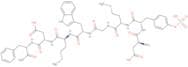
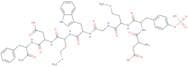
CAS 25126-32-3
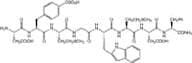
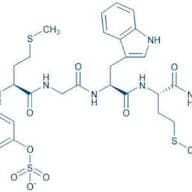
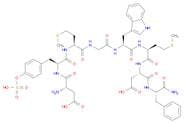
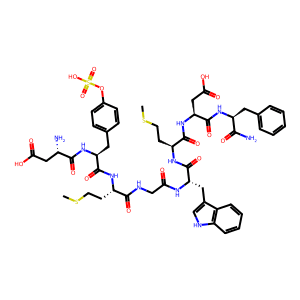
:(27-tir(so(3)H))colecistoquinina-fragmento (26-33)-amida
Descrição:
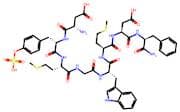
A substância química conhecida como "(27-tir(so(3)H))colecistoquinina-fragmento (26-33)-amida," com o número CAS 25126-32-3, é um fragmento peptídico derivado da colecistoquinina (CCK), um hormônio envolvido na digestão e saciedade. Este fragmento específico consiste em aminoácidos de 26 a 33 da molécula de CCK, com uma tirosina sulfatada na posição 27, que é crucial para sua atividade biológica. A presença do grupo sulfato melhora a interação do peptídeo com seus receptores, influenciando vários processos fisiológicos, como a contração da vesícula biliar e a secreção de enzimas do pâncreas. A estrutura deste peptídeo inclui uma sequência de aminoácidos ligados por ligações peptídicas, e exibe propriedades típicas de peptídeos, como solubilidade em água e estabilidade em condições fisiológicas. Sua importância biológica é sublinhada por seu papel no sistema gastrointestinal, tornando-o um assunto de interesse em estudos relacionados à digestão, regulação do apetite e potenciais aplicações terapêuticas em distúrbios gastrointestinais.
Fórmula:C49H62N10O16S3
InChI:InChI=1/C49H62N10O16S3/c1-76-18-16-34(55-47(69)37(58-44(66)32(50)23-41(61)62)21-28-12-14-30(15-13-28)75-78(72,73)74)45(67)53-26-40(60)54-38(22-29-25-52-33-11-7-6-10-31(29)33)48(70)56-35(17-19-77-2)46(68)59-39(24-42(63)64)49(71)57-36(43(51)65)20-27-8-4-3-5-9-27/h3-15,25,32,34-39,52H,16-24,26,50H2,1-2H3,(H2,51,65)(H,53,67)(H,54,60)(H,55,69)(H,56,70)(H,57,71)(H,58,66)(H,59,68)(H,61,62)(H,63,64)(H,72,73,74)/t32-,34-,35-,36-,37-,38-,39-/m0/s1
SMILES:CSCC[C@@H](C(=NCC(=N[C@@H](Cc1c[nH]c2ccccc12)C(=N[C@@H](CCSC)C(=N[C@@H](CC(=O)O)C(=N[C@@H](Cc1ccccc1)C(=N)O)O)O)O)O)O)N=C([C@H](Cc1ccc(cc1)OS(=O)(=O)O)N=C([C@H](CC(=O)O)N)O)O
Sinónimos:- (tyr(so3H)27)-cholecystokinin fragment*26-33 amid
- Sincalide
- Cholecystokinin Octapeptide
- Tyr(SO3H]27)Cholecystokinin fragment 26-33 Amide
- alpha-aspartyl-O-sulfotyrosylmethionylglycyltryptophylmethionyl-alpha-aspartylphenylalaninamide
- L-alpha-aspartyl-O-sulfo-L-tyrosyl-L-methionylglycyl-L-tryptophyl-L-methionyl-L-alpha-aspartyl-L-phenylalaninamide
- Sincalide(CCK-8)
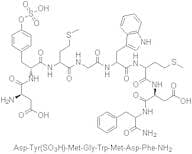
- Asp-Tyr(SO3H)-Met-Gly-Trp-Met-Asp-Phe-NH2
- Caerulein, 1-de(5-oxo-L-proline)-2-de-L-glutamine-5-L-methionine-
- Cholecystokinin C-terminal octapeptide
- Cholecystokinin octapeptide (26-33 sulfated)
- Cholecystokinin-(26-33)-amide
- Cholecystokinin-8 (chicken)
- Cholecystokinin-8 (pig)
- Cholecystokinin-8 (Squalus acanthias)
- Cholecystokinin-8 (swine)
- Cholecystokinin-pancreozymin (swine intestine C-terminal octapeptide)
- Cholecystokinin-pancreozymin C-terminal octapeptide
- Human CCK-8
- L-Phenylalaninamide, L-α-aspartyl-O-sulfo-L-tyrosyl-L-methionylglycyl-L-tryptophyl-L-methionyl-L-α-aspartyl-
- Sincalid
- Sincalida
- Ver mais sinónimos
Ordenar por
Pureza (%)
0
100
|
0
|
50
|
90
|
95
|
100
11 produtos.
Cholecystokinin, CCK Octapeptide (26-33)
CAS:For cellular and molecular biology applicationsCor e Forma:White, Lyophilized PowderCholecystokinin Octapeptide (sulfated)
CAS:CCK-8 exhibits various gastrointestinal effects as contraction of the gallbladder and stimulation of pancreatic secretion and gastrointestinal transit. In rats, CCK-8 facilitated the uptake of leptin from peripheral circulation to cerebrospinal fluid and its access to the hypothalamus.Fórmula:C49H62N10O16S3Pureza:98.42%Cor e Forma:White PowderPeso molecular:1143.293-10-Caerulein, 5-L-methionine-
CAS:Fórmula:C49H62N10O16S3Pureza:97%Cor e Forma:SolidPeso molecular:1143.2690Sincalide(CCK-8)
CAS:Fórmula:C49H62N10O16S3Pureza:95%~99%Cor e Forma:White to Off-white PowderPeso molecular:1143.27Sincalide
CAS:Sincalide (CCK-8) is an injectable drug used to diagnose gallbladder and pancreas disorders; it's a cholecystokinin fragment.Fórmula:C49H62N10O16S3Pureza:98.32%Cor e Forma:SolidPeso molecular:1143.27Asp-Tyr(SO3H)-Met-Gly-Trp-Met-Asp-Phe-NH2
CAS:Asp-Tyr(SO3H)-Met-Gly-Trp-Met-Asp-Phe-NH2 is a versatile building block that can be used in research on complex compounds, fine chemicals, speciality chemicals and reagents. It is a high quality chemical that can be used as an intermediate or a scaffold. Asp-Tyr(SO3H)-Met-Gly-Trp-Met-Asp-Phe NH2 is soluble in water and has a high degree of solubility in organic solvents. The compound is also stable under acidic conditions.Fórmula:C49H62N10O16S3Pureza:Min. 98.0 Area-%Peso molecular:1,143.27 g/molRef: 3D-W-107263
-Unit-mgmgA consultar1gA consultar50mgA consultar100mgA consultar250mgA consultar500mgA consultarSincalide
CAS:Sincalide is a cholecystokinin (CCK) analog that has been used as a pharmacological agent. It is an agonist for CCK-A receptors and inhibits the activity of protein kinase C. Sincalide also has been shown to suppress tumor growth in experimental models. A polymerase chain reaction analysis of cck-8, a rat CCK receptor gene, showed a high degree of homology with human CCK-A receptor genes. The physiological effects of sincalide are complex and depend on the presence or absence of other hormones such as insulin, glucagon, somatostatin, and leptin.
Fórmula:C49H62N10O16S3Pureza:Min. 95%Cor e Forma:PowderPeso molecular:1,143.27 g/molCCK-Octapeptide (26-33) (Sulfated Form)
CAS:CCK-Octapeptide (26-33) (Sulfated Form) is a peptide that has been shown to have a variety of biological effects. It has been found to enhance the activity of rifampicin against tuberculosis by increasing the activity of the kinase protein. CCK-Octapeptide (26-33) (Sulfated Form) also has natriuretic peptide-like activity, which means it can regulate blood pressure and fluid balance in the body. In addition, it has been shown to inhibit tumor growth and metastasis in animal models, possibly through its ability to modulate guanosine triphosphate-binding proteins. CCK-Octapeptide (26-33) (Sulfated Form) also exhibits trypsin inhibitory activity and thymidine uptake inhibition. Furthermore, it has been studied as a potential treatment for cancer and as an alternative to vasopressin or nesiritide in certain medical conditions where natriuretic peptides are used therFórmula:C49H62N10O16S3Pureza:Min. 95%Peso molecular:1,143.3 g/mol




![(Tyr[SO3H]27)Cholecystokinin fragment 26-33 Amide](/_next/image/?url=https%3A%2Fstatic.cymitquimica.com%2Fproducts%2F7W%2Fthumb%2FGL1683.jpg&w=3840&q=75)