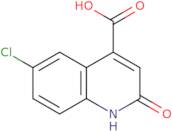
CAS 32431-30-4
:Fórmula:C10H6ClNO3
InChI:InChI=1S/C10H6ClNO3/c11-5-1-2-8-6(3-5)7(10(14)15)4-9(13)12-8/h1-4H,(H,12,13)(H,14,15)
Chave InChI:AMYRRFUUZGORKF-UHFFFAOYSA-N
SMILES:C1=CC2=C(C=C1Cl)C(=CC(=O)N2)C(=O)O
Filtrar por
Percentagem de pureza
0
100
|
0
|
50
|
90
|
95
|
100
Foram encontrados 3 produtos.
- Preços em ordem crescente
- Preços em ordem decrescente
- Menor grau de pureza
- Maior grau de pureza
- Estimativa de entrega mais rápida
6-Chloro-2-oxo-1,2-dihydroquinoline-4-carboxylic acid
CAS:6-Chloro-2-oxo-1,2-dihydroquinoline-4-carboxylic acidFórmula:C10H6ClNO3Pureza:95%Peso molecular:223.626-Chloro-2-oxo-1,2-dihydroquinoline-4-carboxylic acid
CAS:Fórmula:C10H6ClNO3Pureza:95%Peso molecular:223.61256-Chloro-2-oxo-1,2-dihydroquinoline-4-carboxylic acid
CAS:6-Chloro-2-oxo-1,2-dihydroquinoline-4-carboxylic acid (6ClOQ) is a molecule that is used as a diagnostic agent and biodegradable drug. It has high affinity binding with target tissues, such as the liver and kidney. 6ClOQ also has potential as an anticancer drug, which may be due to its ability to inhibit DNA synthesis by interacting with hydroxyl groups. 6ClOQ can be conjugated with different molecules, such as monoclonal antibodies, and this characteristic can be used to increase its efficacy in targeting cancer cells. The conjugation of 6ClOQ to a monoclonal antibody increases the stability of the drug and decreases its toxicity.Fórmula:C10H6ClNO3Pureza:Min. 95%Peso molecular:223.61 g/mol