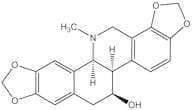
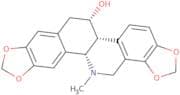
CAS 476-32-4
:(+)-Quelidonina
Descrição:
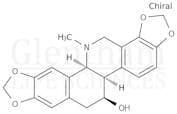
(+)-Quelidonina é um alcaloide que ocorre naturalmente e é derivado da planta Chelidonium majus, comumente conhecida como celidônia maior. Pertence à classe de alcaloides benzofenantridínicos e é caracterizado por sua complexa estrutura policíclica, que inclui um sistema de anéis fundidos. Este composto exibe uma variedade de atividades biológicas, incluindo propriedades antimicrobianas, anti-inflamatórias e potenciais anticancerígenas, tornando-o de interesse na pesquisa farmacológica. (+)-Quelidonina é tipicamente encontrado na forma de um sólido cristalino amarelado e é solúvel em solventes orgânicos como etanol e clorofórmio, mas menos solúvel em água. Sua estereoquímica é significativa, pois a designação (+) indica sua atividade óptica específica, que pode influenciar suas interações biológicas. O mecanismo de ação do composto e seu potencial terapêutico são assuntos de investigação em andamento, destacando sua relevância na química de produtos naturais e aplicações medicinais. Assim como muitos alcaloides, é aconselhável ter cautela em relação ao seu uso, pois pode apresentar toxicidade em certas concentrações.
Fórmula:C20H19NO5
InChI:InChI=1S/C20H19NO5/c1-21-7-13-11(2-3-15-20(13)26-9-23-15)18-14(22)4-10-5-16-17(25-8-24-16)6-12(10)19(18)21/h2-3,5-6,14,18-19,22H,4,7-9H2,1H3/t14-,18-,19+/m0/s1
Chave InChI:InChIKey=GHKISGDRQRSCII-ZOCIIQOWSA-N
SMILES:CN1[C@]2([C@@](C=3C(C1)=C4C(=CC3)OCO4)([C@@H](O)CC=5C2=CC6=C(C5)OCO6)[H])[H]
Sinónimos:- (5bR,6S,12bS)-5b,6,7,12b,13,14-Hexahydro-13-methyl[1,3]benzodioxolo[5,6-c]-1,3-dioxolo[4,5-i]phenanthridin-6-ol
- Chelidonin
- Diphylline
- Stylophorine
- [1,3]Benzodioxolo[5,6-c]-1,3-dioxolo[4,5-i]phenanthridin-6-ol, 5b,6,7,12b,13,14-hexahydro-13-methyl-, (5bR,6S,12bS)-
- [1,3]Benzodioxolo[5,6-c]-1,3-dioxolo[4,5-i]phenanthridin-6-ol, 5b,6,7,12b,13,14-hexahydro-13-methyl-, [5bR-(5bα,6β,12bα)]-
- [5bR-(5bα,6β,12bα)]-5b,6,7,12b,13,14-Hexahydro-13-methyl[1,3]benzodioxolo[5,6-c]-1,3-dioxolo[4,5-i]phenanthridin-6-ol
- Chelidonine
Ordenar por
Pureza (%)
0
100
|
0
|
50
|
90
|
95
|
100
Foram encontrados 9 produtos.
(+)-Chelidonine
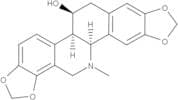
CAS:(+)-Chelidonine analytical standard provided with chromatographic purity, to be used as reference material for qualitative determination.Fórmula:C20H19NO5Pureza:(HPLC) ≥95%Cor e Forma:PowderPeso molecular:353.38(5bR,6S,12bS)-5b,6,7,12b,13,14-Hexahydro-13-methyl[1,3]benzodioxolo[5,6-c]-1,3-dioxolo[4,5-i]phenanthridin-6-ol
CAS:Fórmula:C20H19NO5Pureza:98%Cor e Forma:SolidPeso molecular:353.3686Chelidonine
CAS:Fórmula:C20H19NO5Pureza:≥ 97.0%Cor e Forma:White to light brown powder or crystalsPeso molecular:353.37Chelidonine (Standard)
CAS:Chelidonine (Standard) is a reference standard for research and analysis in studies involving Chelidonine. 1. Chelidonine (Stylophorin) isolated from Chelidonium majus efficiently induced apoptosis in HeLa cells through possible alteration of p38-p53 and AKT/PI3 kinase signalling pathways. 2. Chelidonine is a promising model compound for overcoming MDR and for enhancing cytotoxicity of chemotherapeutics, especially against leukaemia cells, its efficacy needs to be confirmed in animal models. 3. Chelidonine may be a potential therapeutic agent against metastasis of invasive human cancer cells, exhibits antimigratory and antiinvasive effects in MDA-MB-231 cells, by suppressing COL-induced integrin signaling, through inhibiting the formation of the IPP complex and subsequent downregulation of IPP downstream signaling molecules, such as Akt and ERK1/2.Fórmula:C20H19NO5Cor e Forma:SolidPeso molecular:353.37Chelidonine
CAS:Chelidonine from Chelidonium majus triggers HeLa cell apoptosis, may reverse MDR, boost chemotherapeutics against leukemia, and inhibit cancer cell metastasis.Fórmula:C20H19NO5Pureza:98% - 99.61%Cor e Forma:White SolidPeso molecular:353.37Chelidonine
CAS:Natural alkaloidFórmula:C20H19NO5Pureza:≥ 95.0 % (HPLC)Cor e Forma:PowderPeso molecular:353.38Stylophorin
CAS:Stylophorin is a biochemical agent, which is derived from marine organisms, specifically from the symbiotic bacteria associated with certain marine invertebrates. This compound exhibits its effects through the disruption of bacterial cell walls or inhibition of vital microbial enzymatic pathways, leading to antimicrobial activity.Fórmula:C20H19NO5Pureza:Min. 95%Cor e Forma:PowderPeso molecular:353.37 g/mol

![(5bR,6S,12bS)-5b,6,7,12b,13,14-Hexahydro-13-methyl[1,3]benzodioxolo[5,6-c]-1,3-dioxolo[4,5-i]phena…](/_next/image/?url=https%3A%2Fstatic.cymitquimica.com%2Fproducts%2FIN%2Fthumb%2FDA00I8O8.jpg&w=3840&q=75)