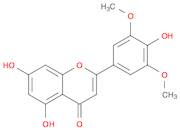
CAS 520-32-1
:Tricina
Descrição:
Tricina, com o número CAS 520-32-1, é um composto flavonoide encontrado principalmente em várias plantas, particularmente no arroz e em outros grãos. É classificado como uma flavona, que é um tipo de flavonoide caracterizado por uma estrutura química específica que inclui uma espinha dorsal de cromona. Tricina exibe propriedades antioxidantes, que contribuem aos seus potenciais benefícios à saúde, incluindo efeitos anti-inflamatórios e anticancerígenos. Também é conhecido por seu papel na pigmentação das plantas e na proteção contra UV. Em termos de solubilidade, Tricina é geralmente solúvel em solventes orgânicos, mas tem solubilidade limitada em água. Sua estrutura molecular inclui grupos hidroxila que aumentam sua reatividade e interação com outras moléculas biológicas. Tricina despertou interesse na ciência dos alimentos e nutrição devido às suas potenciais propriedades promotoras da saúde, tornando-se um tema de pesquisa nos campos da farmacologia e alimentos funcionais. No geral, Tricina representa um composto significativo tanto na biologia vegetal quanto em aplicações terapêuticas potenciais.
Fórmula:C17H14O7
InChI:InChI=1S/C17H14O7/c1-22-14-3-8(4-15(23-2)17(14)21)12-7-11(20)16-10(19)5-9(18)6-13(16)24-12/h3-7,18-19,21H,1-2H3
Chave InChI:InChIKey=HRGUSFBJBOKSML-UHFFFAOYSA-N
SMILES:O=C1C=2C(OC(=C1)C3=CC(OC)=C(O)C(OC)=C3)=CC(O)=CC2O
Sinónimos:- 3′,5′-O-Dimethyltricetin
- 4H-1-Benzopyran-4-one, 5,7-dihydroxy-2-(4-hydroxy-3,5-dimethoxyphenyl)-
- 4′,5,7-Trihydroxy-3′,5′-dimethoxyflavone
- 5,7,4′-Trihydroxy-3′,5′-dimethoxyflavone
- 5,7-Dihydroxy-2-(4-Hydroxy-3,5-Dimethoxy-Phenyl)Chromen-4-One
- 5,7-Dihydroxy-2-(4-hydroxy-3,5-dimethoxyphenyl)-4H-1-benzopyran-4-one
- 5,7-Dihydroxy-2-(4-hydroxy-3,5-dimethoxyphenyl)chromen-4-one
- Flavone, 4′,5,7-trihydroxy-3′,5′-dimethoxy-
- NSC 294579
- Tricetin 3',5'-dimethyl ether
- Tricin
Filtrar por
Percentagem de pureza
0
100
|
0
|
50
|
90
|
95
|
100
Foram encontrados 13 produtos.
- Preços em ordem crescente
- Preços em ordem decrescente
- Menor grau de pureza
- Maior grau de pureza
- Estimativa de entrega mais rápida
5,7,4Trihydroxy-3,5-Dimethoxyflavone
CAS:5,7,4Trihydroxy-3,5-DimethoxyflavoneFórmula:C17H14O7Pureza:>99%Peso molecular:330.295,7-Dihydroxy-2-(4-hydroxy-3,5-dimethoxyphenyl)-4H-chromen-4-one
CAS:Fórmula:C17H14O7Pureza:95%Cor e Forma:SolidPeso molecular:330.2889Ref: IN-DA00D8Q4
2mg67,00€1mg68,00€5mg80,00€10mg129,00€25mg203,00€50mg244,00€100mg287,00€250mg526,00€1g1.010,00€Tricin (Standard)
CAS:Tricin (Standard) is a reference standard for research and analysis in studies involving Tricin. Tricin can inhibit human cytomegalovirus (HCMV) replication by inhibiting CDK9. Tricin inhibits the proliferation and invasion of C6 glioma cells via the upregulation of focal-adhesion-finase (FAK)-targeting microRNA-7.Fórmula:C17H14O7Peso molecular:330.295,7-Dihydroxy-2-(4-hydroxy-3,5-dimethoxyphenyl)-5,6-dihydro-4H-chromen-4-one
CAS:Produto ControladoApplications Tricin is a type of flavanoid studied for its immunomodulatory effects.
References Liang, H. R. et al.: Pla. Med., 63(4), 316-319, (1997)Fórmula:C17H14O7Cor e Forma:NeatPeso molecular:330.29Tricin
CAS:Tricin blocks HCMV by halting CDK9 and curbs C6 glioma growth by boosting miRNA-7 to target FAK.Fórmula:C17H14O7Pureza:98.39% - 99.51%Cor e Forma:SolidPeso molecular:330.295,7-Dihydroxy-2-(4-hydroxy-3,5-dimethoxyphenyl)-4H-chromen-4-one
CAS:5,7-Dihydroxy-2-(4-hydroxy-3,5-dimethoxyphenyl)-4H-chromen-4-oneFórmula:C17H14O7Pureza:95%Peso molecular:330.29Tricin
CAS:Oxygen-heterocyclic compoundFórmula:C17H14O7Pureza:≥ 95.0 % (HPLC)Cor e Forma:PowderPeso molecular:330.29Tricin
CAS:Tricin is a nucleoside antibiotic, which is a biochemical compound derived from natural sources involving the pentose sugar and nucleobase configuration typical of nucleosides. It functions by inhibiting bacterial RNA polymerase, leading to interference in the transcription process essential for bacterial replication and protein synthesis. This inhibition results in the disruption of bacterial growth, making it a valuable tool in laboratory settings for researching bacterial gene expression and transcriptional regulation.Fórmula:C17H14O7Pureza:Min. 98 Area-%Cor e Forma:PowderPeso molecular:330.29 g/mol