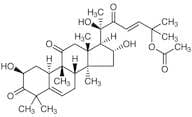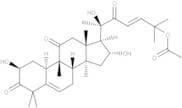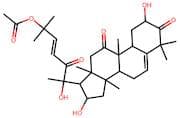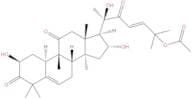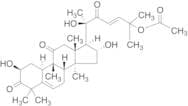
CAS 6199-67-3
:(+)-Cucurbitacina B
Descrição:
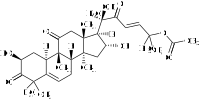
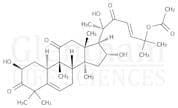
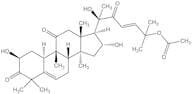
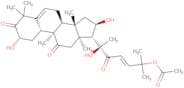
(+)-Cucurbitacina B é um composto triterpenoide pertencente à família dos cucurbitacinos, que é derivado principalmente de várias plantas da família Cucurbitaceae, como pepinos e abóboras. Este composto é caracterizado por sua complexa estrutura tetracíclica, que contribui à sua atividade biológica. É conhecido por seu sabor amargo e tem sido estudado por suas potenciais propriedades farmacológicas, incluindo efeitos anticancerígenos, anti-inflamatórios e antidiabéticos. (+)-Cucurbitacina B exibe citotoxicidade contra várias linhagens celulares cancerosas, tornando-se um assunto de interesse na pesquisa do câncer. Além disso, demonstrou influenciar várias vias de sinalização, incluindo aquelas relacionadas à apoptose e à proliferação celular. O composto é tipicamente encontrado em baixas concentrações em extratos de plantas e pode ser isolado por meio de várias técnicas de extração e purificação. Sua estrutura única e atividades biológicas fazem dele um composto valioso para mais pesquisas em química medicinal e farmacologia. No entanto, devido aos seus efeitos potentes, é aconselhável ter cautela em seu uso e manuseio.
Fórmula:C32H46O8
InChI:InChI=1S/C32H46O8/c1-17(33)40-27(2,3)13-12-23(36)32(9,39)25-21(35)15-29(6)22-11-10-18-19(14-20(34)26(38)28(18,4)5)31(22,8)24(37)16-30(25,29)7/h10,12-13,19-22,25,34-35,39H,11,14-16H2,1-9H3/b13-12+/t19-,20+,21-,22+,25+,29+,30-,31+,32+/m1/s1
Chave InChI:InChIKey=IXQKXEUSCPEQRD-DKRGWESNSA-N
SMILES:C[C@]12[C@@](C)([C@@]([C@@](C(/C=C/C(OC(C)=O)(C)C)=O)(C)O)([C@H](O)C1)[H])CC(=O)[C@]3(C)[C@]2(CC=C4[C@]3(C[C@H](O)C(=O)C4(C)C)[H])[H]
Sinónimos:- (23E)-2,16,20-trihydroxy-9,10,14-trimethyl-1,11,22-trioxo-4,9-cyclo-9,10-secocholesta-5,23-dien-25-yl acetate
- (2S,4R,9beta,16alpha)-2,16,20-trihydroxy-9,10,14-trimethyl-1,11,22-trioxo-4,9-cyclo-9,10-secocholesta-5,23-dien-25-yl acetate
- (2S,4R,9beta,16alpha,17xi,23E)-2,16,20-trihydroxy-9,10,14-trimethyl-1,11,22-trioxo-4,9-cyclo-9,10-secocholesta-5,23-dien-25-yl acetate
- (2S,4R,9beta,16alpha,23E)-2,16,20-trihydroxy-9,10,14-trimethyl-1,11,22-trioxo-4,9-cyclo-9,10-secocholesta-5,23-dien-25-yl acetate
- (2β,9β,10α,16α,23E)-25-(Acetyloxy)-2,16,20-trihydroxy-9-methyl-19-norlanosta-5,23-diene-3,11,22-trione
- 19-Nor-9β,10α-lanosta-5,23-diene-3,11,22-trione, 2β,16α,20,25-tetrahydroxy-9-methyl-, 25-acetate
- 19-Norlanosta-5,23-diene-3,11,22-trione, 25-(acetyloxy)-2,16,20-trihydroxy-9-methyl-, (2β,9β,10α,16α,23E)-
- Amarine
- Cucurbitacine B
- Hy-N 0416
- NSC 144154
- NSC 49451
- Ver mais sinónimos
Ordenar por
Pureza (%)
0
100
|
0
|
50
|
90
|
95
|
100
10 produtos.
Cucurbitacin B
CAS:Fórmula:C32H46O8Pureza:>98.0%(HPLC)Cor e Forma:White to Light yellow powder to crystalPeso molecular:558.71Cucurbitacin B
CAS:Cucurbitacin B analytical standard provided with w/w absolute assay, to be used for quantitative titration.Fórmula:C32H46O8Pureza:(HPLC) ≥95%Cor e Forma:PowderPeso molecular:558.72Cucurbitacin B
CAS:Cucurbitacin B (cucB) is a triterpenoid constituent of Cucurbitaceae vegetables and a promising phytochemical for cancer prevention, cucB induces G(2) arrest and apoptosis through a STAT3-independent but ROS-dependent mechanism in SW480 cells.Fórmula:C32H46O8Pureza:95%~99%Cor e Forma:White powderPeso molecular:558.712Cucurbitacin B
CAS:Cucurbitacin B (Cuc B) has profound in vitro and in vivo antiproliferative effects against human pancreatic Y cells.Fórmula:C32H46O8Pureza:97.1% - 99.33%Cor e Forma:SolidPeso molecular:558.70Cucurbitacin B
CAS:Fórmula:C32H46O8Pureza:≥ 98.0%Cor e Forma:White to off-white powderPeso molecular:558.71Cucurbitacin b
CAS:Carboxylic acid with additional oxygen functionsFórmula:C32H46O8Pureza:≥ 90.0 % (HPLC)Cor e Forma:PowderPeso molecular:558.71Cucurbitacin B
CAS:Produto Controlado<p>Cucurbitacin B is a triterpenoid compound, which is derived from plants primarily within the Cucurbitaceae family. This compound exhibits its mode of action through the inhibition of the JAK-STAT signaling pathway, effectively disrupting processes that are critical for cell survival and proliferation. As a result, Cucurbitacin B is being extensively studied for its antiproliferative and pro-apoptotic properties, especially in the context of cancer research.</p>Fórmula:C32H46O8Pureza:Min. 95%Cor e Forma:White PowderPeso molecular:558.7 g/molCucurbitacin B
CAS:Produto Controlado<p>Applications Cucurbitacin B is a tetracyclic triterpenoid, which can induce apoptosis in human hepatoma cells. It can also induce DNA damage and autophagy in MCF-7 breast cancer cells.In the wild, watermelons, cucumbers, and muskmelons produce bitter Cucurbitacins to defend against preditors. Humans have bred these fruits to eliminate these compounds thereby yielding fruits that are more appealing to our palate.<br> Not a dangerous good if item is equal to or less than 1g/ml and there is less than 100g/ml in the package<br>References Sun, Y., et al.: Eur. J. Pharmacol. 768, 28 (2015); Ren, G., et al.: J. Nat. Med. 69, 522 (2015); C&E News p. 10, Dec. 5, 2016j<br></p>Fórmula:C32H46O8Cor e Forma:NeatPeso molecular:558.70