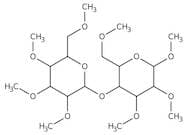
CAS 9004-67-5
:Metilcelulose
Descrição:
Metilcelulose é um derivado da celulose caracterizado pela substituição de grupos hidroxila no polímero de celulose por grupos metila. Essa modificação confere propriedades únicas, tornando Metilcelulose um composto versátil amplamente utilizado em várias aplicações. É um pó branco e inodoro que é solúvel em água fria, formando um gel viscoso, mas é insolúvel em água quente. Metilcelulose exibe excelentes propriedades de formação de filmes, espessamento e emulsificação, o que o torna valioso em produtos alimentícios, farmacêuticos e cosméticos. Sua capacidade de reter umidade e fornecer textura melhora a qualidade de produtos assados e outros itens alimentares. Além disso, Metilcelulose é não tóxico e biodegradável, contribuindo para seu apelo em formulações ambientalmente amigáveis. Na indústria farmacêutica, serve como aglutinante e espessante em formulações de medicamentos. Sua propriedade de gelificação térmica, onde forma um gel ao ser aquecido, também é utilizada em várias aplicações industriais. No geral, Metilcelulose é um ingrediente multifuncional de grande importância em vários setores devido às suas características físico-químicas únicas.
Fórmula:CH4O·xUnspecified
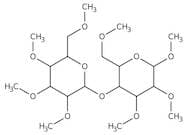
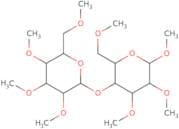
InChI:InChI=1/C12H20O10/c1-21-9-11-13(23-3)15(24-4)18(27-7)20(30-11)31-14-12(10-22-2)29-19(28-8)17(26-6)16(14)25-5/h11-20H,9-10H2,1-8H3/t11?,12?,13?,14-,15?,16?,17?,18?,19?,20+/m1/s1
Sinónimos:- 55Hd100
- 55Hd15
- 55Hd20
- 55Hd400
- 55Hd4000
- 55Hd50
- Adulsin
- Bagolax
- Bulkaloid
- Cellapret
- Cellogran
- Cellothyl
- Cellumeth
- Cethylose
- Cethytin
- Citrucel
- Cologel
- Emp-H
- Hydrolose
- MMTs-BTR
- MTs
- Mecellose
- Mellose
- Methoxycellulose
- Methulose
- Methylcellulose
- Napolone
- Nicel
- O-Methylcellulose
- Rhomellose
- Sp-G
- Syncelose
- Viscol
- Viscosol
- Methocel
- Cellulose, methyl ether
- (6S)-3,4,5-trimethoxy-2-(methoxymethyl)-6-[(3R)-4,5,6-trimethoxy-2-(methoxymethyl)tetrahydropyran-3-yl]oxy-tetrahydropyran
- Bufapto Methalose
- Cellulose Methyl Ether
- Cellulose, methyl ether
- Ver mais sinónimos
Ordenar por
Pureza (%)
0
100
|
0
|
50
|
90
|
95
|
100
Methyl Cellulose (1000-1800mPa·s, 2% in Water at 20°C)
CAS:Cor e Forma:White to Almost white powder to crystalMethyl Cellulose (350-550mPa·s, 2% in Water at 20°C)
CAS:Cor e Forma:White to Light yellow powder to crystalMethyl Cellulose (13-18mPa·s, 2% in Water at 20°C)
CAS:Cor e Forma:White to Almost white powder to crystalMethyl Cellulose (20-30mPa·s, 2% in Water at 20°C)
CAS:Cor e Forma:White to Almost white powder to crystalMethyl Cellulose (3500-5600mPa·s, 2% in Water at 20°C)
CAS:Cor e Forma:White to Almost white powder to crystalMethyl Cellulose (80-120mPa·s, 2% in Water at 20°C)
CAS:Cor e Forma:White to Almost white powder to crystalMethyl cellulose, viscosity 400 cPs
CAS:Methyl cellulose is used as a thickener and emulsifier in various food and cosmetic products like hair shampoos, toothpastes and liquid soaps. It is used in the preparation of capsules in nutritional supplements. It is also used as a gel in advanced cookery and as a lubricant. It is also involved inFórmula:C20H38O11Cor e Forma:Powder, White to greyPeso molecular:454.51Methyl cellulose, viscosity 4000 cPs
CAS:Methyl cellulose is used as a thickener and an emulsifier in various food and cosmetic products; as a gel in advanced cookery and as a lubricant. It is also involved in the treatment of constipation. It acts as a buffer additive in capillary electrophoresis to control electoosmotic flow for improvedFórmula:C20H38O11Cor e Forma:White, PowderPeso molecular:454.51Methyl cellulose, viscosity 8000 cPs
CAS:Methyl cellulose is used as a thickener and emulsifier in various food and cosmetic products, and also as a treatment of constipation. It is also used as binders, lubricants, steric stabilizer, water retention aid and sizing in the production of papers and textiles as it protects the fibers from absMethyl cellulose, viscosity 1600 cPs
CAS:Thickener and emulsifier in various food and cosmetic products, and also as a treatment of constipation. Methyl cellulose, as a gel, has the unique property of setting when hot and melting when cold. Methyl cellulose is used as a variable viscosity personal lubricant. Methyl cellulose is used in the
Fórmula:C20H38O11Cor e Forma:White to pale cream or pale yellow, PowderPeso molecular:454.51Methyl cellulose, viscosity 15 cPs
CAS:Methyl cellulose is used as an emulsifying and suspending agent in cosmetics, pharmaceutics and the chemical industry. It is used therapeutically as a bulk laxative. This Thermo Scientific Chemicals brand product was originally part of the Alfa Aesar product portfolio. Some documentation and label iFórmula:C20H38O11Cor e Forma:Powder, White to pale yellowPeso molecular:454.51Methyl cellulose
CAS:Fórmula:C6H7O2(OH)x(OCH3)ynPureza:90 - 99 %Cor e Forma:White to off-white powderPeso molecular:N/AMethyl Cellulose (7000-10000mPa·s, 2% in Water at 20°C)
CAS:Cor e Forma:White to Almost white powder to crystalMethyl cellulose
CAS:Methylcellulose is a natural polymer that gels on heating. Methylcellulose is not toxic.Fórmula:C20H38O11Pureza:≥98%Cor e Forma:SolidPeso molecular:454.513Methylcellulose
CAS:Applications Methylcellulose is used as a preservative, thickener and emulsifier in various food and cosmetic substances.
References Otoni, C. et al.: J. Agri. Food Chem., 62, 5214 (2014); Nagai, N. et al.: Toxicol., 319, 53 (2014);Fórmula:C20H38O11Cor e Forma:NeatPeso molecular:454.5Methyl cellulose - USP (viscosity ca 1500cP)
CAS:Cellulose derivative, food thickener and emulsifier, bulk forming laxativeCor e Forma:Powder