CAS 9005-38-3
:Alginato de sódio
Descrição:
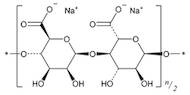
Alginato de sódio é um polissacarídeo de ocorrência natural derivado de algas marrons, composto principalmente por unidades de ácido manurônico e gulurônico. É um pó branco a amarelado que é solúvel em água, formando um gel viscoso ao ser hidratado. Este biopolímero é conhecido por sua capacidade de formar géis na presença de cátions divalentes, como íons de cálcio, tornando-o valioso em aplicações alimentícias, farmacêuticas e biomédicas. Alginato de sódio é amplamente utilizado como agente espessante, estabilizador e emulsificante em vários produtos alimentares, incluindo sorvetes e molhos para saladas. Na indústria farmacêutica, atua como agente de liberação de medicamentos e é utilizado em curativos devido à sua biocompatibilidade e capacidade de manter um ambiente úmido. Além disso, Alginato de sódio é reconhecido por sua baixa toxicidade e é geralmente considerado seguro para consumo. Suas propriedades únicas, como a formação de gel e viscosidade, fazem dele um ingrediente versátil em inúmeras aplicações industriais.
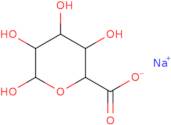
Fórmula:C5H7O4COONa
InChI:InChI=1/C6H10O7.Na/c7-1-2(8)4(5(10)11)13-6(12)3(1)9;/h1-4,6-9,12H,(H,10,11);/q;+1/p-1/t1-,2-,3-,4-,6+;/m0./s1
SMILES:C1(C(C(C(=O)O)OC(C1O)O)O)O.[Na]
Sinónimos:- 1-3F
- Algecolloid
- Algin
- Alloid
- Alman
- Alroid-G
- Alto
- Amnucol
- Ascophyllum
- EHV
- Flavicam
- GMB
- Gos-Lyi
- Halltex
- Kelcosol
- Kelgin
- Kelset
- Kelsize
- Keltex
- Keltone
- Kelvis
- Kimitex
- Lamitex
- MV
- Manucol
- Minus
- Mosanon
- Natriumalginat
- Nouralgine
- Nspll
- Pectalgine
- Proctin
- Pronova
- Protanal
- Protatek
- Seacor
- Skat-Ulv
- Skat-Uvl
- Solgin
- Sorugin
- Stipine
- Tagat
- Tragaya
- Kelgin F
- Alginic acid, sodium salt
- Cohasal IH
- sodium 3,4,5,6-tetrahydroxytetrahydro-2H-pyran-2-carboxylate (non-preferred name)
- alginic acid sodium
- Polymannuronic acid sodium salt
- Sodium alginate
- SODIUM ALIGINATE
- sodium (2S,3S,4S,5S,6R)-3,4,5,6-tetrahydroxytetrahydro-2H-pyran-2-carboxylate (non-preferred name)
- daridqh
- antimigrantc45
- ALGINIC SODIUM
- cecalginetbv
- algin(polysaccharide)
- algiponl-1168
- algiline
- Alginic acid monosodium salt
- SODIUM ALGINATE 500-600
- SODIUM ALGINATE 80-120
- SODIUM ALGINATE 300-400
- alginatekmf
- FEMA 2015
- Ver mais sinónimos
Ordenar por
Pureza (%)
0
100
|
0
|
50
|
90
|
95
|
100
Sodium alginate, viscosity 250 - 350 mPa.s
CAS:Sodium alginate is a natural polysaccharide that is extracted from seaweed and used as an emulsifier, thickener, and stabilizer in food products. It is also used to create a gel with water or other liquids. The viscosity of sodium alginate can be modified by adding sugar, glycosylation, or methylation. Click modification is used to introduce fluorine atoms into the polymer backbone. Sodium alginate may be modified by adding oligosaccharides or monosaccharides for use as a bio-sorbent in wastewater treatment plants.Cor e Forma:PowderSodium alginate, high viscosity
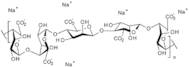
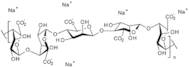
CAS:Sodium salt of a polysaccharide obtained from the brown seaweeds (e.g. Laminaria hyperborea, Fucus vesiculosus, Ascophyllum nodosum). The chemical structure consists of blocks of (1,4) linked-β-D-polymannuronic acid (poly M), (1,4) linked-α-L-polyguluronic acid (poly G) and alternating blocks of the two uronic acids (poly MG). Alginates form strong gels with divalent metal cations and the egg box model has been used to describe this form of gelation. The main use for alginate is in textile printing as a thickener in the printing of cottons with reactive dyes. In the food industry it is used as a thickener and gelling agent. Recently, it has been shown that ternary mixtures of Konjac glucomannan, Xanthan gum and Sodium alginate can form a non-covalently linked complex which exhibits enhanced rheological properties of value in, for example, functional foods. The image was kindly provided by Prof Mike Guiry from Cork who runs ‘The Seaweed Site’.High viscosity (500-500mPa.s).Pureza:Min. 95%Cor e Forma:White PowderSodium alginate, Laminaria Hyperborea
CAS:Sodium alginate is a biocompatible polymer that is used in the treatment of wastewater. It is a water-soluble substance that forms a viscous solution when dissolved in water. Sodium alginate has been shown to inhibit the growth of bacteria and fungi, as well as to reduce the number of coliforms and other microorganisms in water. The potential for an alginate to be biocompatible depends on its chemical structure, with Laminaria Hyperborea being the most biocompatible. Alginates have been shown to have surface properties that are similar to those of natural tissue, making them useful for wound dressings.Viscosity: 10-20 mPa.sFórmula:C6H9NAO7Cor e Forma:PowderPeso molecular:216.12 g/molSodium alginate, low viscosity
CAS:Sodium salt of a polysaccharide obtained from the brown seaweeds (e.g. Laminaria hyperborea, Fucus vesiculosus, Ascophyllum nodosum). The chemical structure consists of blocks of (1,4) linked-β-D-polymannuronic acid (poly M), (1,4) linked-α-L-polyguluronic acid (poly G) and alternating blocks of the two uronic acids (poly MG). Alginates form strong gels with divalent metal cations and the egg box model has been used to describe this form of gelation. The main use for alginate is in textile printing as a thickener in the printing of cottons with reactive dyes. In the food industry it is used as a thickener and gelling agent. Recently, it has been shown that ternary mixtures of Konjac glucomannan, Xanthan gum and Sodium alginate can form a non-covalently linked complex which exhibits enhanced rheological properties of value in, for example, functional foods. The image was kindly provided by Prof Mike Guiry from Cork who runs ‘The Seaweed Site’.Viscosity: min 50 mPa.sCor e Forma:White PowderSodium Alginate LV extrapure, 4-12cps, 30mesh
CAS:Cor e Forma:White to Beige and Faint Brown to Light Brown, PowderSodium alginate, viscosity 300 - 600 mPa.s
CAS:Sodium alginate is the sodium salt of a polysaccharide obtained from brown seaweeds. The main use for alginate is in textile printing as a thickener in the printing of cottons with reactive dyes. In the food industry it is used as a thickener and gelling agent. The chemical structure consists of blocks of (1,4) linked-β-D-polymannuronic acid (poly M), (1,4) linked-α-L-polyguluronic acid (poly G) and alternating blocks of the two uronic acids (poly MG).Cor e Forma:PowderSodium alginate, viscosity 100 - 150 mPa.s
CAS:Sodium alginate is a soluble fiber that is extracted from brown seaweed. It is a natural carbohydrate that can be modified to create a variety of sugar-based derivatives, such as Oligosaccharides, Monosaccharides, and Custom Synthesis. Sodium alginate has been modified with Fluorination, Methylation, Glycosylation, and Click Modification to create high-purity products for various applications.Pureza:90.8 To 106.0%Cor e Forma:Powder