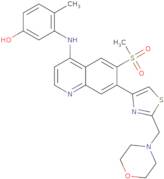
CAS 955879-81-9
:Fórmula:C25H26N4O4S2
InChI:InChI=1S/C25H26N4O4S2/c1-16-3-4-17(30)11-21(16)27-20-5-6-26-22-12-19(24(13-18(20)22)35(2,31)32)23-15-34-25(28-23)14-29-7-9-33-10-8-29/h3-6,11-13,15,30H,7-10,14H2,1-2H3,(H,26,27)
Chave InChI:KNLRJRUFOIDTER-UHFFFAOYSA-N
SMILES:CC1=C(C=C(C=C1)O)NC2=C3C=C(C(=CC3=NC=C2)C4=CSC(=N4)CN5CCOCC5)S(=O)(=O)C
Filtrar por
Percentagem de pureza
0
100
|
0
|
50
|
90
|
95
|
100
Foram encontrados 1 produtos.
- Preços em ordem crescente
- Preços em ordem decrescente
- Menor grau de pureza
- Maior grau de pureza
- Estimativa de entrega mais rápida
4-Methyl-3-((6-(methylsulfonyl)-7-(2-(morpholinomethyl)thiazol-4-yl)quinolin-4-yl)amino)phenol
CAS:4-Methyl-3-(6-methylsulfonyl-7-(2-(morpholinomethyl)thiazol-4-yl)quinoline-4-ylamino)phenol (MTQ) is a signal molecule that has been found to induce cellular transformation. MTQ binds to the signal peptide of the protein and then enters the cell. It is then phosphorylated by a kinase, which causes it to bind to DNA. The binding of MTQ to DNA activates transcription factors, which leads to an increase in gene expression and cancer cell growth. MTQ has been shown to activate signal pathways and inhibit polymerase chain reactions in myeloma cells. This agent also inhibits the movement of chromosomes during mitosis, leading to cell death.Fórmula:C25H26N4O4S2Pureza:Min. 95%Peso molecular:510.6 g/mol