Enzima
Os inibidores de enzimas são moléculas que se ligam a enzimas e diminuem sua atividade. Esses inibidores são amplamente utilizados em pesquisas para estudar a cinética enzimática, regulação e o papel de enzimas específicas nas vias metabólicas. Os inibidores de enzimas também são cruciais no desenvolvimento de medicamentos, pois muitos agentes terapêuticos funcionam inibindo enzimas envolvidas em processos patológicos. Ao direcionar enzimas, esses inibidores podem modular vias bioquímicas e oferecer tratamentos potenciais para várias doenças. Na CymitQuimica, oferecemos uma ampla seleção de inibidores de enzimas de alta qualidade para apoiar sua pesquisa em bioquímica, farmacologia e descoberta de medicamentos.
Subcategorias de "Enzima"
- Anidrase carbónica(178 produtos)
- Hidroxilase(30 produtos)
- MPO(2 produtos)
- Redutase(52 produtos)
- Tirosinase(67 produtos)
Foram encontrados 3587 produtos de "Enzima"
Ordenar por
Pureza (%)
0
100
|
0
|
50
|
90
|
95
|
100
Chymase
CAS:<p>Chymase (alternative names mast cell protease 1, mast cell serine proteinase, skeletal muscle protease, EC 3.4.21.39) is a serine protease, found in mast cells and basophil granulocytes.</p>Pureza:Min. 95%Adenylate Kinase 1, human, recombinant
<p>Adenylate kinase 1 (EC 2.7.4.3) catalyzes interconversion between ATP, ADP and AMP by catalyzing the following reaction: ATP + AMP ⇔ 2 ADP One unit of Adenylate kinase 1 will convert 1.0 µmol ATP and 1.0 µmol AMP to 2.0 µmol ADP per min at optimum conditions.</p>Pureza:Min. 95%α Amylase enzyme
<p>Alpha Amylase (Amylase, α-Amylase, 1,4-α-D-glucan glucanohydrolase, glycogenase, systematic name 4-α-D-glucan glucanohydrolase; EC 3.2.1.1, CAS Number [9000-90-2]) is an enzyme that catalyses hydrolysis of large polysacharides into smaller fragments. Alpha amylase targets alpha bonds of 1→4 glycosidic linkages of poly- and oligosaccharides with three or more D-glucose units. One unit of Alpha Amylase will catalyze the hydrolysis of 1.0 μmol of 2-chloro-4-nitrophenyl-α-D-maltotrioside to yield 2-chloro-4-nitrophenol per minute at 37°C. Human pancreatic Alpha Amylase is supplied as clear, colorless to light yellow liquid solution at ≥400U/mL, specific activity ≥100 U/mg protein.Store at 2-8 °C on arrival.</p>Pureza:Min. 95%Transglutaminase from guinea pig liver
CAS:<p>Transglutaminase (2.3.2.13) is an enzyme that catalyzes formation of isopeptide bonds between the γ-carboxamide groups ( -(C=O)NH2 ) of glutamine side chains and amino groups. The donor of the amino group is usually (but not always) an ε-amino group ( -NH2 ) of lysine residue. The reaction also releases ammonia: Gln-(C=O)NH2 + NH2-Lys → Gln-(C=O)NH-Lys + NH3One unit of transglutaminase will catalyze the formation of 1.0 μmole transglutamination product per min at pH 6.0 and 37 °C.</p>Pureza:Min. 95%Amylase protein
<p>Alpha Amylase (Amylase, α-Amylase, 1,4-α-D-glucan glucanohydrolase, glycogenase, ptyalin; systematic name 4-α-D-glucan glucanohydrolase; EC 3.2.1.1, CAS Number [9000-90-2]) is an enzyme that catalyses hydrolysis of large polysacharides into smaller fragments. Alpha amylase targets alpha bonds of 1→4 glycosidic linkages of poly- and oligosaccharides with three or more D-glucose units. One unit of Alpha Amylase will catalyze the hydrolysis of 1.0 μmol of 2-chloro-4-nitrophenyl-α-D-maltotrioside to yield 2-chloro-4-nitrophenol per minute at 37°C. Human salivary Alpha Amylase is supplied as clear, colorless liquid solution at ≥2000U/mL, specific activity ≥200 U/mg protein. Store at -20°C on arrival.</p>Pureza:Min. 95%Ribonuclease A
CAS:<p>Ribonuclease A (RNase A) is widely used to break down RNA in DNA purification. RNase A catalyzes the endonucleolytic cleavage of phosphodiester bonds of RNA.</p>Alkaline phosphatase
CAS:<p>One unit of alkaline phosphatase (EC 3.1.3.1) will hydrolyze 1.0 µmol of 4-nitrophenyl phosphate per min at 25°C and pH 9.6.</p>Pureza:Min. 95%Cor e Forma:PowderCathepsin B from human placenta
CAS:<p>Cathepsin B is a lysosomal proteolytic enzyme of the cysteine protease family. It is present in all mammalian cells. It is essential for the intracellular protein turnover. Cathepsin B may be a useful tool in Alzheimer′s research, as it may have a role in the natural defense against the disease.</p>Pureza:Min. 95%Lactase - >300U/mg
CAS:<p>beta-Galactosidase (EC 3.2.1.23, shortly beta-Gal, also know as lactase) catalyses the hydrolysis of beta-d-galactoside in the presence of water to galactose and alcohol, or lactose into glucose and galactose. beta-Gal has a molecular weight of 540,000 and is composed of four identical subunits of MW 135,000, each with an independent active site. The enzyme has divalent metals as cofactors, with chelated Mg2+ ions required to maintain active site conformation. The molecule contains numerous sulfhydryl groups and is glycosylated.</p>Neuron-specific enolase human
CAS:<p>Neuron-specific enolase human (ENO2, Enolase 2, Neural enolase, Gamma-enolase, Phosphopyruvate hydratase, 2-phospho-D-glycerate hydro-lyase; EC 4.2.1.11) is the enzyme that is catalyzes the following reaction: 2-phospho-D-glycerate ⇌ phosphoenolpyruvate + H2O One unit of enolase will convert 1.0 μmole of 2-phosphoglycerate to phosphoenolpyruvate per min.</p>PNPase
<p>Specific activity: >500 units/mg-protein.Unit definition: One unit will polymerize 1.0 micro mole of ADP, releasing 1.0 micro mole of inorganic phosphate in 15 minutes at pH 9.1 at 37 °C.</p>Aminoacyl tRNA synthetase-IN-1
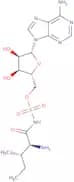
CAS:<p>Enzyme involved in protein translation and catalyzes the aminoacylation reaction</p>Fórmula:C16H25N7O7SPureza:Min. 95%Cor e Forma:PowderPeso molecular:459.48 g/molLipase Kit, 25 unique EUCODIS® lipases, recombinant - EL Kit
<p>Lipases belong to the family of esterases and naturally act on triglycerides at lipid-water interfaces. Lipases/esterases can be used as versatile tools in hydrolytic reactions, esterifications and transesterification reactions in industrial and food applications. The Lipase kit contains 25 lipases with different pH and temperature optima and substrate specificity properties.</p>Butyrylcholinesterase
<p>Butyrylcholinesterase (BCHE, BuChE, PCHE, pseudocholinesterase, plasma cholinesterase, Acylcholine acyl-hydrolase, Choline esterase; EC 3.1.1.8, CAS No [9001-08-5]) is an enzyme that made in the liver and found mainly in blood plasma. It catalyzes the following reaction: Acylcholine + H2O → choline + carboxylic acidOne unit of Butyrylcholinesterase will change absorbance by 0.2 milliunits (mA) per minute at optimal buffer conditions and 37 ̊C. Equine serum butyrylcholinesterase is supplied as white to pale grey-green powder with activity of ≥50U/mg and specific activity of ≥300U/mg protein. It can be dissolved at 5 mg/mL concentration in 50 mM Tris-HCl pH 7.3 - 7.5, giving colorless to slightly green solution. Equine serum butyrylcholinesterase is activated by Ca2+, optimum pH 7-8, KM=18 µM (butyrylthiocholine at 25°C). Store at -20°C on arrival.</p>Alcohol Oxidase - vacuum-dried powder, >0.6 units/mg solid
CAS:<p>Alcohol oxidase (EC 1.1.3.13) is an enzyme that catalyzes the following chemical reaction: a primary alcohol + O2 + H2O ⇌ an aldehyde + H2O2 One unit of alcohol oxidase will oxidize 1.0 µmole of methanol to formaldehyde per min at pH 7.5 and 25 °C.</p>EUCODIS® CalB01, engineered variant of Candida antarctica Lipase B - ELCB01
<p>Lipases belong to the family of esterases and naturally act on triglycerides at lipid-water interfaces. Lipases/esterases can be used as versatile tools in hydrolytic reactions, esterifications and transesterification reactions in industrial and food applications. The CalB01 lipase has a temperature optimum in the 40 - 50 °C range and pH optimum between pH 5 and 8.</p>Citrate synthase
CAS:<p>Citrate synthase (E.C. 2.3.3.1) is an enzyme that catalyzes the following reaction: acetyl-CoA + oxaloacetate + H2O → citrate + CoA-SHOne unit of citrate synthase will form 1.0 μmole of citrate from acetyl-CoA and oxalacetate per min at pH 8.0 and 37 °C.Origin is porcine heart.Molecular weight ~ 49kDa (monomer) and ~ 98kDa (dimer)</p>Fórmula:C197H238O43S6Cor e Forma:PowderPeso molecular:3,486 g/molPlasmin
CAS:<p>Plasmin, human is a serin protease which present in the blood and is involved in the cleavage of cross-linked fibrin, a process known as fibrinolysis.One unit will produce one micromole of P-Nitroanilide from D-Val-Leu-Lys-P-Nitroanilide per minute at pH 7.5 at 37°C</p>Recombinant Isocitrate Dehydrogenase
CAS:<p>Recombinant Isocitrate Dehydrogenase is a bioengineered enzyme, which is derived from microbial or eukaryotic expression systems designed to mirror its naturally occurring form. This enzyme catalyzes the oxidative decarboxylation of isocitrate to alpha-ketoglutarate, utilizing NADP+ as a cofactor in the process. Its mode of action involves the conversion of isocitrate to alpha-ketoglutarate with the concomitant reduction of NADP+ to NADPH.</p>Pureza:Min. 95%