Enzima
Subcategorias de "Enzima"
- Anidrase carbónica(197 produtos)
- Hidroxilase(36 produtos)
- MPO(2 produtos)
- Redutase(51 produtos)
- Tirosinase(71 produtos)
Foram encontrados 3623 produtos de "Enzima"
Asparaginase, from E.coli, recombinant, lyophilized - EASP001
Asparaginase (EC 3.5.1.1) is an enzyme that catalyzes the following reaction: Asparagine + H2O → Aspartate + NH4+ Industrially, asparaginase is used to reduce the formation of acrylamide in starch-containing food ingredients and products during production processes. Asparaginase has a temperature optimum in the 30 – 50 °C range and pH optimum between pH 8 and 9. One unit will yield 1.0 μmole of ammonia from asparagine per min.Phosphorylase B from rabbit muscle
CAS:Phosphorylase B is an enzymatic protein, specifically an isoform of glycogen phosphorylase, derived from rabbit muscle. This enzyme plays a critical role in glycogen metabolism by catalyzing the phosphorolytic cleavage of α(1→4) glycosidic bonds in glycogen, releasing glucose-1-phosphate. The rabbit muscle source provides a well-studied model due to its high enzyme activity and availability, facilitating in-depth biochemical and structural analysis.
Pureza:Min. 95%Chitinase
CAS:Chitinase (systematic name (1→4)-2-acetamido-2-deoxy-β-D-glucan glycanohydrolase, EC 3.2.1.14) is a hydrolase that breaks down glycosidic bonds in chitin. One unit of chitinase will yield 1.0 mg of N-acetyl-D-glucosamine from chitin per hour at pH 6.0 and 25 °C.Fórmula:C17H16N8ZnPureza:Min. 95%Peso molecular:397.74 g/molRibonuclease A
CAS:Ribonuclease A (RNase A) is widely used to break down RNA in DNA purification. RNase A catalyzes the endonucleolytic cleavage of phosphodiester bonds of RNA.Superoxide dismutase PEG
Superoxide dismutase coupled to polyethylene glycol. Superoxide dismutase (EC 1.15.1.1) is an enzyme that catalyzes the following reaction: 2 H+ + 2 O2− → O2 + H2O2 thus converting an extremely reactive and cytotoxic superoxide radical into oxygen and (significantly less reactive) hydrogen peroxide.
Plasmin
CAS:Plasmin, human is a serin protease which present in the blood and is involved in the cleavage of cross-linked fibrin, a process known as fibrinolysis.One unit will produce one micromole of P-Nitroanilide from D-Val-Leu-Lys-P-Nitroanilide per minute at pH 7.5 at 37°CGlutathione peroxidase
CAS:Glutathione peroxidase (EC 1.11.1.9) is an enzyme that reduces peroxides to limit oxidative damage, by catalyzing the following reaction: 2 GSH + H2O2 → GS–SG + 2 H2O One unit of glutathione peroxidase will catalyze the conversion of 1.0 µmole of H2O2 per minute at pH 7.0 and 25 °C in the presence of reduced glutathione. Reduced glutahione is available here.Pureza:Min. 95%Peso molecular:84,500 g/molLactase - >300U/mg
CAS:beta-Galactosidase (EC 3.2.1.23, shortly beta-Gal, also know as lactase) catalyses the hydrolysis of beta-d-galactoside in the presence of water to galactose and alcohol, or lactose into glucose and galactose. beta-Gal has a molecular weight of 540,000 and is composed of four identical subunits of MW 135,000, each with an independent active site. The enzyme has divalent metals as cofactors, with chelated Mg2+ ions required to maintain active site conformation. The molecule contains numerous sulfhydryl groups and is glycosylated.Alcohol dehydrogenase, from yeast
CAS:Alcohol dehydrogenase (EC 1.1.1.1) is the enzyme that catalyzes interconversion between alcohols and aldehydes or ketones, using NAD+/NADH as a cofactor in the following reaction: CH3CH2OH + NAD+ ⇔ CH3CHO + NADH + H+ One unit of alcohol dehydrogenase will convert 1.0 µmol of ethanol to acetaldehyde per minute at pH 8.8 and 25 °C.
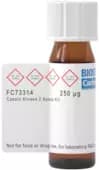
Casein Kinase 2
Casein kinase 2 (CK2, CSNK2; EC 2.7.11.1) is a constitutively active serine and threonine protein kinase. It plays a role in a range of cellular processes, including DNA repair, cell cycle control, metabolic regulation, circadian rhythms and more. Its known substrates include hundreds of proteins. One unit of CK2 will phosphorylate of 1 pmol of of peptide substrate in 1 minute at 30°C and presence of ATP.Fórmula:C45H73N19O24Pureza:Min. 95%Peso molecular:1,264.17 g/molProtein disulfide isomerase from bovine liver
CAS:An enzyme that catalyzes the formation and breakage of disulfide bonds in the folding of proteinsFórmula:C7H5Cl2NO5SPureza:Min. 95%Peso molecular:286.09 g/molCarboxypeptidase Y, from S. cerevisiae, recombinant, lyophilized - ECPY001
CAS:Carboxypeptidase Y (EC 3.4.16.1) is an exopeptidase enzyme. It hydrolyzes peptide bonds of C-terminal residues and it remains active in the presence of urea at low to moderate concentrations. One unit of the Carboxypeptidase Y will hydrolyze 1.0 μmole of a chromogenic peptide substrate, releasing C-terminal alanine and generating a light-absorbing product. Carboxypeptidase Y has been obtained from yeast S. cerevisiae, has a broad substrate specificity and can therefore be used in sequence analysis of proteins. Carboxypeptidase Y has a temperature optimum in the 20 – 30 °C range and pH optimum between pH 6 and 7.Aspartic acid proteinase
CAS:Aspartic acid proteinase is a type of proteolytic enzyme, which originates from various biological sources including humans, fungi, and plants. It is characterized by its action via two critical aspartic acid residues in the active site, which facilitate the hydrolysis of peptide bonds in proteins. This enzyme operates optimally in acidic environments, making it crucial in processes like digestion and protein processing within cellular compartments such as lysosomes.
Neuron-specific enolase human
CAS:Neuron-specific enolase human (ENO2, Enolase 2, Neural enolase, Gamma-enolase, Phosphopyruvate hydratase, 2-phospho-D-glycerate hydro-lyase; EC 4.2.1.11) is the enzyme that is catalyzes the following reaction: 2-phospho-D-glycerate ⇌ phosphoenolpyruvate + H2O One unit of enolase will convert 1.0 μmole of 2-phosphoglycerate to phosphoenolpyruvate per min.
Luciferase from Vibrio fischeri
CAS:Luciferase enzymes sourced from Vibrio fischeriCor e Forma:PowderEUCODIS® Nitrilhydratase 23, recombinant enzyme - ENH023
Nitrile hydratase 23 recombinantly expressed in E. coli comes in a freeze-dried formulation. Nitrile hydratases can be utilized to convert nitriles into their corresponding amides, e.g. to produce acrylamide from acrylonitrile. Additional applications include the removal of nitriles from industrial wastewater. Our nitrile hydratases have been tested for hydrolysis of the following substrates:cyclohexanecarbonitrile, cinnamonitrile, benzonitrile, methacrylonitrile, pivalonitrile.
Secreted Phospholipase A2-IIA, human, recombinant
The secreted phospholipase A2-IIA (sPLA2-IIA, PLA2, systematic name phosphatidylcholine 2-acylhydrolase; EC 3.1.1.4) is an enzyme that catalyses the hydrolysis of glycerophospholipids at the sn2 position, yielding 1-acylglycerophosphocholine and a fatty acid. One unit of secreted phospholipase A2-IIA will hydrolyze 1.0 μmole of substrate per min under optimal conditions.Pureza:Min. 95%Acid phosphatase
CAS:One unit will hydrolyse 1.0μmol of 4-nitrophenyl phosphate per minute at 37°C and pH 4.8. Substrate for enzyme analysis is the 4-nitrophenyl phosphate disodium hexahydrate (EN08508).Fórmula:C6H10O2Pureza:Min. 95%Peso molecular:114.14 g/molUbiquitin thiolesterase UCHL1
CAS:Ubiquitin thiolesterase UCHL1 (Ubiquitin carboxy-terminal hydrolase L1; EC 3.1.2.15) is an enzyme that hydrolyses small C-terminal ubiquitin adducts to regenerate ubiquitin.Ribonuclease T1 from aspergillus oryzae
CAS:Ribonuclease T1 is an endonuclease enzyme, which is derived from the fungus Aspergillus oryzae. It specifically cleaves single-stranded RNA at the 3' end of guanosine residues, which involves hydrolyzing the phosphodiester bond to produce 3′-phosphomononucleotides and 5′-hydroxylated oligonucleotides. This enzyme’s high specificity and catalytic efficiency make it valuable for various applications.Pureza:Min. 95%