Corantes, Pigmentos, Tinturas, Imagens Fluorescentes
Corantes, colorações e tinturas são ferramentas essenciais na biologia molecular, cruciais para visualizar e estudar o DNA, cromossomos e núcleos celulares. Esses compostos permitem que os pesquisadores destaquem componentes celulares específicos, facilitando a observação e análise detalhadas ao microscópio. Nesta categoria, você encontrará uma ampla gama de corantes e colorações de alta qualidade usados em várias técnicas de coloração, incluindo corantes fluorescentes para análise de DNA e cromossomos, colorações histológicas para amostras de tecido e corantes específicos para estruturas celulares. Essas ferramentas são indispensáveis em pesquisas genéticas, citologia, histologia e diagnósticos, proporcionando clareza e contraste em amostras biológicas. Na CymitQuimica, oferecemos uma seleção abrangente de corantes, colorações e tinturas para apoiar sua pesquisa em biologia molecular e garantir resultados precisos e confiáveis em seus estudos.
Subcategorias de "Corantes, Pigmentos, Tinturas, Imagens Fluorescentes"
- Corantes Ácidos(49 produtos)
- Azobenzenos(270 produtos)
- Corantes azóicos(7 produtos)
- Corantes básicos(27 produtos)
- Corantes de Cumarina(71 produtos)
- Corantes de cianina, corantes de Squarylium(53 produtos)
- Corantes de DCM(4 produtos)
- Diariletenos(12 produtos)
- Corantes de Dipirrometeno(26 produtos)
- Corantes directos(17 produtos)
- Corantes dispersos(2 produtos)
- Sensibilizadores de corantes(12 produtos)
- Corantes(416 produtos)
- Corantes e pigmentos(911 produtos)
- Geração de corantes insolúveis(14 produtos)
- Geração de corantes solúveis(11 produtos)
- Hexaarilbiimidazol(4 produtos)
- Indicadores(575 produtos)
- Corantes Mordente(10 produtos)
- Corantes de Infravermelhos-próximo (NIR)(28 produtos)
- Corantes a óleo(15 produtos)
- Outros Pigmentos e Corantes(2 produtos)
- Corantes de Perileno(17 produtos)
- Corantes fotocrómicos(40 produtos)
- Corantes de Ftalocianina, Corantes de Porfirina(101 produtos)
- Corantes de Quinacridona(8 produtos)
- Espiropirano(16 produtos)
- Pigmentos e Corantes(243 produtos)
- Pigmentos e Corantes para Microscopia(5 produtos)
- Corantes Vat(5 produtos)
- Corante Xanteno(65 produtos)
Exibir 23 mais subcategorias
Foram encontrados 756 produtos de "Corantes, Pigmentos, Tinturas, Imagens Fluorescentes"
Ordenar por
Pureza (%)
0
100
|
0
|
50
|
90
|
95
|
100
Direct Blue 15
CAS:Direct Blue 15 is a water-soluble organic dye that is used in electrochemical impedance spectroscopy for wastewater treatment. The high salt and physiological effects of Direct Blue 15 have been studied in dose groups of rats. Direct Blue 15 was not found to be carcinogenic to rats, but did cause liver lesions at high doses. However, it did not cause DNA damage or induce mutations in the calf-thymus DNA. The hydroxyl group on the molecule allows it to bind to amines, which may explain its toxicity and mutagenicity.Fórmula:C34H24N6O16S4Na4Pureza:Min. 95%Peso molecular:992.81 g/molC.I.Reactive Red 120
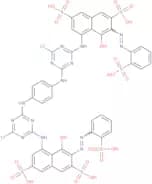
CAS:<p>C.I.Reactive Red 120 is a reactive dye that has been shown to adsorb onto the crystal structure of formic acid and react at a temperature of 50°C. C.I.Reactive Red 120 is also catalytic, with an efficiency of up to 80%. The antibacterial activity of this dye has been shown to be comparable to that of other dyes, such as Reactive Yellow 3 and Reactive Blue 15. This dye is used in the detection, identification, and quantification of bacteria by liquid chromatography (LC) with UV-visible spectroscopy or LC-MS/MS analysis. It can be used for bacterial identification in the presence of escherichia coli and bovine serum albumin (BSA) proteins as well as other interfering substances in biological samples.</p>Fórmula:C44H30O20N14S6Cl2Pureza:Min. 95%Cor e Forma:PowderPeso molecular:1,338.09 g/molSomatostatin-14 (reduced)
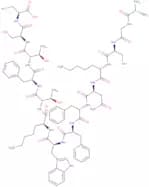
CAS:Somatostatin-14 (reduced) H-Ala-Gly-Cys-Lys-Asn-Phe-Phe-Trp-Lys-Thr-Phe-Thr-Ser-Cys is a synthetic peptide that is an adjuvant for vaccines. It induces a biphasic response by increasing the humoral immune response and decreasing the cellular immune response. Somatostatin has been shown to decrease the severity of symptoms in patients with psychiatric disorders and can be used as a long term treatment for these conditions. Somatostatin also has effects on the pancreas, such as inhibiting insulin release, leading to decreased blood glucose levels. Its disulfide bond in its structure may be important for its activity and stability.Fórmula:C76H106N18O19S2Pureza:Min. 95%Peso molecular:1,639.9 g/molVictoria blue B
CAS:<p>Victoria Blue B is a compound that contains potassium dichromate and sodium citrate. It has been shown to have high resistance against many types of bacteria, including human serum and cell nuclei. Victoria Blue B has been shown to adsorb nitrite ions from wastewater, which can be useful for the treatment of sewage or as an antimicrobial agent in biological samples. The mechanism by which Victoria Blue B does this is not yet fully understood.</p>Fórmula:C33H32N3ClPureza:Min. 70 Area-%Cor e Forma:PowderPeso molecular:506.08 g/mol([15N]Gly)-Glutathione (reduced)
CAS:Please enquire for more information about ([15N]Gly)-Glutathione (reduced) including the price, delivery time and more detailed product information at the technical inquiry form on this pagePureza:Min. 95%Tetrabromophenol blue
CAS:Tetrabromophenol blue is a model system for the study of the mechanism of action of protein-inhibiting drugs. It has been shown to inhibit cancer cells and human pathogens by binding to basic proteins in the cell membrane, thereby preventing their activity. Tetrabromophenol blue inhibits polymerase chain reaction (PCR) by acting as a competitive inhibitor with respect to DNA, and also inhibits fluorescein angiography by reducing the rate at which dye is taken up by cells. Tetrabromophenol blue binds to wild-type strains of bacteria and halts protein synthesis, but does not bind to mutant strains or human serum. This drug has been shown to be effective against hl-60 cells when used at physiological levels.Fórmula:C19H6Br8O5SPureza:Min. 95%Cor e Forma:Brown PowderPeso molecular:985.55 g/mol1,9-Dimethyl-methylene blue zinc chloride
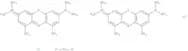
CAS:1,9-Dimethyl-methylene blue zinc chloride double salt is a fluorescent dye that has been used in the study of hyaluronic acid and mesenchymal stem cells. The compound absorbs light at a wavelength of 580 nm, which is the same as the absorption wavelength for hyaluronic acid and mesenchymal stem cells. 1,9-Dimethyl-methylene blue zinc chloride double salt can be used to measure the amount of these compounds in tissues. This dye also shows sensitivity to artifacts such as hemolysis and lipemia, making it useful for research purposes.Fórmula:(C18H22ClN3S)2•ZnCl2Pureza:Min. 95%Cor e Forma:PowderPeso molecular:832.11 g/molFluorol yellow 088
CAS:<p>Please enquire for more information about Fluorol yellow 088 including the price, delivery time and more detailed product information at the technical inquiry form on this page</p>Fórmula:C22H16OPureza:Min. 95%Peso molecular:296.36 g/molFluorescent Brightener 28
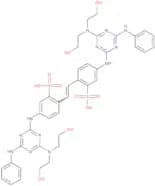
CAS:Fluorescent Brightener 28 is a fluorescent dye that is used for the diagnosis of opportunistic fungal infections. It is also used as a marker for cell proliferation in tissue culture. Fluorescent Brightener 28 binds to the signal-peptide region of RNA polymerase II and can be detected using immunofluorescence microscopy. The fluorescent signal is observed in the nucleus, cytoplasm, or both. Fluorescent Brightener 28 has been shown to bind to human α1-acid glycoprotein (AAG) and α2-macroglobulin, which can affect drug interactions. This dye has no effect on fatty acid metabolism and does not interfere with the test results when testing samples such as blood or urine.Fórmula:C40H44N12O10S2Pureza:Min. 95%Cor e Forma:PowderPeso molecular:916.99 g/mol(Z-Asp-Glu-Val-Asp)2-Rhodamine 110
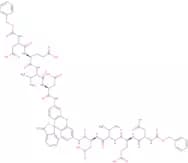
CAS:<p>Fluorogenic dye targeting caspase 3</p>Fórmula:C72H78N10O27Pureza:Min. 95%Peso molecular:1,515.44 g/molBrilliant green
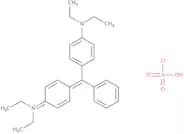
CAS:Brilliant green is a polymerase chain reaction (PCR) reagent that is used to monitor the progress of DNA amplification. It has been shown to bind specifically to double-stranded DNA and prevent the RNA polymerase from binding, thereby preventing transcription and replication. This dye may be used as an antimicrobial agent in wastewater treatment, where it can inhibit the growth of Aerobacter aerogenes. The adsorption properties of Brilliant green have been studied using an electrochemical impedance spectroscopy and Langmuir adsorption isotherm techniques. The hydrophobic interactions between this dye and the anhydrous sodium surface have also been investigated by structural analysis.Fórmula:C27H34N2O4SCor e Forma:Green PowderPeso molecular:482.64 g/molC.I.Direct Red 83:1
CAS:C.I.Direct Red 83:1 is a dye that has been used in wastewater treatment to remove color. It is a polymerized dye that has been shown to be more efficient than the decolouration process, which is the traditional method of removing color from wastewater. The light source for this process must be within the range of 350-500 nm and at least 100 mW/cm2 intensity. This dye has also been shown to be an effective photolysis agent for organic compounds such as phenols, amines, and sulfides.Pureza:Min. 95%C.I.Solvent red 197
CAS:C.I.Solvent Red 197 is a dye that is soluble in organic solvents and has a particle size of less than 10 microns. It is used in the textile industry as an extracellular dye and can be used for the production of polyols, uv irradiation, corrosion inhibitor, high concentrations, condensation products, high resistance, organic solvent, volatile oil, substrate film and polymerization initiator. The dye also exhibits affinity ligand properties which are used in microcapsules to bind to substances such as proteins or nucleic acids.Fórmula:C23H19N5OPureza:Min. 85 Area-%Peso molecular:381.43 g/molC.I.Disperse Orange 25
CAS:C.I. Disperse Orange 25 is a dye that has been used in the textile industry for over 30 years. It is soluble in water and has low toxicity, and is not considered hazardous to health. C.I. Disperse Orange 25 is used as an optical sensor and fluorescent agent in kinetic studies of biological treatment of wastewater, and it can also be used as a reactive or activated antimicrobial agent. The dye can be synthesized using supercritical fluid technology, which makes it a potential candidate for use with radiation-sensitive polymers to form polymer matrices with antimicrobial properties that are resistant to microbial attack by radiation.Fórmula:C17H17N5O2Pureza:Min. 95%Peso molecular:323.35 g/molAcid Yellow 3 Aluminum Lake
CAS:Please enquire for more information about Acid Yellow 3 Aluminum Lake including the price, delivery time and more detailed product information at the technical inquiry form on this pagePureza:Min. 95%Cor e Forma:PowderXTT sodium
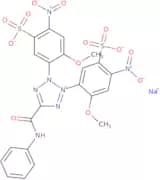
CAS:XTT sodium salt is a tetrazolium salt, which forms water-soluble formazan on bioreduction and has been used to assess cell viability by production of an orange colour.Fórmula:C22H17N7O13S2•NaPureza:Min. 95%Cor e Forma:PowderPeso molecular:674.53 g/molPigment red 48 (C.I. 15865)
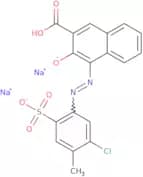
CAS:<p>Pigment Red 48 (C.I. 15865) is a red organic pigment that is soluble in water and most organic solvents. It has a melting point of 200°C and is used in paints, plastics, textiles, paper, and other products. Pigment Red 48 (C.I. 15865) can be synthesized by the diazonium salt coupling reaction between an aromatic amine and an acid chloride. The pigment also has a hydroxyl group that enables it to form covalent bonds with other molecules such as polymers or proteins. Pigment Red 48 (C.I. 15865) is used in many products because of its high stability, excellent heat resistance, low toxicity, non-irritating properties, high transparency, and good color fastness to light and washing.BR> Pigment Red 48 (C.I. 15865) is not considered hazardous according to the Globally Harmonized System of Classification and Lab</p>Fórmula:C18H11ClN2Na2O6SPureza:Min. 95%Peso molecular:464.79 g/molBenz[b]indeno[1,2-d]pyran-3,4,6a,9,10(6H)-pentol, 7,11b-dihydro-,(6aS,11bR)-
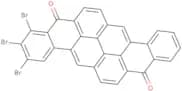
CAS:Fórmula:C16H14O6Pureza:97%Cor e Forma:SolidPeso molecular:302.27876C.I.Vat Orange 4
CAS:<p>C.I. Vat Orange 4 is a synthetic organic compound that is used as a pigment and a coating. It is soluble in organic solvents and can be used as an additive to polyethylene glycols, monomers, and coatings. C.I. Vat Orange 4 has been shown to react with radiation and metal hydroxides to form the polymerization inhibitor propionate. This polymerization inhibitor prevents polymerization reactions from occurring at high temperatures or when exposed to thermal energy.</p>Pureza:Min. 95%



![([15N]Gly)-Glutathione (reduced)](/_next/image/?url=https%3A%2Fstatic.cymitquimica.com%2Fproducts%2F3D%2Fthumb-webp%2FFG109306.webp&w=3840&q=75)



![Benz[b]indeno[1,2-d]pyran-3,4,6a,9,10(6H)-pentol, 7,11b-dihydro-,(6aS,11bR)-](/_next/image/?url=https%3A%2Fstatic.cymitquimica.com%2Fproducts%2FIN%2Fthumb-webp%2FDA00I98R.webp&w=3840&q=75)