Compostos Deuterados
Foram encontrados 4233 produtos de "Compostos Deuterados"
Diethylene glycol d8
CAS:Produto ControladoDiethylene glycol d8 is a deuterated analog of diethylene glycol. It is synthesized from ethylene oxide and diethylene glycol by substitution of one hydrogen atom with deuterium. The sequences of this molecule have been determined, yielding a traceless product that can be used as a synthetic intermediate in the production of imidazoles. Diethylene glycol d8 is also used to study anions, acidic materials, and isotopic labeling. This compound has been methylated, butylated, or solvented to form different derivatives for use in studies on other molecules.
Fórmula:C4H2D8O3Pureza:Min. 97 Area-%Cor e Forma:Colorless Clear LiquidPeso molecular:114.17 g/molBenzidine D8
CAS:Produto ControladoBenzidine D8 is a benzidine compound that has been shown to be carcinogenic. It is used in the production of dyes and colorants, and it is found in wastewater from dyeing factories. Benzidine D8 has been detected in human urine, which may be due to occupational exposure. This chemical can also be found in the environment as a result of industrial discharge. The carcinogenicity of benzidine D8 is mediated by its ability to produce reactive metabolites that bind to DNA, forming adducts. These adducts inhibit DNA replication and transcription, leading to cell death through inhibition of protein synthesis. Benzidine D8 undergoes metabolism via oxidative reactions with amines or hydrolysis with hydrophilic compounds such as alcohols or phenols, which are present at high levels in the bladder tissue. The risk of bladder cancer increases when benzidine D8 binds to these amines or hydrophilic compounds, resulting in the formation of reactive metabolites that can bind to DNA
Fórmula:C12H4D8N2Pureza:Min. 95%Peso molecular:192.28 g/molVitamin D3-d6
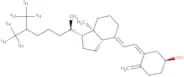
CAS:Produto ControladoVitamin D3-d6 is a vitamin that has ionizable properties. It is available in the form of an oil and can be used as a dietary supplement for infants, as well as adults. Vitamin D3-d6 has been validated by various assays, including those based on chemical ionization, high-performance liquid chromatography, and gas chromatography. Sample preparation procedures include saponification and extraction with isooctane. The analytical method involves detection by UV light at 254 nm or fluorescence at 365 nm. The efficiency of this vitamin is low because it easily degrades when exposed to light or air.Fórmula:C27H38D6OPureza:Min. 95%Cor e Forma:PowderPeso molecular:390.67 g/molProgesterone-d9
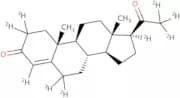
CAS:Produto ControladoProgesterone-d9 is a compound that is used in the diagnosis of adrenocortical carcinoma. It can be extracted from the serum of patients with this cancer using an acetate extraction technique. Progesterone-d9 has been shown to be a useful biomarker for short-term exposure to water contaminated with nomegestrol acetate, and it has also been shown to be a useful tool for wastewater treatment. The use of Progesterone-d9 as a biomarker is limited by its instability in human serum and its susceptibility to matrix effects. This compound can be analyzed by liquid chromatography mass spectrometry (LC-MS/MS) methods, which are sensitive and specific. A drawback of this analytical method is that it requires extensive sample preparation. The LC-MS/MS method can also be used to measure prosteroid levels, which have been found to correlate with levels of camp in humans.Fórmula:C21H21O2D9Pureza:Min. 95%Cor e Forma:Off-White To Yellow SolidPeso molecular:323.51 g/molTrideuteriomethylbenzene
CAS:Produto ControladoTrideuteriomethylbenzene is a chemical compound that contains three deuterium atoms. It is a member of the class of compounds called alkyl-deuteriomethylbenzenes, which are used as proton donors in chemical reactions. It has been shown to be an effective supercritical solvent for the separation of long-chain alcohols from hydrocarbons. Trideuteriomethylbenzene may also be used as a photoelectron donor for the determination of time constants and depression constants by electron diffraction.
Fórmula:C7H5D3Pureza:Min. 95%Peso molecular:95.16 g/mol24,25-Dihydroxy vitamin D2
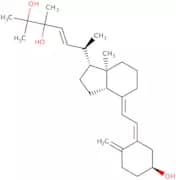
CAS:24,25-Dihydroxy vitamin D2 is a form of vitamin D that has been shown to be effective in the treatment of biliary cirrhosis and neonatal cirrhosis. It is synthesized from 25-hydroxyvitamin D3 by the enzyme 24-hydroxylase. The assay sensitivity for this compound is 10 ng/mL. This form of vitamin D has been shown to have an effect on serum bilirubin levels in patients with biliary cirrhosis. 24,25-Dihydroxy vitamin D2 can also be used to treat patients with chronic renal failure who are deficient in vitamin D3. The plasma concentration of 24,25-dihydroxyvitamin D2 is lower than that of 25-hydroxyvitamin D2 and 1,25-dihydroxyvitamin D2 because it is more rapidly metabolized by the liver.
Fórmula:C28H44O3Pureza:Min. 98 Area-%Cor e Forma:PowderPeso molecular:428.65 g/molTetrabenazine-d6
CAS:Produto ControladoTetrabenazine is a drug that is used to treat Parkinson's disease. It decreases the release of dopamine, which can reduce symptoms such as tremors and rigidity. Tetrabenazine has been shown to be an effective treatment for Parkinson's disease in clinical trials with long-term efficacy. Tetrabenazine also has a number of side effects, including hypotension, hallucinations, and depression.br>Tetrabenazine can interact with other drugs or medications such as monoamine oxidase inhibitors, antidepressants, or antipsychotics. This medication should not be taken by people who have liver impairment, because it may lead to liver damage. br>Tetrabenazine is a drug that belongs to the class of pharmacological agents known as selective monoamine reuptake inhibitors (SSRIs). These agents work by blocking the reuptake of serotonin (5-HT), dopamine (DA), or norepinephrine (NE) into the presFórmula:C19H21D6NO3Pureza:Min. 95%Peso molecular:323.46 g/mol1-Amino-2,4-imidazolidinedione-13C3
CAS:1-Amino-2,4-imidazolidinedione-13C3 is an antibiotic that belongs to the group of nitrofurans. It is used for the treatment of infections caused by bacteria that are resistant to other antibiotics. The LC-MS/MS analysis showed that 1-aminohydantoin was formed as a degradation product of chloramphenicol and that this metabolite had been detected in urine samples from patients treated with chloramphenicol. Nitrofuran is also a possible degradation product. A reaction monitoring experiment using ionization monitoring and monitoring on the precursor ion at m/z 287 confirmed the presence of 1-aminohydantoin in a sample containing both chloramphenicol and nitrofuran. Quantification was performed using calibration curves obtained from pure standards.Fórmula:C3H5N3O2Pureza:Min. 95%Peso molecular:118.12 g/mol4-Aminobiphenyl-D9
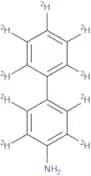
CAS:Produto Controlado4-Aminobiphenyl is a chemical compound that belongs to the group of aromatic amines. It is a human carcinogen and has been shown to cause cancer in animals. 4-Aminobiphenyl has been detected in the environment as an environmental pollutant and can be found in small quantities at low levels in food, air, and water. 4-Aminobiphenyl can be hydrolyzed by acid or alkaline hydrolysis to form its hydrolysate, which contains nitroarenes that are not present in the original compound. The DNA modification caused by 4-aminophenol may be due to its ability to modify DNA bases through reactive metabolites such as nitroarenes.
Fórmula:C12H2D9NPureza:Min. 95%Peso molecular:178.27 g/molrac 1,2-Bis-palmitoyl-3-chloropropanediol-D5
CAS:Produto ControladoRac-1,2-Bis-palmitoyl-3-chloropropanediol (rac1,2BPC) is a dispersive compound that has been used in the experimental phase of extraction. It has been shown to be efficient in the quantification and screening of fatty acids. Rac1,2BPC has also been used as a spiking agent for food samples to identify contaminants. The recoveries have been validated and linearity has been demonstrated. Rac1,2BPC is an anion that can be quantified by liquid chromatography with wavelength detection at 202 nm.
Fórmula:C35H62D5ClO4Pureza:Min. 95%Peso molecular:592.38 g/molIodoethane-d5
CAS:Produto ControladoIodoethane-d5 is a chromatographic reagent that is used for the determination of bond cleavage reactions. The reaction yield for bond cleavage reactions with iodoethane-d5 has been determined to be approximately 50%. Iodoethane-d5 is used in magnetic resonance spectroscopy, where it has been shown to be an effective probe for the measurement of proton and resonance mass. Iodoethane-d5 can also be used as a pharmacokinetic marker. It has been found that iodoethane-d5 is better than ethane at calculating pharmacokinetic parameters such as volume of distribution and clearance.Fórmula:CD3CD2IPureza:Min. 95%Cor e Forma:Colourless LiquidPeso molecular:160.99 g/molChloroacetic Acid-13C2
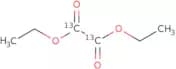
CAS:Please enquire for more information about Chloroacetic Acid-13C2 including the price, delivery time and more detailed product information at the technical inquiry form on this pagePureza:Min. 95%Diethyl oxalate-¹³C2
CAS:Please enquire for more information about Diethyl oxalate-¹³C2 including the price, delivery time and more detailed product information at the technical inquiry form on this pageFórmula:C4C2H10O4Pureza:Min. 95%Peso molecular:148.13 g/molDimethyl sulfoxide-d6
CAS:Produto ControladoDimethyl sulfoxide-d6, commonly called deuterated DMSO or DMSO-d6, differs isotopically from dimethyl sulfoxide (DMSO), in that the hydrogen atoms have been substituted by deuterium isotopes (2D). Dimethylsulfoxide-d6 is extensively used as an NMR solvent, which shows a characteristic shift observed at 2.50 ppm in 1H-NMR.
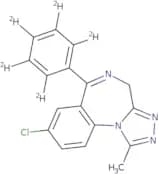
Fórmula:C2D6OSPureza:95%MinPeso molecular:84.17 g/molAlprazolam-D5 solution (100 ug/ml in methanol)
CAS:Produto ControladoAlprazolam is a benzodiazepine drug used as an anxiolytic, anticonvulsant, and sedative. It is one of the most commonly prescribed drugs in the United States. Alprazolam-d5 solution is a solution that contains alprazolam labeled with D5. It can be used for wastewater treatment to identify the presence of trifluoroacetic acid (TFA) in wastewater samples. The dispersive solid-phase extraction method was validated for use with this labeled compound by detecting alprazolam-d5 at concentrations of 0.0025 µg/mL or less in urine samples within 10 minutes. Alprazolam-d5 solution has been shown to be stable in acidic pH environments and can be used for detection times up to 2 hours.
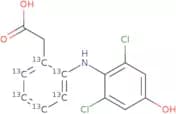
Fórmula:C17H8ClD5N4Pureza:Min. 95%Cor e Forma:Clear LiquidPeso molecular:313.8 g/mol4’-Hydroxy diclofenac-13C6
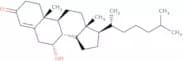
CAS:Please enquire for more information about 4’-Hydroxy diclofenac-13C6 including the price, delivery time and more detailed product information at the technical inquiry form on this pageFórmula:C6C8H11Cl2NO3Pureza:Min. 95%Cor e Forma:PowderPeso molecular:318.15 g/mol7-Hydroxy-4-cholesten-3-one-D7
CAS:Produto Controlado7-Hydroxy-4-cholesten-3-one-D7 (7OHCD7) is a metabolite of the bile acid, cholic acid. It is generated by the action of cholesterol 7α hydroxylase on cholesterol in the liver. It is excreted in bile, which is then absorbed back into the body from the gut and used for energy metabolism. 7OHCD7 has been shown to be an inhibitor of histone deacetylases, which are enzymes that regulate gene transcription. This inhibition leads to increased transcriptional regulation and reduced inflammatory responses in bowel disease models. 7OHCD7 has also been shown to increase cholesterol levels and reduce inflammation in humans with metabolic syndrome.
Fórmula:C27H44O2Pureza:Min. 95%Peso molecular:400.64 g/mol2-MCPD-d5
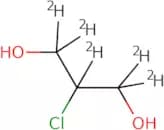
CAS:Produto Controlado2-MCPD-d5 is a deuterated fatty acid that can be used to calibrate gas chromatography for the determination of 2-MCPD in infant formula. The compound is processable and can be used as an internal standard. It has been validated by regression analysis and shown to have a good correlation with the sulfate solution method. 2-MCPD-d5 has been shown to produce reaction products that are similar to those produced by the methylation of 2-MCPD. This compound has also been shown to be useful as a model system for studying the formation of MCFA esters, including those containing sulfur, nitrogen, or oxygen.Fórmula:C3H2ClD5O2Pureza:Min. 95%Peso molecular:115.57 g/molHalobetasol Propionate-d5
CAS:Produto ControladoHalobetasol propionate-d5 is a steroid that is used to treat asthma. It is available as an inhalant, which is delivered directly into the lungs. When used in conjunction with another medication, such as salmeterol, it can help to reduce symptoms of asthma. Halobetasol propionate-d5 has been shown to be a potent anti-inflammatory agent that suppresses the inflammation of the airways and prevents asthma symptom. The drug does not have any negative side effects on lung function or respiratory muscles.Fórmula:C25H26D5F3O5SPureza:Min. 95%Peso molecular:505.6 g/molCholesterol-2,2,3,4,4,6-d6
CAS:Produto ControladoCholesterol-2,2,3,4,4,6-d6 is a chemical compound that is used as a reference standard for cholesterol. It is typically used in the preparation of samples for analysis by nuclear magnetic resonance spectroscopy and other analytical techniques. Cholesterol-2,2,3,4,4,6-d6 has been shown to be an effective inhibitor of influenza virus replication in vitro and in vivo. It also inhibits the replication of a number of other viruses including papillomavirus and herpes simplex virus. The molecule has been shown to bind to the viral membrane system with high affinity and specificity. Cholesterol-2,2,3,4,4,6-d6 also prevents the fusion of influenza virus with host cell membranes by inhibiting the conformational changes required for this process.Fórmula:C27D6H40OPureza:Min. 95%Peso molecular:392.69 g/mol