Organoborano
Os organoboranos são compostos orgânicos caracterizados pela presença de átomos de boro ligados ao carbono. Estes compostos são derivados da molécula BH3 e desempenham um papel importante em várias reações químicas, incluindo como intermediários na síntese orgânica. Na CymitQuimica, oferecemos uma ampla gama de organoboranos para apoiar suas necessidades de pesquisa e industriais. Nossos produtos são projetados para oferecer alto desempenho e confiabilidade em seus processos sintéticos.
Foram encontrados 6123 produtos de "Organoborano"
Ordenar por
Pureza (%)
0
100
|
0
|
50
|
90
|
95
|
100
2,6-Dimethylphenylboronic Acid
CAS:Produto Controlado<p>Applications 2,6-Dimethylphenylboronic acid<br></p>Fórmula:C8H11BO2Cor e Forma:NeatPeso molecular:149.982-(6,6-Dimethyl-1-cyclohexen-1-yl)-4,4,5,5-tetramethyl-1,3,2-dioxaborolane
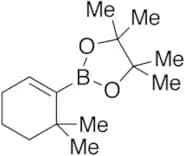
CAS:Produto Controlado<p>Applications 2-(6,6-Dimethyl-1-cyclohexen-1-yl)-4,4,5,5-tetramethyl-1,3,2-dioxaborolane was used in the preparation of conformationally constrained cyclic carboxylic acid derivatives useful as GPR40 modulators for treating metabolic disorders.<br></p>Fórmula:C14H25BO2Cor e Forma:NeatPeso molecular:236.1582-Acetylphenylboronic Acid
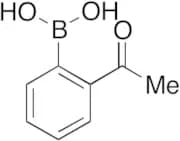
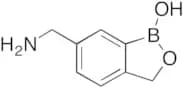
CAS:Produto Controlado<p>Applications 2-Acetylphenylboronic Acid is a reactant used in the synthesis of potent, selective phenylimidazole-based tissue factor/factor VIIa (FVIIa) inhibitors.<br>References Glunz, P.W., et. al.: Bioorg. Med. Chem. Lett., 25, 21699 (2015)<br></p>Fórmula:C8H9BO3Cor e Forma:NeatPeso molecular:163.976-(Aminomethyl)-1,3-dihydro-2,1-benzoxaborol-1-ol
CAS:Produto ControladoFórmula:C8H10BNO2Cor e Forma:NeatPeso molecular:162.982Isopropenylboronic Acid Pinacol Ester
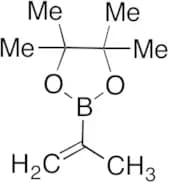
CAS:Produto Controlado<p>Applications Isopropenylboronic Acid Pinacol Ester, can be used as an intermediate in the synthesis of variety of cyclic and acyclic organic compounds. It is also shown that the α-Substituted Allyl/Croty of this compound can be used for highly Diastereo- and Enantioselective allylboration of aldehydes.<br>References Salaun, J. et al.: Topics in Curr. Chem. 1, 144 (1988); Chen, J. et al.: J. Amer. Chem. Soci., 135, 5316 (2013);<br></p>Fórmula:C9H17BO2Cor e Forma:NeatPeso molecular:168.042-tert-Butyldimethylsilyloxyethanol
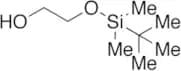
CAS:Produto Controlado<p>Stability Acid Sensitive<br>Applications 2-tert-Butyldimethylsilyloxyethanol (cas# 102229-10-7) is a compound useful in organic synthesis.<br> Not a dangerous good if item is equal to or less than 1g/ml and there is less than 100g/ml in the package<br></p>Fórmula:C8H20O2SiCor e Forma:NeatPeso molecular:176.333-(Cyclopropylcarbamoyl)phenylboronic Acid (>90%)
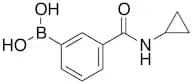
CAS:Produto Controlado<p>Applications 3-(Cyclopropylaminocarbonyl)phenylboronic acid<br></p>Fórmula:C10H12BNO3Pureza:>90%Cor e Forma:NeatPeso molecular:205.02Trimethylsilylethynyl(phenyl)iodonium Tetrafluoroborate
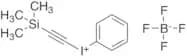
CAS:Produto Controlado<p>Applications Trimethylsilylethynyl(phenyl)iodonium Tetrafluoroborate is used in synthesis of 1-Alkynyl(triphenyl)arsonium Tetrafluoroborates by onium transfer reaction of 1-Alkynyl(phenyl)iodonium Tetrafluoroborates with Triphenylarsine. Also, used in preparation of Furan- and Thiophene-substituted alkynes and alkynyl ketones by Copper Iodide-catalyzed coupling and carbonylation of Heterocyclic Boronic Acids with Alkynyliodonium salts.<br>References Nagaoka, T., et al.: Tetrah. Lett., 36, 261-4 (1995); Yu, Chan-Mo, et al.: Synlett, 2631-2634 (2005);<br></p>Fórmula:C11H14ISi•BF4Cor e Forma:NeatPeso molecular:301.22 + 86.81trans-Campestanyl 3-(4-(tert-Butyldimethylsilyl)oxy)-ferulate
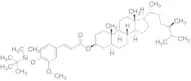
Produto Controlado<p>Applications trans-Campestanyl 3-(4-(tert-Butyldimethylsilyl)oxy)-ferulate is an intermediate used in the synthesis of trans-Campestanyl Ferulate (C155308), which is used for synthesis of trans-feruloyl-β-sitostanol.<br>References Condo, A., et al.: J. Agric. Food Chem., 49, 4961 (2001);<br></p>Fórmula:C44H72O4SiCor e Forma:NeatPeso molecular:693.1263-Isobutylphenylboronic Acid
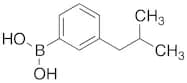
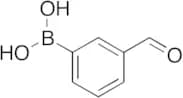
CAS:Produto ControladoFórmula:C10H15BO2Cor e Forma:NeatPeso molecular:178.0363-Formylphenylboronic Acid
CAS:Produto Controlado<p>Applications 3-Formylphenylboronic Acid is a reactant in the synthesis of I-BET726 (GSK1324726A), a potent tetrahydroquinoline ApoA1 up-regulator and selective BET bromodomain inhibitor.<br> Not a dangerous good if item is equal to or less than 1g/ml and there is less than 100g/ml in the package<br>References Gosmini, R., et. al.: J. Med. Chem., 57, 8111 (2014)<br></p>Fórmula:C7H7BO3Cor e Forma:NeatPeso molecular:149.944-(Morpholinosulfonyl)phenylboronic Acid Pinacol Ester
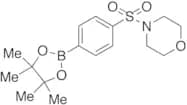
CAS:Produto ControladoFórmula:C16H24BNO5SCor e Forma:NeatPeso molecular:353.241Methoxy4-[[(1,1-dimethylethyl)dimethylsilyl]oxy]-3-benzenemethanol
CAS:Produto Controlado<p>Applications Methoxy4-[[(1,1-dimethylethyl)dimethylsilyl]oxy]-3-benzenemethanol, is prepared synthetically from vanillin (V097500) with an intermediate of methoxy-4-[[(1,1-dimethylethyl)dimethylsilyl]oxy]-3-benzaldehyde (M269710).<br>References Gowravarm, S. et al.: Adv. Synth. Catal., 343, 169 (2001)<br></p>Fórmula:C14H24O3SiCor e Forma:NeatPeso molecular:268.43Allyltrimethylsilane
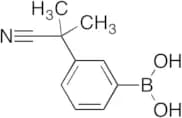
CAS:Produto Controlado<p>Stability Volatile<br>Applications Allyltrimethylsilane is used in the allylation of aldehydes, imines, allylic and benzylic alcohols, and chiral α-keto-amides that are derived from (S)-proline esters.<br> Not a dangerous good if item is equal to or less than 1g/ml and there is less than 100g/ml in the package<br>References Yadav, J.S., et al.: Tetrahedron Lett., 43, 3783 (2002); Aggarwal, V.K., et al.: Tetrahedron Lett., 37, 3745 (1996); Wang, D.K., et al.: J. Org. Chem., 64, 4233 (1999); Kaur, G., et al.: Tetrahedron Lett., 38, 2521 (1997); Soai, K., et al.: J. Chem. Soc., Chem. Commun., 15, 1016 (1984)<br></p>Fórmula:C6H14SiCor e Forma:NeatPeso molecular:114.263-(2-Cyanopropan-2-yl)phenylboronic acid
CAS:Produto ControladoFórmula:C10H12BNO2Cor e Forma:NeatPeso molecular:189.0191,1,1,5,7,7,7-Heptamethyl-3,3-bis[(trimethylsilyl)oxy]tetrasiloxane
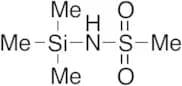
CAS:Produto Controlado<p>Applications 1,1,1,5,7,7,7-Heptamethyl-3,3-bis[(trimethylsilyl)oxy]tetrasiloxane is used in the analysis of organosilicon compounds (eg hexamethyldisiloxane) using gas chromatography or mass spectrometry.<br>References Wurst, M., et al.: Chromatographia, 6, 359 (1973), Wurst, M.: Chemicky Prumysl, 22, 124 (1972)<br></p>Fórmula:C13H40O5Si6Cor e Forma:NeatPeso molecular:444.967N-(Trimethylsilyl)methanesulfonamide
CAS:Produto ControladoFórmula:C4H13NO2SSiCor e Forma:NeatPeso molecular:167.302(2,5-Dimethylphenyl)boronic Acid
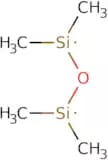
CAS:Produto Controlado<p>Applications (2,5-Dimethylphenyl)boronic Acid is a useful synthetic intermediate. It can be used to prepare fluorenones/indenofluorenediones.<br>References Liu, T., et al.: Org. Lett., 13, 2452 (2011)<br></p>Fórmula:C8H11BO2Cor e Forma:NeatPeso molecular:149.981,1,3,3-Tetramethyldisiloxane
CAS:<p>1,1,3,3-Tetramethyldisiloxane is a chemical compound that belongs to the group of functional groups. It can be isolated from hydrolysis of methyltrichlorosilane with sodium hydroxide and cellulose acetate. 1,1,3,3-Tetramethyldisiloxane has two isomers with different properties: 3-methylsilsesquioxane and 3-ethylsilsesquioxane. The former has an ethyl group at the end of its molecule and the latter has an ethyl group in the middle. The two isomers are not interchangeable because they have different physical properties. The 3-methylsilsesquioxane isomer reacts with aluminium to form a metathesis reaction product containing silanol groups on one side of the aluminum molecule and hydroxy groups on the other side. This product can be used as a catalyst for subsequent reactions in organic synthesis reactions involving</p>Fórmula:C4H14OSi2Pureza:Min. 95%Cor e Forma:Clear LiquidPeso molecular:134.32 g/molBoron carbide - 10um particle size
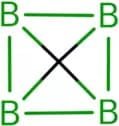
CAS:Produto ControladoBoron carbide is a hard, refractory material with high melting point. It is used in the production of ceramic and as a catalyst. Boron carbide has been shown to be effective in the treatment of wastewater due to its ability to adsorb organic matter and heavy metals. Boron carbide also has thermal expansion properties that make it suitable for use in various engineering applications. Boron carbide is composed of boron and carbon atoms, which interact through steric effects. The nitrogen atoms on the surface of boron carbide particles are responsible for its reactivity with other materials, such as silicon or zirconium oxide. The kinetic energy of the reaction mechanism can be determined by examining the surface methodology of boron carbide particles with a microscope.Fórmula:B4CPureza:Min. 95%Peso molecular:55.25 g/mol


![Methoxy4-[[(1,1-dimethylethyl)dimethylsilyl]oxy]-3-benzenemethanol](/_next/image/?url=https%3A%2Fstatic.cymitquimica.com%2Fproducts%2FTR%2Fthumb-webp%2FM269715.webp&w=3840&q=75)

![1,1,1,5,7,7,7-Heptamethyl-3,3-bis[(trimethylsilyl)oxy]tetrasiloxane](/_next/image/?url=https%3A%2Fstatic.cymitquimica.com%2Fproducts%2FTR%2Fthumb-webp%2FH264925.webp&w=3840&q=75)