Organoborano
Os organoboranos são compostos orgânicos caracterizados pela presença de átomos de boro ligados ao carbono. Estes compostos são derivados da molécula BH3 e desempenham um papel importante em várias reações químicas, incluindo como intermediários na síntese orgânica. Na CymitQuimica, oferecemos uma ampla gama de organoboranos para apoiar suas necessidades de pesquisa e industriais. Nossos produtos são projetados para oferecer alto desempenho e confiabilidade em seus processos sintéticos.
Foram encontrados 6123 produtos de "Organoborano"
Ordenar por
Pureza (%)
0
100
|
0
|
50
|
90
|
95
|
100
Tris(trimethylsilyl)guanine
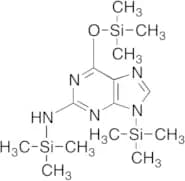
CAS:Produto Controlado<p>Applications Tris(trimethylsilyl)guanine is an intermediate used in the synthesis of 9-(2-Hydroxyethyl)guanine (H942035), which is an impurity of the antiviral agent Acyclovir (A192400). 9-(2-Hydroxyethyl)guanine is a nucleoside phosphotransferase acceptor.<br>References Kamimura, A. et al.: Agric. Biol. Chem., 37, 2037 (1973);<br></p>Fórmula:C14H29N5OSi3Cor e Forma:NeatPeso molecular:367.674-Phenoxyphenylboronic acid
CAS:<p>4-Phenoxyphenylboronic acid is a chemical inhibitor of protein kinase. It binds to the ATP binding site of the enzyme and prevents ATP from binding, thereby inhibiting the phosphorylation of proteins. This inhibition blocks the activation of downstream pathways that are involved in cell proliferation, leading to apoptotic cell death. 4-Phenoxyphenylboronic acid has been shown to inhibit growth of human cancer cells in vitro. This molecule also inhibits root formation and plant growth, which may be due to its ability to selectively inhibit protein kinases found in plant cells.</p>Fórmula:C12H11BO3Pureza:Min. 95%Peso molecular:214.02 g/mol(1-Fluorovinyl)methyldiphenylsilane
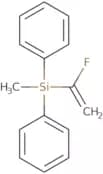
CAS:<p>1-Fluorovinylmethyldiphenylsilane is a reactive, cross-coupling reagent that is used to synthesize organofluorine compounds. It reacts with nucleophiles such as sulfoxides, peroxides, halides, and amines to form an organofluorine compound. The nucleophile can be either in the presence or absence of hydrogen peroxide as a catalyst. The product of this reaction can be a sulfoxide, peroxide, or amine. 1-Fluorovinylmethyldiphenylsilane has been shown to react with nitro groups and iodides to form organofluorine compounds. 1-Fluorovinylmethyldiphenylsilane is soluble in organic solvents such as hexane and chloroform. This reagent should not be stored in metal containers because it will react with them spontaneously.</p>Fórmula:C15H15FSiPureza:Min. 95%Peso molecular:242.36 g/molLithium tetrakis(pentafluorophenyl)borate ethyl etherate
CAS:Produto Controlado<p>Lithium tetrakis(pentafluorophenyl)borate ethyl etherate is a lithium salt of the etherate ester of pentafluorophenylboronic acid (B(C6F5)3). The complex is an electron donor and ligand, which can stabilize the high-energy intermediate state in the reaction. Lithium tetrakis(pentafluorophenyl)borate ethyl etherate reacts with magnesium to form a magnesium salt and ethylene. This product can be used as a co-catalyst for coupling reactions, such as the synthesis of cyclic compounds from alkenes.</p>Fórmula:C24BF20·(C4H10O)2·LiPureza:Min. 95%Peso molecular:760.11 g/mol1-(difluoromethyl)-4-(4,4,5,5-tetramethyl-1,3,2-dioxaborolan
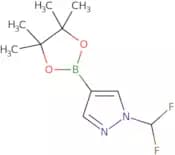
CAS:<p>Please enquire for more information about 1-(difluoromethyl)-4-(4,4,5,5-tetramethyl-1,3,2-dioxaborolan including the price, delivery time and more detailed product information at the technical inquiry form on this page</p>Fórmula:C10H15BF2N2O2Pureza:Min. 95%Peso molecular:244.05 g/molIsopentylboronic acid
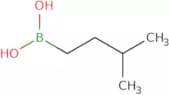
CAS:<p>Isopentylboronic acid is a boron-containing organic compound that is used for the catalysis of cross-coupling reactions, such as the Suzuki reaction. It reacts with aryl halides to form an alkylboronic ester and a metal salt. Isopentylboronic acid is also used to produce trimers in the presence of formyl or nitro groups. Isopentylboronic acid may also be used as a reagent to convert alcohols into chlorides or bromides. This compound has been shown to react with alkali metal ions on one side and alkyl substituents on the other side, leading to deuterium incorporation at the carbon atom adjacent to the carboxylic acid group. Isopentylboronic acid can also be used for dehydrating alcohols and converting alkynes into alkenes when heated in the presence of an alkali metal chloride.</p>Fórmula:C5H13BO2Pureza:Min. 95%Peso molecular:115.97 g/molPotassium vinyltrifluoroborate
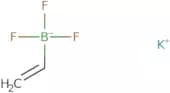
CAS:<p>Potassium vinyltrifluoroborate is a salt that contains the inorganic anion potassium and the organic ligand vinyltrifluoroborate. It is used as an electrolyte in electrochemical cells, such as fuel cells, to increase power output by increasing the conductivity of the electrolyte. This compound has been shown to be effective against chronic kidney disease and infectious diseases such as HIV and malaria. Potassium vinyltrifluoroborate also has anti-cancer properties due to its ability to inhibit cellular proliferation and induce apoptosis in cancer cells. The mechanism of action of this drug is still unclear but may be due to its ability to inhibit proteases, such as ns3 protease found in human erythrocytes.</p>Fórmula:C2H3BF3KPureza:Min. 95%Cor e Forma:PowderPeso molecular:133.95 g/mol(2,4-Dimethylphenyl)boronic acid
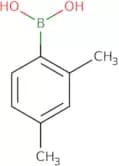
CAS:<p>(2,4-Dimethylphenyl)boronic acid is an arylboronic acid that is used in organic synthesis. The boron atom of the 2,4-dimethylphenyl group coordinates with the metal atom in the catalyst to form a stable complex. This allows for a multilayer reaction and fluorescence to occur. The activated fluorine atoms can be used to boost the reaction by adding them to the substrate and increasing the rate of oxidation. Astragalus membranaceus and rapeseed extracts have been shown to increase the rate of oxidation as well as inhibiting the formation of disaccharides. These extracts also have shown anti-inflammatory effects when tested on rats. (2,4-Dimethylphenyl)boronic acid has also been found to interact with dihydroisoquinolines, which are compounds that are structurally similar to morphine and codeine.</p>Fórmula:C8H11BO2Pureza:Min. 95%Peso molecular:149.98 g/molEthylamine-boron trifluoride
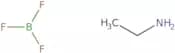
CAS:Produto Controlado<p>Ethylanine-boron trifluoride complex (EBTF) is a reactive intermediate that is used in the synthesis of epoxy resins. EBTF reacts with dibutyltin oxide to produce a boron-containing reaction product. The mechanism of this reaction has been studied using fluorescence probes and is found to be dependent on temperature and concentration. EBTF also reacts with epoxides, glycol ethers, and fatty acids to form similar products with different structures. This chemical can be used as a thermal expansion agent for coatings or as a crosslinking agent in polymers.</p>Fórmula:C2H7BF3NPureza:Min. 95%Cor e Forma:White To Off-White SolidPeso molecular:112.89 g/molPinacol vinylboronate
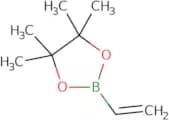
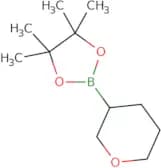
CAS:<p>Pinacol vinylboronate is an anticancer agent that has been shown to inhibit the growth of cancer cells. Pinacol vinylboronate inhibits the activity of cellular targets and generates reactive oxygen species through a hydrogen-bond-mediated mechanism, which eventually leads to cell death. This drug has also been shown to have functional groups that act as pharmacophores for cancer, which may be due to its ability to form hydrogen bonds with the hydroxyl group in DNA.</p>Fórmula:C8H15BO2Pureza:Min. 95%Cor e Forma:Clear LiquidPeso molecular:154.01 g/molTetrahydropyran-3-boronic acid pinacol ester
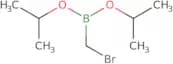
CAS:<p>Please enquire for more information about Tetrahydropyran-3-boronic acid pinacol ester including the price, delivery time and more detailed product information at the technical inquiry form on this page</p>Fórmula:C11H21BO3Pureza:Min. 95%Peso molecular:212.09 g/molDiisopropyl(bromomethyl)boronate
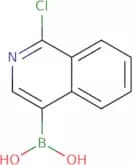
CAS:<p>Diisopropyl(bromomethyl)boronate is a reagent used in organic synthesis. It is an alkynyl boronic ester that reacts with alkenes to form new carbon-carbon bonds. Diisopropyl(bromomethyl)boronate can be used for the asymmetric synthesis of α,β-unsaturated carbonyl compounds and other oxidations of aldehydes and ketones. This reagent has been shown to have a high yield, solvents are not required for its preparation, and it is stable at room temperature. Diisopropyl(bromomethyl)boronate also reacts with haloalkanes and argon gas to generate organoboranes.</p>Fórmula:C7H16BBrO2Pureza:Min. 95%Peso molecular:222.92 g/mol(1-Chloroisoquinolin-4-yl)boronic acid
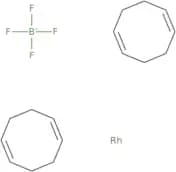
CAS:<p>Please enquire for more information about (1-Chloroisoquinolin-4-yl)boronic acid including the price, delivery time and more detailed product information at the technical inquiry form on this page</p>Fórmula:C9H7BClNO2Pureza:Min. 95%Peso molecular:207.42 g/molBis (1,5-Cyclooctadiene) rhodium(I)tetrafluoroborate
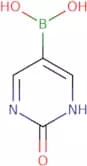
CAS:<p>Bis (1,5-Cyclooctadiene) rhodium(I)tetrafluoroborate (BODIPY) is a catalyst that enhances the rate of hydrosilylation reactions. This catalyst has been shown to be effective in the synthesis of aryl chlorides from amines and aldehydes with high enantioselectivity. BODIPY is also immobilized on silica gel to create an active catalyst for asymmetric synthesis. The immobilization process on silica gel is done by reacting BODIPY with ammonium formate and amines. The resulting catalyst can be used for the synthesis of functionalized organic compounds, such as pyrrolidines, tetrahydrofurans, and thiophenes.</p>Fórmula:C16H24BF4RhPureza:Min. 95%Peso molecular:406.07 g/mol2-Hydroxypyrimidine-5-boronicacid
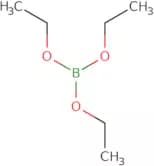
CAS:<p>Please enquire for more information about 2-Hydroxypyrimidine-5-boronicacid including the price, delivery time and more detailed product information at the technical inquiry form on this page</p>Fórmula:C4H5BN2O3Pureza:Min. 95%Peso molecular:139.91 g/molTriethyl borate
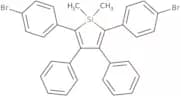
CAS:<p>Triethyl borate is an inorganic acid that is used as a catalyst. It has been shown to react with hydrochloric acid and orthoboric acid to form hydrogen boron hydride (H3BO3) and water. It also reacts with hydrogen chloride, forming hydrogen boron chloride, which can be used to prepare the active form of boric acid. This reaction is reversible and the equilibrium can be shifted by adding a base such as sodium hydroxide or ammonia. Triethyl borate is reactive, so it should only be handled in well-ventilated areas. The structural analysis of this compound reveals that it contains two hydroxyl groups that are involved in intramolecular hydrogen bonding, which helps stabilize its structure. Triethyl borate has been shown to have anti-infectious properties, inhibiting the growth of infectious bacteria such as Staphylococcus aureus and Streptococcus pneumoniae.</p>Fórmula:C6H15BO3Pureza:Min. 95%Peso molecular:145.99 g/mol2,5-Bis(4-bromophenyl)-1,1-dimethyl-3,4-diphenylsilole
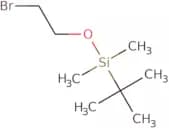
CAS:<p>Please enquire for more information about 2,5-Bis(4-bromophenyl)-1,1-dimethyl-3,4-diphenylsilole including the price, delivery time and more detailed product information at the technical inquiry form on this page</p>Fórmula:C30H24Br2SiPureza:Min. 95%Peso molecular:572.41 g/mol(2-Bromoethoxy)-tert-butyldimethylsilane
CAS:<p>2-Bromoethoxy-tert-butyldimethylsilane is a conjugate that has been shown to have anticancer efficacy in vivo. It is a pyrimidine derivative and inhibits the viral enzyme RNA polymerase, thereby inhibiting viral replication. 2-Bromoethoxy-tert-butyldimethylsilane also inhibits glyceraldehyde 3-phosphate dehydrogenase, which is an enzyme that catalyzes the conversion of glucose into glyceraldehyde 3-phosphate and plays an important role in glycolysis. The compound has been shown to be active against mouse tumors, which are associated with endogenous retroviruses. The compound has also been shown to inhibit gapdh, an enzyme involved in energy metabolism and cancer therapy.</p>Fórmula:C8H19BrOSiPureza:Min. 95%Cor e Forma:Colorless Clear LiquidPeso molecular:239.23 g/molPhenyl-1,2-carborane
CAS:Produto Controlado<p>Please enquire for more information about Phenyl-1,2-carborane including the price, delivery time and more detailed product information at the technical inquiry form on this page</p>Fórmula:C8H16B10Pureza:Min. 95%Cor e Forma:Colourless Or White To Off-White Solid Or Liquid (May Vary)Peso molecular:220.32 g/mol(3-Chloropropyl)diphenylsulfonium tetrafluoroborate
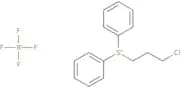
CAS:<p>Please enquire for more information about (3-Chloropropyl)diphenylsulfonium tetrafluoroborate including the price, delivery time and more detailed product information at the technical inquiry form on this page</p>Fórmula:C15H16ClS•BF4Pureza:Min. 95%Peso molecular:350.61 g/mol