Amidas
As amidas são uma ampla gama de compostos químicos que contêm pelo menos um anel heterocíclico, que possui átomos de pelo menos dois elementos diferentes na estrutura do anel, e pelo menos um grupo amida (-CONH2). Esses compostos são cruciais na síntese de produtos farmacêuticos, polímeros e agroquímicos. As amidas exibem propriedades e reatividade únicas, tornando-as intermediários valiosos na síntese orgânica. Na CymitQuimica, oferecemos uma seleção abrangente de amidas de alta qualidade para apoiar suas necessidades de pesquisa e industriais.
Foram encontrados 16485 produtos de "Amidas"
Ordenar por
Pureza (%)
0
100
|
0
|
50
|
90
|
95
|
100
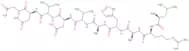
Amyloid b-Protein (1-40) amide trifluoroacetate salt
CAS:Please enquire for more information about Amyloid b-Protein (1-40) amide trifluoroacetate salt including the price, delivery time and more detailed product information at the technical inquiry form on this pageFórmula:C194H296N54O57SPureza:Min. 95%Peso molecular:4,328.82 g/mol2-Chloro-N-[2-(diethylamino)ethyl]-4-quinolinecarboxamide
CAS:2-Chloro-N-[2-(diethylamino)ethyl]-4-quinolinecarboxamide is a carboxamide analog of dibucaine. It is synthesized from chloroacetyl chloride and isatin in the presence of sodium hydroxide. The synthesis has been scaled to an industrial level. 2-Chloro-N-[2-(diethylamino)ethyl]-4-quinolinecarboxamide has been shown to have analgesic properties, similar to those of dibucaine. Radiolysis of this compound gives a carboxylic acid and a heterocyclic ring product.Fórmula:C16H20ClN3OPureza:95%MinCor e Forma:PowderPeso molecular:305.8 g/molPAR-4 (1-6) amide (human) trifluoroacetate salt
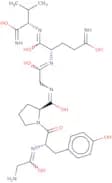
CAS:<p>Please enquire for more information about PAR-4 (1-6) amide (human) trifluoroacetate salt including the price, delivery time and more detailed product information at the technical inquiry form on this page</p>Fórmula:C28H42N8O8Pureza:Min. 95%Peso molecular:618.68 g/molHexahydroisonicotinamide
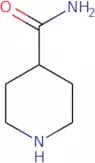
CAS:<p>Hexahydroisonicotinamide (HNI) is a potent amyloid protein inhibitor that is structurally related to picolinic acid. HNI has been shown to be effective in the treatment of infectious diseases caused by bacteria, such as diazonium salt-resistant strains of Pseudomonas aeruginosa and Enterobacter cloacae. Hexahydroisonicotinamide is also active against methicillin-resistant Staphylococcus aureus (MRSA), which may be due to its structural similarity to picolinic acid. The molecular weight of HNI is 587.6, with a molecular formula of C9H11N3O2. It has been shown that hexahydroisonicotinamide inhibits the transfer reaction between an amide and piperidinium, as well as the phosphorylation of proteins by enzyme kinases. This drug binds to hydrated biphenyl molecules and inhibits their</p>Fórmula:C6H12N2OPureza:Min. 95%Cor e Forma:White To Yellow SolidPeso molecular:128.17 g/molApelin-36 (1-16) amide (human) trifluoroacetate salt
CAS:Please enquire for more information about Apelin-36 (1-16) amide (human) trifluoroacetate salt including the price, delivery time and more detailed product information at the technical inquiry form on this pageFórmula:C74H117N27O20Pureza:Min. 95%Peso molecular:1,704.89 g/molPAR-4 (1-6) amide (mouse) trifluoroacetate salt
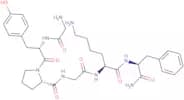
CAS:<p>PAR-4 (1-6) amide (mouse) trifluoroacetate salt H-Gly-Tyr-Pro-Gly-Lys-Phe-NH2 trifluoroacetate salt is a guanine nucleotide binding protein that belongs to the PAR family of proteins. It is expressed in wild type mice and binds to the cytosolic calcium, which regulates polymerase chain reaction. PAR-4 (1-6) amide (mouse) trifluoroacetate salt H-Gly-Tyr-Pro-Gly-Lys-Phe NH2 trifluoroacetate salt can be used as a potential drug target for epidermal growth factor. It has been shown to activate transcription polymerase chain and transcriptase polymerase chain during transcriptional regulation of messenger RNA.</p>Fórmula:C33H46N8O7Pureza:Min. 95%Peso molecular:666.77 g/molNeural-Cadherin (76-85) amide (chicken)
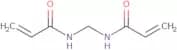
CAS:<p>Please enquire for more information about Neural-Cadherin (76-85) amide (chicken) including the price, delivery time and more detailed product information at the technical inquiry form on this page</p>Fórmula:C44H75N17O13Pureza:Min. 95%Peso molecular:1,050.17 g/molN,N'-Methylenediacrylamide
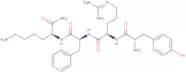
CAS:N,N'-Methylenediacrylamide is a water-soluble compound that has been used as a fluorescent probe for hydrogen bonding. It has been shown to have different phase transition temperatures in different solvents and can be used as an experimental model for studying the effects of temperature on the behavior of water molecules. N,N'-Methylenediacrylamide reacts with hydrochloric acid to form the fatty acid N,N'-methylenebis(3-chloroacrylic acid) under acidic conditions. This reaction is reversible, and the reverse process can be catalyzed by sodium citrate or human serum. When exposed to radiation or surface methodology, it emits light at a wavelength of 350 nm.Fórmula:C7H10N2O2Pureza:Min. 95%Cor e Forma:White Clear LiquidPeso molecular:154.17 g/mol(D-Arg2,Lys4)-Dermorphin (1-4) amide
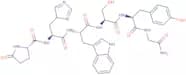
CAS:Dermorphin is a neuropeptide that has been shown to reduce cortisol levels in badgers and has been shown to have biological activity in vitro. Dermorphin also has a number of pharmacokinetic properties, including water solubility, lipid solubility, and oral bioavailability. The drug binds to δ receptors and inhibits the enzyme activities of rat liver microsomes. Dermorphin is used as an analgesic for bowel disease, such as inflammatory bowel disease or hypogaea. Dermorphin has antinociceptive properties (pain-relieving).Fórmula:C30H45N9O5Pureza:Min. 95%Peso molecular:611.74 g/molLHRH (1-6) amide Pyr-His-Trp-Ser-Tyr-Gly-NH2
CAS:Please enquire for more information about LHRH (1-6) amide Pyr-His-Trp-Ser-Tyr-Gly-NH2 including the price, delivery time and more detailed product information at the technical inquiry form on this pageFórmula:C36H42N10O9Pureza:Min. 95%Peso molecular:758.78 g/molGastric Inhibitory Polypeptide (6-30) amide (human) trifluoroacetate salt
CAS:Please enquire for more information about Gastric Inhibitory Polypeptide (6-30) amide (human) trifluoroacetate salt including the price, delivery time and more detailed product information at the technical inquiry form on this pageFórmula:C139H209N35O38SPureza:Min. 95%Peso molecular:3,010.43 g/molN-(3-Dimethylaminopropyl)acrylamide, stabilized with MEHQ
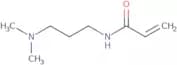
CAS:<p>N-(3-Dimethylaminopropyl)acrylamide is a polymerization initiator that is used in the synthesis of polymers. It is also a model protein, which can be used to study bacterial growth rates and tissue metabolism. N-(3-Dimethylaminopropyl)acrylamide has been shown to have biological properties similar to human serum, as well as to serve as a model for primary cells. The FT-IR spectroscopy of N-(3-Dimethylaminopropyl)acrylamide reveals the presence of chloride ions in its molecular structure. The reaction mechanism for this compound has been determined by deionized water and ionic reactions with chloride ions.</p>Fórmula:C8H16N2OPureza:Min. 95%Peso molecular:156.23 g/molN-Des(2-diethylamino) metoclopramide acetic acid
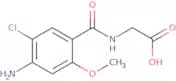
CAS:N-Des(2-diethylamino) metoclopramide acetic acid is a benzyl ester of metoclopramide, a prodrug that is metabolized to the active form in the body. It has been shown to be effective against healthy human subjects and hplc analyses of biological samples have shown it to be a metabolite of metoclopramide. N-Des(2-diethylamino) metoclopramide acetic acid is used as a catalyst for catalytic hydrogenation reactions, such as the conversion of methyl esters into ethyl or butyl esters. It can also be used for catalytic hydrogenation reactions with diazomethane, such as those required for the synthesis of quinolones.Fórmula:C10H11ClN2O4Pureza:Min. 95%Peso molecular:258.66 g/molNα-(5-fluoro-2,4-dinitrophenyl)-D-leucinamide
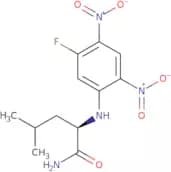
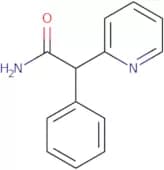
CAS:Nalpha-(5-fluoro-2,4-dinitrophenyl)-D-leucinamide is a chemical compound that inhibits the activity of proteases. It has been shown to inhibit leukemia cells and actinomycetes. This chemical binds to the active site of proteases, inhibiting the hydrolysis of peptides by blocking the access of water molecules to the reactive site. In addition, Nalpha-(5-fluoro-2,4-dinitrophenyl)-D-leucinamide can also be used as a fluorescent probe for protease activity in analytical methods. The product research on this compound has shown that it is a potent inhibitor of cyclic peptide synthetases and can be used as an anti-inflammatory agent.Fórmula:C12H15FN4O5Pureza:Min. 95%Cor e Forma:Off-White To Yellow SolidPeso molecular:314.27 g/molPhenyl-(2-pyridyl)acetamide
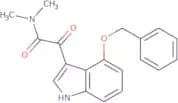
CAS:<p>Please enquire for more information about Phenyl-(2-pyridyl)acetamide including the price, delivery time and more detailed product information at the technical inquiry form on this page</p>Fórmula:C13H12N2OPureza:Min. 95%Peso molecular:212.25 g/mol4-(Benzyloxy)-N,N-dimethyl-indole-3-glyoxylamide
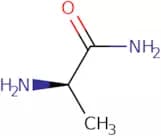
CAS:Please enquire for more information about 4-(Benzyloxy)-N,N-dimethyl-indole-3-glyoxylamide including the price, delivery time and more detailed product information at the technical inquiry form on this pageFórmula:C19H18N2O3Pureza:Min. 95%Peso molecular:322.36 g/mol(2R)-2-Aminopropanamide
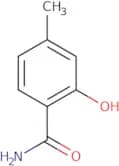
CAS:(2R)-2-Aminopropanamide is a chemical compound that is classified as an amide. It has been shown to inhibit bacterial growth and induce apoptosis in mammalian cells, but not in bacteria. This drug has a number of hydrogen bonding interactions with the carbonyl group and amide functional groups and can bind to affinity ligands with hydrogen bonding interactions. (2R)-2-Aminopropanamide inhibits the activity of enzymes that are involved in the synthesis of d-alanine, which is a precursor for protein synthesis. It also inhibits the enzyme glutamine synthase, which plays a key role in building up nitrogen reserves in bacteria. The drug binds to DNA by forming hydrogen bonds with the phosphate backbone and intercalates into double-stranded DNA by forming van der Waals interactions with base pairs.Fórmula:C3H8N2OPureza:Min. 95%Peso molecular:88.11 g/mol4-Methylsalicylamide
CAS:<p>4-Methylsalicylamide is a chemical compound that belongs to the class of isonicotinic amides. It is a potent anti-inflammatory agent with minimal inhibitory concentration (MIC) values of 4 µg/mL for gram-positive bacteria and 8 µg/mL for gram-negative bacteria. This compound has been shown to be effective against methicillin-resistant Staphylococcus aureus (MRSA) and Clostridium perfringens, although is not active against acid-fast bacteria such as Mycobacterium tuberculosis or Mycobacterium avium complex. 4-Methylsalicylamide has been shown to have an inhibitory effect on ring-opening, which may be due to its ability to acetylate mitochondrial membranes, altering the membrane potential. The molecular modeling studies also showed that 4MSAM binds at the same site as antibiotics such as penicillin and erythromycin in bacterial ribos</p>Fórmula:C8H9NO2Pureza:Min. 95%Cor e Forma:PowderPeso molecular:151.16 g/molSyndyphalin SD-33
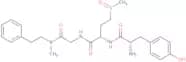
CAS:Please enquire for more information about Syndyphalin SD-33 including the price, delivery time and more detailed product information at the technical inquiry form on this pageFórmula:C25H34N4O5SPureza:Min. 95%Peso molecular:502.63 g/mol4-Amino-6-(trifluoromethyl)benzene-1,3-disulfonamide
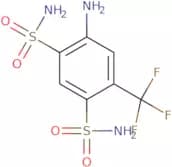
CAS:<p>4-Amino-6-(trifluoromethyl)benzene-1,3-disulfonamide (4AFBDS) is a chemical compound that can be used for the treatment of wastewater. It has shown to be effective against anhydrase, which is an enzyme that catalyzes the conversion of water to hydrogen peroxide and hydroxide ion. 4AFBDS also attenuates oxidative stress in cardiac cells and inhibits the production of active oxygen species by inhibiting the activity of carbonic anhydrase. The chromatographic method used to detect 4AFBDS was found to be more sensitive than a standard colorimetric assay, making it a better tool for detecting this compound in wastewater samples. br> br> br> br> br> This compound has been shown to have inhibitory effects on e3 ubiquitin ligase, which plays a role in protein degradation via aut</p>Fórmula:C7H8F3N3O4S2Pureza:Min. 95%Peso molecular:319.28 g/mol


![2-Chloro-N-[2-(diethylamino)ethyl]-4-quinolinecarboxamide](/_next/image/?url=https%3A%2Fstatic.cymitquimica.com%2Fproducts%2F3D%2Fthumb-webp%2FFC20289.webp&w=3840&q=75)