Glicociência
A glicociência é o estudo dos carboidratos e seus derivados, bem como das interações e funções biológicas em que participam. Este campo de pesquisa é crucial para compreender uma ampla variedade de processos biológicos, incluindo o reconhecimento celular, a sinalização, a resposta imune e o desenvolvimento de doenças. A glicociência tem aplicações importantes na biotecnologia, na medicina e no desenvolvimento de novos medicamentos e terapias. Na CymitQuimica, oferecemos uma ampla seleção de produtos de alta qualidade e pureza para pesquisa em glicociência. Nosso catálogo inclui monossacarídeos, oligossacarídeos, polissacarídeos, glicoconjugados e reagentes específicos, projetados para apoiar os pesquisadores em seus estudos sobre a estrutura, função e aplicações dos carboidratos em sistemas biológicos. Esses recursos são destinados a facilitar descobertas científicas e aplicações práticas em diversas áreas das biociências e da medicina.
Subcategorias de "Glicociência"
- Amino açúcares(108 produtos)
- Anticorpos Glico-Relacionados(282 produtos)
- Glicolípidos(46 produtos)
- Glicosaminoglicanos (GAGs)(55 produtos)
- Glicosídeos(419 produtos)
- Monossacáridos(6.624 produtos)
- Oligossacarídeos(3.682 produtos)
- Polissacáridos(503 produtos)
Foram encontrados 11046 produtos de "Glicociência"
Ordenar por
Pureza (%)
0
100
|
0
|
50
|
90
|
95
|
100
2-Azido-2-deoxy-3,4-(R)-benzylidene-D-arabino-1.5-lactone
2-Azido-2-deoxy-3,4-(R)-benzylidene-D-arabino-1.5-lactone is a fluorinated sugar that can be used for glycosylation reactions. It is a custom synthesis and its CAS number is 54856-82-9. This sugar has been modified with methyl groups to increase its stability in the presence of water. The sugar is highly pure and has a purity of 98%.Pureza:Min. 95%Glycyl-2'-fucosyllactose
<p>Glycyl-2'-fucosyllactose is a monosaccharide that is modified by glycosylation, methylation, and click modification. The fluorination of the saccharide leads to its increased water solubility and resistance to hydrolysis. Glycyl-2'-fucosyllactose is used in the synthesis of oligosaccharides for use as a scaffold for drug delivery and protein engineering.</p>Fórmula:C20H36N2O15Pureza:Min. 95%Peso molecular:544.5 g/mol1,2-Diacetate 3,4-di-O-methyl-D-xylopyranose
CAS:Please enquire for more information about 1,2-Diacetate 3,4-di-O-methyl-D-xylopyranose including the price, delivery time and more detailed product information at the technical inquiry form on this pageFórmula:C11H18O7Pureza:Min. 95%Peso molecular:262.26 g/molMan-7 Glycan, 2-AB labelled
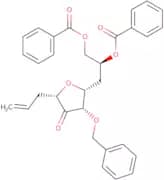
Man-7 Glycan is a synthetic, 2-AB labelled fluorinated monosaccharide. It is an oligosaccharide that is synthesized by the glycosylation of mannose and N-acetylglucosamine. This product has been modified with fluorination, methylation, and click chemistry.Pureza:Min. 95%(S)-3-((2R,3S,5S)-5-Allyl-3-(benzyloxy)-4-oxotetrahydrofuran-2-yl)propane-1,2-diyl dibenzoate
CAS:<p>(S)-3-((2R,3S,5S)-5-Allyl-3-(benzyloxy)-4-oxotetrahydrofuran-2-yl)propane-1,2-diyl dibenzoate is a small molecule that inhibits the activity of the epidermal growth factor receptor (EGFR). The EGFR is a transmembrane protein that binds to and signals through growth factor proteins. Inhibition of EGFR signaling prevents activation of downstream proteins such as extracellular signal regulated kinase 1/2 and phosphatidylinositol 3 kinase. This stabilized form has been shown to inhibit the growth of tumor cells in vitro and in vivo.</p>Pureza:Min. 95%Methyl 2,3,4-tri-O-benzoyl-α-D-glucopyranoside
CAS:Methyl 2,3,4-tri-O-benzoyl-α-D-glucopyranoside is a glycosylation agent that is used for the synthesis of complex carbohydrates and monosaccharides. This product is also used in Click chemistry as a reactive group. Methyl 2,3,4-tri-O-benzoyl-α-D-glucopyranoside can be fluorinated or saccharified to produce high purity sugars for use in pharmaceuticals. Methyl 2,3,4-tri-O-benzoyl -αD -glucopyranoside has CAS number 52621–71–3. It is synthesized through the reaction of benzaldehyde with glycerol in the presence of sodium hydroxide and potassium carbonate.Fórmula:C28H26O9Pureza:Min. 95%Cor e Forma:PowderPeso molecular:506.5 g/mol2-Deoxy-D-ribose
CAS:<p>Used in synthetic organic chemistry and natural product synthesis. Induces apoptosis by inhibiting the synthesis and increasing the efflux of glutathione. It is used for synthesis of optically active dipyrrolyl alkanols from pyrroles on the surface of montmorillonite KSF clay.</p>Fórmula:C5H10O4Pureza:Min. 98 Area-%Cor e Forma:White PowderPeso molecular:134.13 g/molDideoxyrhamnojirimycin
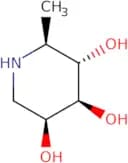
CAS:<p>Dideoxyrhamnojirimycin is a synthetic drug that has been modified to have the same structure as natural dideoxyribonucleosides. It is used in the treatment of myelodysplastic syndrome and thalassemia major. Dideoxyrhamnojirimycin inhibits DNA synthesis by blocking the incorporation of deoxyribonucleotides into DNA, which prevents cell division and stops the spread of cancer cells. Dideoxyrhamnojirimycin also has anti-inflammatory effects by inhibiting prostaglandin synthesis.</p>Pureza:Min. 95%2,3,5-Tri-O-benzyl-L-lyxofuranose
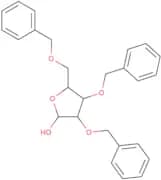
CAS:<p>2,3,5-Tri-O-benzyl-L-lyxofuranose is an acetal that is prepared by hydrolysis of 2,3,5-tri-O-benzylglycol with sodium methoxide in methanol. It can be made from the dimethyl acetal by displacement with sulphonate. The aldehyde group can be converted to an acetal by reaction with ethylene glycol and hydrochloric acid. The displacement of the aldehyde group with methoxide produces the acetal. Dimethyl acetals are also displaced by methyl iodide to produce aldehydes. Acetals are readily hydrolysed and acidic hydrolysis produces the corresponding alcohols.</p>Fórmula:C26H28O5Pureza:Min. 95%Peso molecular:420.5 g/mol5-O-Acetyl-1,2-O-isopropylidene-a-D-xylofuranose
CAS:5-O-Acetyl-1,2-O-isopropylidene a-D-xylofuranose is a fluorinated carbohydrate that is synthesized from acetylene gas and the sugar 1,2-O-isopropylidene. It is a complex carbohydrate that can be used as an additive in the food industry. 5-O Acetyl 1,2-O isopropylidene a D xylofuranose has been shown to act as an inhibitor of bacterial growth. It also has the ability to inhibit methylation and glycosylation reactions by competitively binding to the enzyme UDP-Nacetylglucosamine pyrophosphorylase. 5 O Acetyl 1,2 - O isopropylidene a D xylofuranose can be custom synthesized with high purity and it can be modified with methylation or glycosylation.Fórmula:C10H16O6Pureza:Min. 95%Cor e Forma:White to off-white solid.Peso molecular:232.23 g/mola-D-Mannose-1-phosphate ammonium salt
CAS:<p>a-D-Mannose-1-phosphate ammonium salt is a modification of an oligosaccharide, a carbohydrate that is complex in structure. It is a custom synthesis and has high purity. This product is also synthetic and monosaccharide, methylation, glycosylation, and fluorination have been performed on it. The CAS No. for this compound is 1388225-12-4.</p>Fórmula:C6H19O9PN2Pureza:Min. 95%Cor e Forma:PowderPeso molecular:294.2 g/molMethyl 2-O-methyl-α-D-xylofuranoside
CAS:<p>A partially protected methyl xyloside</p>Fórmula:C7H14O5Pureza:Min. 95%Cor e Forma:PowderPeso molecular:178.18 g/mol(5S)-3-Benzyloxycarbonylamino-5-(hydroxymethyl)-2(5H)-furanone
(5S)-3-Benzyloxycarbonylamino-5-(hydroxymethyl)-2(5H)-furanone, also known as (5S)-3-benzyloxycarbonylamino-5-(hydroxymethyl)furan-2(5H)one or 5′,6′-dihydroxy-3′,4′,5′-trimethoxyacetophenone is a modification of the carbohydrate with an Oligosaccharide. This modification is a custom synthesis that has been synthesized and provided in high purity and CAS number. It is a monosaccharide that can be methylated or glycosylated and has many different uses including in polysaccharides such as sugar. The fluorination of this saccharide provides it with an extra protection against degradation.Pureza:Min. 95%Amylopectin - from potato starch
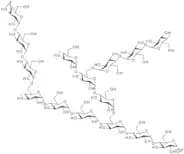
CAS:<p>Starch component; highly branched glucan</p>Cor e Forma:White Off-White PowderMono(6-mercapto-6-deoxy)-β-cyclodextrin
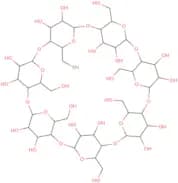
CAS:This beta-cyclodextrin (β-CD) derivative is a functionalized cyclic oligosaccharide composed of seven glucose units, characterized by a hydrophilic exterior and a lipophilic cavity (bigger than α-CD and smaller than γ-CDs), which allows it to encapsulate various guest molecules. This structural feature facilitates its use in multiple applications, including pharmaceuticals, food enhancement, and cosmetics. In the pharmaceutical industry, it enhances the solubility and stability of poorly water-soluble drugs, improving their bioavailability and efficacy while also masking unpleasant tastes. The food sector utilizes it as a stabilizer for flavors, colors, and nutrients, extending shelf life by protecting sensitive ingredients from degradation. In cosmetics, it serves as a complexing agent for fragrances and active components, ensuring their stability and controlled release. Its use expands to many other fields, including nanotechnology for drug delivery systems, environmental remediation for extracting organic pollutants, textiles for slow-release fragrances, and analytical chemistry for chiral separation.Fórmula:C42H70O34SPureza:Min. 95%Cor e Forma:PowderPeso molecular:1,151.05 g/mol2,6-Di-tert-butyldimethylsilyl-γ-cyclodextrin
This gamma-cyclodextrin (γ-CD) derivative is a modified cyclic oligosaccharide composed of eight glucose units, featuring a larger cavity size than α- and β-cyclodextrins. This structural characteristic allows γ-CDs to form inclusion complexes with a wider range of guest molecules, making it particularly versatile in various industries. In the food sector, it is used as a carrier and stabilizer for flavors, fat-soluble vitamins, and polyunsaturated fatty acids, protecting volatile compounds from evaporation. In pharmaceuticals, it enhances the solubility and bioavailability of poorly water-soluble drugs and, thanks to its larger ring size, allows for the encapsulation of larger molecules or even entire drug molecules. γ-CDs and derivatives are also used for environmental remediation and, in analytical chemistry, for the extraction and concentration of target substances.Fórmula:C144H304O40Si16Pureza:Min. 95%Peso molecular:3,125.3 g/molD-Raffinose pentahydrate
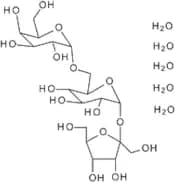
CAS:<p>Raffinose is the most abundant of the family of oligosaccharides that are alpha-galactosyl derivatives of sucrose (Collins, 2006). The other main member of the group is the tetrasaccharide stachyose. Raffinose is found in sugar beet molasses and whole grains. Soybean oligosaccharides make up approximately 5% of dry matter in whole beans and up to 8% of dry matter in soybean meal. Together raffinose and stachyose rank second only to sucrose in abundance, as water-soluble carbohydrates (Kumar, 2010).</p>Fórmula:C18H32O16·5H2OPureza:Min. 98 Area-%Cor e Forma:White PowderPeso molecular:594.51 g/mol4-O-Allyl-3,6-di-O-tert-butyldimethylsilyl-D-glucal
<p>4-O-Allyl-3,6-di-O-tert-butyldimethylsilyl-D-glucal is a custom synthesis of an oligosaccharide. It has been modified with fluorination, methylation, and click chemistry. 4-O-Allyl-3,6-di-O-tert-butyldimethylsilyl-D-glucal has been shown to be a high purity product that can be used in glycosylation reactions. This compound is very reactive and can be used in the synthesis of complex carbohydrates such as saccharides and polysaccharides.</p>Pureza:Min. 95%Methyl 2,3,4-tri-O-benzyl-6-O-triisopropylsilyl-a-D-mannopyranoside
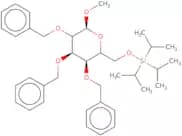
CAS:<p>Methyl 2,3,4-tri-O-benzyl-6-O-triisopropylsilyl-a-D-mannopyranoside is a glycosylation agent that can be used in the synthesis of oligosaccharides and polysaccharides. The compound is fluorinated at the C2 position and methylated at the C3 position. The final product is a white solid with a purity level of >99%. The molecular formula is CHO and the molecular weight is 522.9 g/mol.<br>Methyl 2,3,4-tri-O-benzyl-6-O-(1,1'-biphenyl)-aD manno pyranoside can be synthesized through click chemistry by reacting an alkyne (1) with trimethylsilylacetylene (2). This reaction yields an α,β unsaturated carbonyl (3), which undergoes pall</p>Fórmula:C37H52O6SiPureza:Min. 95%Peso molecular:620.91 g/molL-Iduronic acid sodium salt
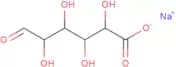
CAS:<p>L-iduronic acid (IdoA) (Collins, 2006) is the major uronic acid component of the glycosaminoglycans dermatan sulfate, chondroitin sulfate and heparin. Iduronic acid is also present in heparan sulfate, although in a minor amount relative to glucuronic acid. Glycosaminoglycans represent a physiologically important group of molecules involved in a variety of biological functions, such as, cell proliferation, cell-to-cell communication, wound healing, coagulation, morphogenesis, and pathogenesis. Glycosaminoglycans present an intriguing target for the design of new approaches for diagnostic and therapeutic agents against various infectious diseases (Kamhi, 2013).</p>Fórmula:C6H9NaO7Pureza:Min. 95%Cor e Forma:Slightly Yellow PowderPeso molecular:216.12 g/mol