Glicociência
Subcategorias de "Glicociência"
- Amino açúcares(108 produtos)
- Anticorpos Glico-Relacionados(282 produtos)
- Glicolípidos(46 produtos)
- Glicosaminoglicanos (GAGs)(55 produtos)
- Glicosídeos(419 produtos)
- Monossacáridos(6.616 produtos)
- Oligossacarídeos(3.718 produtos)
- Polissacáridos(502 produtos)
Foram encontrados 11011 produtos de "Glicociência"
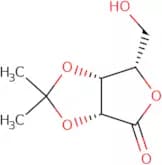
2,3-O-Isopropylidene-L-lyxonic acid-1,4-lactone
CAS:2,3-O-Isopropylidene-L-lyxonic acid-1,4-lactone is an enantiopure compound that is a member of the glycoside family. It has been shown to inhibit the activity of glycosidases, which are enzymes that hydrolyze glycosides. 2,3-O-Isopropylidene-L-lyxonic acid-1,4-lactone has an ambiguous stereochemistry due to its carbon chains and catalytic groups. The conformational analysis of this compound reveals that it can be classified as a chiral molecule because it lacks a plane of symmetry. Crystallographic analysis has shown that 2,3-O-Isopropylidene-L-lyxonic acid-1,4-lactone adopts a dimeric form and crystallizes in an asymmetric unit cell with space group P2(1)22(1).Fórmula:C8H12O5Pureza:Min. 97 Area-%Cor e Forma:White PowderPeso molecular:188.18 g/molMonosialyllacto-N-hexaose II
Monosialyllacto-N-hexaose II is a synthetic, fluorinated oligosaccharide that is synthesized by glycosylation of the sugar monosialyllactose. Monosialyllacto-N-hexaose II has a molecular weight of 514.5 Da and is soluble in water. It can be used for applications such as custom synthesis, modification of complex carbohydrates, or click chemistry.Pureza:Min. 95%N-(7-Oxadecyl)deoxynojirimycin
CAS:N-(7-Oxadecyl)deoxynojirimycin is a chaperone protein. It belongs to the group of proteins that are deficient in patients with type 1 glycogen storage disease and can be used to treat this condition. N-(7-Oxadecyl)deoxynojirimycin has been shown to bind to the endoplasmic reticulum, thereby preventing the maturation of certain proteins and their transport into other cellular compartments. This agent also has a protective function in muscle cells by preventing protein degradation due to abnormal folding or misfolding. The long-term effect of N-(7-Oxadecyl)deoxynojirimycin on skeletal muscle is unclear, although it has been found to be beneficial in the short term for patients with type 1 glycogen storage disease.
Fórmula:C15H31NO5Pureza:Min. 95%Cor e Forma:PowderPeso molecular:305.41 g/mol1,2,3,4,6-Penta-O-acetyl-a-D-glucopyranose
CAS:1,2,3,4,6-Penta-O-acetyl-a-D-glucopyranose is a chemical compound that is an ester of the sugar penta-O-acetyl-a-D-glucopyranose and acetic acid. It has been shown to inhibit the activity of a number of enzymes, including proteins such as phospholipases C and D and fatty acid synthetases. The 1,2,3,4,6-penta-O-acetyl analogues have been shown to be effective in inhibiting model systems for the pathogenesis of inflammatory bowel disease and cancer. The hydroxyl group on the sugar ring may be important for binding to these enzymes.Fórmula:C16H22O11Pureza:Min. 95%Cor e Forma:White PowderPeso molecular:390.34 g/mol2-Azido-((R)-3,5-O-benzylidene)-2,6-dideoxy- L-gluco-hexitol
2-Azido-((R)-3,5-O-benzylidene)-2,6-dideoxy-L-gluco-hexitol is a modified sugar that is synthesized from the natural sugar D-glucose. It has been fluorinated at the 2 position of the carbon chain to create an azido group. The chemical modification of this sugar allows for its use in a variety of applications, such as click chemistry, Methylation and Polysaccharide synthesis.Pureza:Min. 95%Kojibiose
CAS:A rare sugar, prebiotic fibre and inhibitor of α-glucosidases. It inhibits animal-, plant- and microorganism-derived α-glucosidases I. In rodent models for diabetes, it ameliorates arachidic acid-induced liver injury and reduces hepatic inflammatory markers.Fórmula:C12H22O11Pureza:Min. 99 Area-%Cor e Forma:White PowderPeso molecular:342.3 g/mol1-6-Bis- O- Tert.butyldimethylsilyl- 3, 4- O-isopropylidene)-D- mannitol
1-6-Bis-O-tert.butyldimethylsilyl-3,4-O-isopropylidene)-D-mannitol is a glycosylation agent that has been used in the synthesis of complex carbohydrates. This compound is synthesized by the click reaction between 1,6-bis(tert.butyldimethylsilyl)glycerol and aldehyde 3,4-(O)-isopropylidene)-D-mannitol. It is a high purity product with CAS No. 65425-06-7 and can be customized for your needs.Pureza:Min. 95%Polyguluronic acid
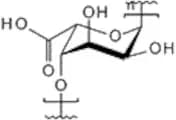
CAS:Polyguluronic acid is produced from alginates by partial hydrolysis and chromatography of brown algae such as Laminaria digitata, Ascophyllum nodosum and Fucus spp.
The image was kindly provided by Prof Mike Guiry from Cork who runs ‘The Seaweed Site’.MW is ca 6000 - 8000Da.poly-M levels are ca 3%Pureza:(%) Min. 80%Cor e Forma:Off-White PowderPeso molecular:194.14Benzoyl 2,3-O-isopropylidene-L-ribofuranoside
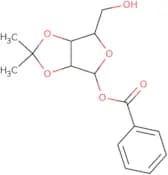
CAS:Benzoyl 2,3-O-isopropylidene-L-ribofuranoside is a custom synthesis that can be modified with fluorination and methylation. It is a monosaccharide that has been synthesized from L-ribose, which are sugar molecules found in the cell walls of bacteria. The chemical structure of benzoyl 2,3-O-isopropylidene-L-ribofuranoside has been shown to be similar to the sugar molecule found on glycoproteins on the surface of staphylococci. This chemical has also been shown to inhibit the production of enzymes that are necessary for the synthesis of glycosaminoglycans.Fórmula:C15H18O6Pureza:Min. 95%Peso molecular:294.3 g/mol1,4-β-D-Xylopentaose
CAS:Xylopentaose is a pentose sugar that belongs to the group of polyols. It has been shown to be a dietary supplement that improves the lipid profile in mice and humans, which may be due to its ability to inhibit diacylglycerol acyltransferase, thereby preventing the synthesis of triglycerides. Xylopentaose is also able to increase serum glucose levels by stimulating insulin secretion through the activation of pancreatic β-cells. Xylopentaose can be used as a sweetener because it has some sweetness but does not cause tooth decay like sugar does.Fórmula:C25H42O21Pureza:Min. 95%Cor e Forma:PowderPeso molecular:678.59 g/molMethyl 2,3,4-tri-O-benzoyl-6-O-triisopropylsilyl-a-D-glucopyranoside
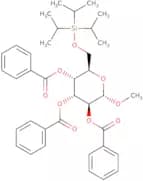
CAS:Methyl 2,3,4-tri-O-benzoyl-6-O-triisopropylsilyl-a-D-glucopyranoside is a Custom synthesis that is a complex carbohydrate. It is an Oligosaccharide with a Polysaccharide that is modified by Methylation and Glycosylation. This saccharide has CAS No. 356060-80-5 and can be found in Click modification and Synthetic. Methyl 2,3,4-tri-O-benzoyl-6-O-triisopropylsilyl-a-D -glucopyranoside has a high purity and fluorination level.Fórmula:C37H46O9SiPureza:Min. 95%Peso molecular:662.86 g/molN-Acetylmuramic acid
CAS:Component of peptidoglycan in bacterial cell walls. Peptidoglycan is a mesh-like polymer, made of a glycan backbone containing alternating subunits of Nâacetylglucosamine (GlcNAc) and Nâacetylmuramic acid (MurNAc). An enzyme substrate that is used to characterize and differentiate MurNAc and GlcNAc kinases.
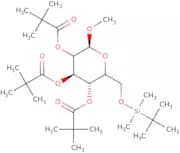
Fórmula:C11H19NO8Pureza:Min. 97 Area-%Cor e Forma:White PowderPeso molecular:293.27 g/molMethyl 6-O-tert-butyldimethylsilyl-2,3,4-tri-O-pivaloyl-a-D-galactopyranoside
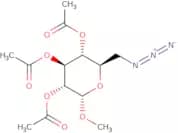
Methyl 6-O-tert-butyldimethylsilyl-2,3,4-tri-O-pivaloyl-a-D-galactopyranoside is a synthetic saccharide that can be used as a monosaccharide building block in the synthesis of complex carbohydrates. It has a CAS number and can be custom synthesized to meet the customer's needs. It is also fluorinated and can be modified with Click chemistry. This product is high purity and has been synthesized from glycosylation and fluorination.Fórmula:C28H52O9SiPureza:Min. 95%Peso molecular:560.81 g/molMethyl 2,3,4-tri-O-acetyl-6-azido-6-deoxy-a-D-glucopyranoside
CAS:Methyl 2,3,4-tri-O-acetyl-6-azido-6-deoxy-a-D-glucopyranoside is a modification of the sugar glucose. It is a synthetically modified oligosaccharide that is used in the synthesis of complex carbohydrates and polysaccharides. Methyl 2,3,4-tri-O-acetyl-6-azido-6-deoxyglucopyranoside has been used for the fluorination and saccharide methylation reactions.Fórmula:C13H19N3O8Pureza:Min. 95%Cor e Forma:White PowderPeso molecular:345.31 g/mol1,2-O-Isopropylidene-a-L-xylofuranose
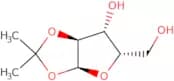
CAS:1,2-O-Isopropylidene-a-L-xylofuranose is a sulfate transport molecule that is present in the blood plasma. It binds to sulfate anions which are then transported by the sodium/sulfate co-transporter from the blood and into cells. This process is called equilibrative or facilitated transport. 1,2-O-Isopropylidene-a-L-xylofuranose also binds to adenosine and transports it across membranes. This process is regulated by surface receptors and uptake transporters that regulate the rate of adenosine uptake at different parts of the body.Fórmula:C8H14O5Pureza:Min. 98 Area-%Cor e Forma:White PowderPeso molecular:190.2 g/mol1,5-Anhydro-D-fructose
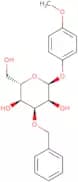
CAS:Antioxidant; antibacterial; suppresses LPS-induced inflammatory responseFórmula:C6H10O5Pureza:Min. 95%Cor e Forma:PowderPeso molecular:162.14 g/mol4-Methoxyphenyl 3-O-benzyl-β-D-galactopyranoside
CAS:4-Methoxyphenyl 3-O-benzyl-β-D-galactopyranoside is a microstructural stabilizer that can be used in the production of thermoelectric materials. It has been shown to inhibit the growth of bacteria and fungi at temperatures as low as −5°C. The compound has also been shown to have neuroprotective effects, which may be due to its ability to stabilize mitochondria and reduce oxidative stress. 4-Methoxyphenyl 3-O-benzyl-β-D-galactopyranoside is an endogenous ligand for unidentified receptors. It also binds to the amyloid protein in Alzheimer's disease, but does not show any significant toxicity in mice and rats.Fórmula:C20H24O7Pureza:Min. 95%Cor e Forma:Off-White PowderPeso molecular:376.4 g/molD-Allono-1,5-lactone
CAS:D-Allono-1,5-lactone is a glycoside that has been custom synthesized. It is a high purity product with a variety of modification options. This compound can be used for the synthesis of sugars, Click modification, fluorination, and glycosylation. D-allono-1,5-lactone has CAS No. 894408-50-5 and is classified as an oligosaccharide or sugar. It can also be methylated or modified to create saccharides or complex carbohydrates.Fórmula:C6H10O6Pureza:Min. 95%Peso molecular:178.14 g/molZiyuglycoside I
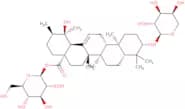
CAS:Ziyuglycoside I is a naturally occurring compound that has been shown to have physiological effects on skin cells. It has been found to bind to collagen and the matrix of skin cells, which may be its mechanism of action. Ziyuglycoside I also has an anti-inflammatory effect, which may be due to its ability to inhibit transcription-polymerase chain reactions (PCR). It has been shown to have antimicrobial activity against some strains of bacteria that are resistant to antibiotics such as erythromycin and tetracycline. Ziyuglycoside I has potential applications in the treatment of infectious diseases and inflammatory skin diseases.
Fórmula:C41H66O13Pureza:Min. 95%Cor e Forma:White PowderPeso molecular:766.95 g/molIron sucrose - 20% Iron
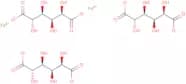
CAS:Iron sucrose is a form of iron that is used in the treatment of iron deficiency anemia. Iron sucrose is administered orally and absorbed in the small intestine. The amounts of iron absorbed are not sufficient to correct the underlying cause of iron deficiency anemia, but can be used as a substitute for oral iron therapy. Iron sucrose has been shown to be safe and effective in treating chronic bowel disease and may be useful in other diseases with inflammatory components, such as infectious diseases and inflammatory bowel disease. Iron sucrose may also be helpful for patients with congestive heart failure or nephrology dialysis who require supplemental erythropoietin.Fórmula:C12H22O11FePureza:Min. 95%Peso molecular:398.14 g/mol