Antivíricos
Os antivirais são compostos especificamente projetados para inibir a replicação e a propagação de vírus, desempenhando um papel crítico no tratamento e na prevenção de infecções virais. Nesta categoria, você encontrará uma seleção abrangente de agentes antivirais destinados exclusivamente a fins de pesquisa laboratorial. Esses produtos são essenciais para estudar os mecanismos virais, desenvolver novas terapias antivirais e compreender os padrões de resistência. Pesquisadores podem utilizar esses antivirais para investigar a eficácia e a segurança de tratamentos potenciais, contribuindo para o avanço da ciência médica e o desenvolvimento de medicamentos antivirais inovadores. A disponibilidade de diversos agentes antivirais apoia a pesquisa de ponta em virologia e aprimora nossa capacidade de combater doenças virais.
Foram encontrados 763 produtos de "Antivíricos"
Ordenar por
Pureza (%)
0
100
|
0
|
50
|
90
|
95
|
100
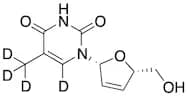
Stavudine-α,α,α,6-d4
CAS:Produto Controlado<p>Applications Stavudine-alpha,alpha,alpha,6-d4 (CAS# 1219803-67-4) is a useful isotopically labeled research compound.<br></p>Fórmula:C10H8D4N2O4Cor e Forma:NeatPeso molecular:228.24(3S,3aR,6aS)-Hexahydrofuro[2,3-b]furan-3-yl Acetate
CAS:Produto Controlado<p>Applications Darunavir intermediate.<br>References Ghosh, A., et al.: J. Med. Chem., 39, 3278 (1996), Ghosh, A., et al.: Bioorg. Med. Chem. Lett., 1998, 8, 687 (1998), Richman, D., et al.: Nature, 410, 995 (2001), Koh, Y., et al.: Antimicrob. Agents Chemother., 47, 3123 (2003),<br></p>Fórmula:C8H12O4Cor e Forma:NeatPeso molecular:172.18R 77975
CAS:Produto Controlado<p>Applications R 77975 is used to modulate lipophilicity in human rhinovirus capsid binders. It also is used in order to identify potential ativiral agents.<br>References Morley, A. et al.: Bioorg. Med. Chem. Lett., 21, 6031 (2011); Tomkinson, N. et al.: Bioorg. Med. Chem. Lett., 22, 7494 (2012);<br></p>Fórmula:C21H27N3O3Cor e Forma:NeatPeso molecular:369.46Levovirin
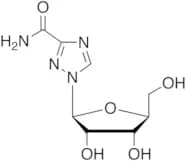
CAS:Produto Controlado<p>Applications Levovirin is a monocyclic L-nucleosides with type 1 cytokine-inducing activity. Levovirin is the L-enantiomer of Ribavirin (R414475) with similar immunomodulatory activity but does not have direct antiviral activity or hemolytic anemia.<br>References Ramasamy, K.S. et al.: J. Med. Chem., 43, 1019 (2000); Fang, C. et al.: J. Appl. Toxicol., 23, 453 (2003):<br></p>Fórmula:C8H12N4O5Cor e Forma:NeatPeso molecular:244.20(2S)-2-[[[(1,1-Dimethylethyl)diphenylsilyl]oxy]methyl]-1,3-oxathiolan-5-ol 5-Acetate
CAS:Produto ControladoFórmula:C22H28O4SSiCor e Forma:NeatPeso molecular:416.61Zanamivir Azide Methyl Ester
CAS:Produto Controlado<p>Applications An intermediate used in the preparation of Zanamivir derivatives.<br>References Andrews, D., et al.: Eur. J. Med. Chem., 34, 563 (1999), Altamore, T., et al.: Bioorg. Med. Chem., 14, 1126 (2006),<br></p>Fórmula:C12H18N4O7Cor e Forma:NeatPeso molecular:330.29(2'R)-2'-Deoxy-2'-fluoro-2'-methyl-uridine 5'-Triphosphate Triethylammonium Salt
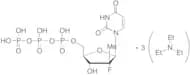
CAS:Produto Controlado<p>Stability Hygroscopic<br>Applications (2'R)-2'-Deoxy-2'-fluoro-2'-methyl-uridine 5'-Triphosphate Tetrasodium Salt is an impurity of Sofosbuvir (P839640) which is a prodrug that is metabolized to the active antiviral agent 2'-deoxy-2'-α-fluoro-β-C-methyluridine-5'-monophosphate.<br>References Lam, A.M.,et al.: Antimicrob. Agents. Chemotherapy., 56, 3359 (2012); Lam, A.M., et al.: J. Virol., 85, 12334 (2011); Sofia, M.J., et al.: J. Medn. Chem., 53, 7202 (2010);<br></p>Fórmula:C28H61FN5O14P3Cor e Forma:Off White SolidPeso molecular:803.73Tenofovir-O-((R)-9-(2-Hydroxypropyl)adenine)-phosphate ester
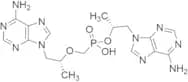
CAS:Produto ControladoFórmula:C17H23N10O4PCor e Forma:Off-WhitePeso molecular:462.41-Boc-2-[4-(2-pyridinyl)benzylidene]hydrazine
CAS:Produto Controlado<p>Impurity Atazanavir Impurity B<br>Applications An intermediate for the preparation of antiviral protease inhibitors. Atazanavir Impurity B<br>References Fassler, A., et al.: J. Med. Chem., 39, 3203 (1996), Bold, G., et al.: J. Med. Chem., 41, 3387 (1998).<br></p>Fórmula:C17H21N3O2Cor e Forma:NeatPeso molecular:299.37Ganciclovir, Antibiotic for Culture Media Use Only
CAS:<p>Ganciclovir is an antiviral agent specifically designed for culture media use. It is a synthetic analogue of 2'-deoxy-guanosine, derived from nucleoside compounds, and operates primarily by inhibiting the replication of viral DNA. Its mode of action involves selective phosphorylation by viral kinases, which converts it into ganciclovir triphosphate, a potent inhibitor of viral DNA polymerase, ultimately preventing viral DNA synthesis.</p>Fórmula:C9H13N5O4Pureza:Min. 98.0 Area-%Peso molecular:255.23 g/molTromantadine hydrochloride
CAS:Produto Controlado<p>Tromantadine hydrochloride is a synthetic antiviral compound, which is a derivative of adamantane. It originates from chemical synthesis, tailored specifically to target viral processes. Tromantadine hydrochloride primarily exerts its effects by inhibiting the penetration of virus particles into host cells and impeding the subsequent stages of viral replication. This mode of action effectively reduces the viral load and hinders the progression of the infection.</p>Fórmula:C16H28N2O2•HClPureza:Min. 95%Peso molecular:316.87 g/molVicriviroc malate
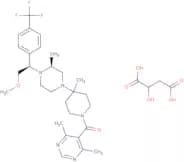
CAS:<p>Vicriviroc malate is a CCR5 antagonist with action on blocking HIV entry into cells by targeting the CCR5 receptor and is used for research on HIV treatment.</p>Fórmula:C28H38F3N5O2•C4H6O5Pureza:Area-% Min. 90 Area-%Cor e Forma:PowderPeso molecular:667.72 g/molAlamifovir
CAS:<p>Alamifovir is an antiviral agent, which is synthetically derived. The mode of action of Alamifovir involves the inhibition of viral replication within host cells by targeting specific viral enzymes crucial for the replication process. This interference with the viral life cycle diminishes the ability of the virus to propagate and spread within the host organism.</p>Fórmula:C19H20F6N5O5PSPureza:Min. 95%Peso molecular:575.42 g/molViramidine hydrochloride
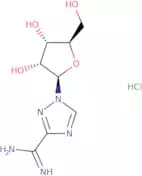
CAS:<p>Viramidine hydrochloride is an antiviral prodrug with action as a precursor to ribavirin, targeting viral RNA synthesis and is used for research on hepatitis C and other viral infections.</p>Fórmula:C8H14ClN5O4Pureza:Min. 95%Peso molecular:279.68 g/molEquisetin
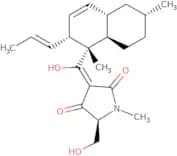
CAS:<p>Equisetin is a secondary metabolite, which is produced by the fungus *Fusarium equiseti*. It operates predominantly through the inhibition of protein synthesis and interference with cellular processes within target organisms. Equisetin exhibits potent antibacterial and antifungal activities primarily by interfering with cell wall synthesis in bacteria and disrupting key pathways in fungi.</p>Pureza:Min. 95%Peramivir
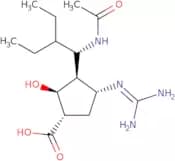
CAS:<p>Selective and potent inhibitor of sialidases (neuraminidases) in influenza A and B viruses. The compound binds tightly to the viral neuraminidase active site in late stages of viral life-cycle. It inhibits shedding sialic acids from host cell surface glycans, which interact with viral hemagglutinin, and consequently prevents release of new viral particles from the host cell surface.</p>Fórmula:C15H28N4O4Pureza:Min. 95%Cor e Forma:PowderPeso molecular:328.41 g/molDarunavir-D9
CAS:<p>Darunavir-D9 is a prodrug of darunavir, which is an HIV protease inhibitor. Darunavir-D9 has been shown to be bioequivalent in pharmacokinetic parameters to darunavir given as a tablet. The drug exhibits a low plasma concentration profile and high clearance values. This may be due to rapid absorption and distribution of the drug, with a short elimination half-life. Darunavir-D9 also has little effect on the matrix effect and reproducibility of the reaction monitoring assay, making it an ideal candidate for use in clinical trials.</p>Fórmula:C27H28D9N3O7SPureza:Min. 95%Peso molecular:556.72 g/mol8-epiAtazanavir
CAS:<p>8-epiAtazanavir is a stereoisomer of the antiretroviral drug Atazanavir, which is derived from synthetic sources. It acts as an HIV-1 protease inhibitor, where it binds to the active site of the viral protease enzyme, thereby preventing the cleavage of precursor proteins required for the maturation of infectious viral particles. This interference with viral replication is achieved by the structural mimicry of the natural substrate of the protease, allowing it to competitively inhibit the enzyme's activity.</p>Fórmula:C38H52N6O7Pureza:Min. 95%Peso molecular:704.38975Carbovir triphosphate triethylamine
CAS:<p>Carbovir triphosphate triethylamine is a nucleotide analog, which is a derivative of nucleoside analogs designed for antiviral applications. It is synthesized through chemical modification of guanosine analogs, resulting in its active triphosphate form. This compound functions as a potent antiretroviral agent by mimicking natural nucleotides and interfering with viral DNA synthesis. The active triphosphate impedes the action of viral reverse transcriptase by incorporating itself into the viral DNA chain, causing premature termination and effectively halting viral replication.</p>Pureza:Min. 95%

![(3S,3aR,6aS)-Hexahydrofuro[2,3-b]furan-3-yl Acetate](/_next/image/?url=https%3A%2Fstatic.cymitquimica.com%2Fproducts%2FTR%2Fthumb-webp%2FH293980.webp&w=3840&q=75)
![(2S)-2-[[[(1,1-Dimethylethyl)diphenylsilyl]oxy]methyl]-1,3-oxathiolan-5-ol 5-Acetate](/_next/image/?url=https%3A%2Fstatic.cymitquimica.com%2Fproducts%2FTR%2Fthumb-webp%2FD474220.webp&w=3840&q=75)

![1-Boc-2-[4-(2-pyridinyl)benzylidene]hydrazine](/_next/image/?url=https%3A%2Fstatic.cymitquimica.com%2Fproducts%2FTR%2Fthumb-webp%2FB665200.webp&w=3840&q=75)