Nucleotídeos
Subcategorias de "Nucleotídeos"
Foram encontrados 2634 produtos de "Nucleotídeos"
5-Amino-1-β-D-ribofuranosyl-1H-imidazole-4-carboxamide
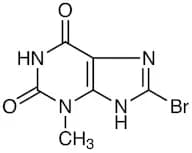
CAS:Fórmula:C9H14N4O5Pureza:95%Cor e Forma:SolidPeso molecular:258.23138-Bromo-3-methylxanthine
CAS:Fórmula:C6H5BrN4O2Pureza:>98.0%(T)(HPLC)Cor e Forma:White to Almost white powder to crystalPeso molecular:245.042'-Deoxy-2'-fluoro-L-uridine
CAS:2'-Deoxy-2'-fluoro-L-uridine is a synthetic nucleoside analog of uridine where the sugar is both fluorinated at the 2' position and in the L-configuration, which is the mirror image of naturally occurring D-nucleosides. This modification makes it structurally distinct and biologically significant for certain applications in drug development and biochemical research.
Fórmula:C9H11FN2O5Pureza:Min. 95%Cor e Forma:White PowderPeso molecular:246.2 g/molRef: 3D-ND02886
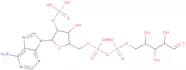
Produto descontinuadoAdenosine-5'-O-diphosphoribose phosphate
CAS:Potential metabolite of NADP+
Fórmula:C15H24N5O17P3Pureza:Min. 95 Area-%Cor e Forma:PowderPeso molecular:639.3 g/molRef: 3D-NA63573
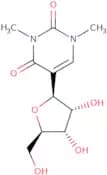
Produto descontinuado1,3-Dimethylpseudouridine
CAS:1,3-Dimethylpseudouridine is a methylated derivative of pseudouridine, which is a naturally occurring modified nucleoside found in RNA. This compounds can be used in research applications
Fórmula:C11H16N2O6Pureza:Min. 95%Cor e Forma:PowderPeso molecular:272.25 g/molRef: 3D-ND162827
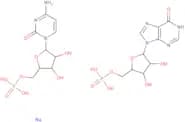
Produto descontinuadoPolyinosinic-polycytidylic acid sodium salt
CAS:Polyinosinic acid-polycytidylic acid (Poly I:C), an agonist of TLR3 toll-like receptors, is a synthetic double-stranded RNA analog, consisting of polyinosinic acid (poly I) paired with polycytidylic acid (poly C), forming a stable duplex structure. PolyI:C stimulates the secretion of pro-inflammatory cytokines and type I interferon through its interaction with endosomal Toll-like receptor 3 (TLR-3) and the cytoplasmic receptors melanoma differentiation-associated gene 5 (MDA-5) and retinoic acid-inducible gene I (RIG-I). This immunostimulant activity makes Poly I:C a useful vaccine adjuvant and is used in vaccine formulations. Poly I:C and its stabilized analogs (e.g., poly-ICLC) are also being actively researched for their dual role in oncology: directly targeting tumors and acting as immune potentiators. For example Poly I:C can induce apoptosis in tumor cells and stimulate immunogenic cell death and is therefore being explored alongside chemotherapy, radiotherapy, and checkpoint inhibitors, helping to overcome resistance mechanisms and strengthen treatment outcomes. We can supply PolyI:C to all stages of your project - from R&D and preclinical phases right up to GMP commercial manufacture. Contact our team for custom Poly I:C products.
For more on poly I:C read out blog 'Poly I:C: A Vaccine Adjuvant With Oncological Potential.'Fórmula:(C10H13N4O8P)x•(C9H14N3O8P)x•NaxCor e Forma:White PowderRef: 3D-TP36521
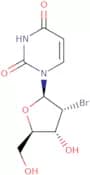
Produto descontinuado2'-Bromo-2'-deoxyuridine
CAS:2'-Bromo-2'-deoxyuridine is a synthetic nucleoside analog of deoxyuridine, in which the 2'-hydroxyl group of the ribose sugar is replaced with a bromine atom (Br) at the 2' position. This modification allows it to be incorporated into DNA during DNA synthesis, where it can replace the normal thymidine. This molecule can potentially be used in molecular biology and cell biology as a thymidine analog to study DNA replication, cell proliferation, and DNA repair.
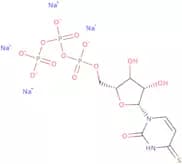
Fórmula:C9H11BrN2O5Pureza:Min. 95%Cor e Forma:PowderPeso molecular:307.1 g/mol4-Thiouridine-5'-triphosphate sodium salt - aqueous solution
CAS:4-Thiouridine-5'-triphosphate sodium salt - aqueous solution (4TUTP) is an analog of uridine and can be used as a template for the synthesis of single-stranded DNA. 4TUTP has been shown to have a high affinity for dsDNA, allowing it to form a ternary complex with DNA polymerase and single-stranded DNA template. 4TUTP can also be used to prepare samples for profiling experiments or other molecular studies. It is reactive, so should be handled with caution in order to avoid unwanted crosslinking. 4TUTP may also be used in chloroplast research.Fórmula:C9H15N2O14P3S·xNaPureza:Min. 95 Area-%Cor e Forma:Clear LiquidPeso molecular:500.20 g/molRef: 3D-NT34810
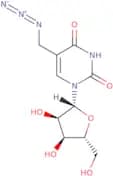
Produto descontinuado5-(Azidomethyl)uridine
CAS:5-(Azidomethyl)uridine (5-AZA-U) is a cytosolic nucleoside analog that inhibits the replication of herpes simplex virus type 1 (HSV-1). It is resistant to degradation by cellular nucleases and is fluorescent, making it a clickable substrate for microscopy. 5-AZA-U has been shown to inhibit the transcription of viral DNA and the synthesis of viral proteins in mammalian cells. This drug has also been shown to be effective against cancer and hepatitis B virus (HBV). 5-AZA-U can be used as an antiviral agent because of its ability to inhibit the posttranscriptional gene expression of HSV-1. 5-(Azidomethyl)uridine is also an analog of uridine, which can be used to study intracellular signaling pathways that regulate proliferation, differentiation, or apoptosis in mammalian cells.
Fórmula:C10H13N5O6Pureza:Min. 95%Cor e Forma:PowderPeso molecular:299.24 g/mol3'-Azido-3'-deoxythymidine-b-D-glucuronide sodium salt
CAS:3'-Azido-3'-deoxythymidine-b-D-glucuronide sodium salt is an antiviral and anticancer agent that inhibits the synthesis of DNA, RNA, and protein. It has shown to be effective against a variety of viruses including HIV-1, herpes simplex virus type 1, influenza A virus, vaccinia virus, and vesicular stomatitis virus. 3'-Azido-3'-deoxythymidine-b-D-glucuronide sodium salt also inhibits the growth of cancer cells in vitro. This drug is a modified nucleoside with a phosphoramidite backbone and a 3'-azido group at one end. The other end contains a beta D glucuronic acid moiety. The modifications allow for the inhibition of DNA synthesis by blocking the incorporation of deoxyribonucleotides into DNA chains.
Fórmula:C16H20N5NaO10Pureza:Min. 95%Cor e Forma:PowderPeso molecular:465.35 g/molRef: 3D-NA06316
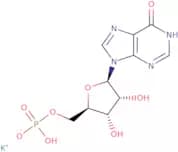
Produto descontinuadoPolyinosinic acid tripotassium salt
CAS:Polyinosinic acid is a single stranded RNA analog which is combined with polycytidylic acid (poly C) to form a stable duplex structure known as Polyinosinic acid-polycytidylic acid (Poly I:C). PolyI:C stimulates the secretion of pro-inflammatory cytokines and type I interferon through its interaction with endosomal Toll-like receptor 3 (TLR-3) and the cytoplasmic receptors melanoma differentiation-associated gene 5 (MDA-5) and retinoic acid-inducible gene I (RIG-I). This immunostimulant activity makes Poly I:C a useful vaccine adjuvant and is used in vaccine formulations. Poly I:C and its stabilized analogs (e.g., poly-ICLC) are also being actively researched for their dual role in oncology: directly targeting tumors and acting as immune potentiators. For example Poly I:C can induce apoptosis in tumor cells and stimulate immunogenic cell death and is therefore being explored alongside chemotherapy, radiotherapy, and checkpoint inhibitors, helping to overcome resistance mechanisms and strengthen treatment outcomes. We can supply PolyI:C to all stages of your project - from R&D and preclinical phases right up to GMP commercial manufacture. Contact our team for custom Poly I:C products.
For more on poly I:C read out blog 'Poly I:C: A Vaccine Adjuvant With Oncological Potential.'Pureza:Min. 95%Ref: 3D-TP65775
Produto descontinuado2',3',5'-Tri-O-acetylinosine
CAS:2′,3′,5′-Tri-O-acetylinosine is a protected form of the nucleoside inosine, with potential for use in the preparation of modified nucleotides and nucleoside analogs.
Fórmula:C16H18N4O8Pureza:Min. 95%Cor e Forma:White To Off-White SolidPeso molecular:394.34 g/molRef: 3D-NT06708
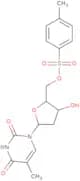
Produto descontinuado5'-O-Tosylthymidine
CAS:5'-O-Tosylthymidine is a bifunctional reagent that is used in the synthesis of DNA. It is a nucleophilic, inorganic compound that reacts with the electrophilic acrylonitrile group on 5'-hydroxythymidine to form a stable thiophosphate linkage. The reaction takes place stepwise and is catalyzed by an enzyme called DNA polymerase. This product has been used as an antimetabolite in medicine, mainly for treating leukemia.
Fórmula:C17H20N2O7SPureza:Min. 95%Peso molecular:396.42 g/molRef: 3D-NT10016
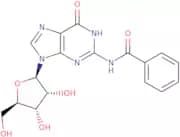
Produto descontinuadoN2-Benzoylguanosine
CAS:N2-Benzoylguanosine is a nucleotide derivative that is formed by the acetylation of guanosine. It has been shown to act as a buffer in alkaline solutions and isomerizes to its n-oxide form when heated. N2-Benzoylguanosine reacts with peroxides such as hydrogen peroxide, glyoxal, and organic peroxides, forming hydroperoxide intermediates that can be converted into other products. The acidic hydrolysis of N2-benzoylguanosine yields the corresponding 6-benzoyladenosines. It has been shown to enhance the activity of uridine in inhibiting bacterial growth, while also acting as an inhibitor of viral RNA synthesis. This compound also reacts with nitrous acid to form an n6-benzoyladenosine derivative that inhibits the formation of RNA chains during transcription.
Fórmula:C17H17N5O6Pureza:Min. 95%Cor e Forma:White to beige solid.Peso molecular:387.35 g/mol