


Nucleosídeos
Foram encontrados 3573 produtos de "Nucleosídeos"
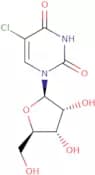
5-Chlorouridine
CAS:5-Chlorouridine is a nucleoside with hypochlorous acid. It has been shown to inhibit the growth of tumor cells in tissue culture and to have an inhibitory effect on cervical cancer, which may be due to its ability to inhibit cellular metabolism and DNA synthesis. 5-Chlorouridine inhibits the uptake of uridine by blocking the conversion of uridine into cytosine, thereby preventing DNA synthesis. This prodrug also prevents radiation from inducing mutations in DNA. The molecular modeling study shows that 5-chlorouridine forms hydrogen bonds with hydroxyl groups in RNA, which may be important for its anti-cancer activity.Fórmula:C9H11ClN2O6Pureza:Min. 95%Cor e Forma:White PowderPeso molecular:278.65 g/mol2'-Deoxyadenosine phosphoramidite dimer
2'-Deoxyadenosine phosphoramidite dimer is a novel nucleoside analog that has been shown to be an effective anticancer agent in vitro. It has also been shown to inhibit viral replication and induce apoptosis in infected cells. This product is used as a DNA monophosphate, diphosphate, and triphosphate activator to increase the efficiency of DNA synthesis. It is also used as a precursor for the synthesis of other nucleosides such as 2'-deoxycytidine phosphoramidite dimer.
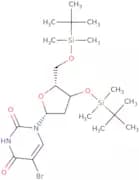
Pureza:Min. 95%3',5'-Bis-O-(tert-butyldimethylsilyl)-5-bromo-2'-deoxyuridine
CAS:3',5'-Bis-O-(tert-butyldimethylsilyl)-5-bromo-2'-deoxyuridine is a novel synthetic nucleoside. It is an intermediate in the synthesis of phosphoramidites and has been used in the synthesis of oligonucleotides and DNA. 3',5'-Bis-O-(tert-butyldimethylsilyl)-5-bromo-2'-deoxyuridine can also be used as antiviral and anticancer agents. 3',5'-Bis-O-(tert-butyldimethylsilyl)-5-bromo-2'-deoxyuridine is soluble in water, ethanol, and chloroform at a concentration of 1 g/L. The purity of this product is greater than 98%.Fórmula:C21H39BrN2O5Si2Pureza:Min. 95%Peso molecular:535.62 g/molLDA
CAS:LDA is a technique for extracting spectral features from a set of spectra. It uses the probabilistic model of discriminant analysis to discriminate between groups of spectra. LDA has been shown to outperform other techniques, such as PCA and MDA, in analyzing datasets with a small number of variables. The algorithm is incrementally updated with new data points and parameters, which makes it an attractive choice for real-time applications.
Pureza:Min. 95%N6-Benzoyl-7-deaza-2'-deoxy-5'-O-DMT-adenosine
CAS:N6-Benzoyl-7-deaza-2'-deoxy-5'-O-DMT-adenosine (BENZA) is a modified nucleoside that is synthesized by the modification of 7-deaza adenosine. BENZA has antiviral activity and has been shown to be a potent activator of the interferon system in vitro. This compound has been shown to be effective against viruses such as HIV, herpes simplex virus, and hepatitis B virus. In addition, BENZA was found to have a high purity level and is available at competitive prices.Fórmula:C39H36N4O6Pureza:Min. 95%Peso molecular:656.73 g/mol2'-Deoxy-2',2'-difluorouridine 5'-triphosphate triethylammonium salt
2'-Deoxy-2',2'-difluorouridine 5'-triphosphate triethylammonium salt is a synthetic nucleoside which is an activator of deoxyribonucleoside monophosphates and diphosphates. This compound has antiviral, anticancer and antimicrobial properties. It is a novel nucleoside that has not been previously reported. This product is high purity, high quality, and CAS No.
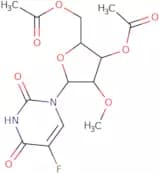
Pureza:Min. 95%3',5'-Di-o-acetyl-5-fluoro-2'-o-methyluridine
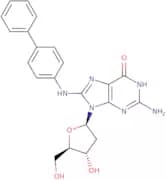
CAS:3',5'-Di-O-acetyl-5-fluoro-2'-O-methyluridine is a modified nucleoside with antiviral properties. 3',5'-Di-O-acetyl-5-fluoro-2'-O-methyluridine inhibits viral replication by inhibiting the enzyme ribonucleotide reductase, which catalyzes the conversion of ribonucleoside diphosphates to deoxyribonucleoside diphosphates. 3',5'-Di-O-acetyl-5-fluoro-2'-O-methyluridine has been shown to be effective against herpes simplex virus type 1 and 2, as well as human cytomegalovirus, and can be used in the treatment of cancer.Fórmula:C14H17FN2O8Pureza:Min. 95%Peso molecular:360.29 g/molN-(2'-Deoxyguanosin-8-yl)-4-amino(biphenyl)
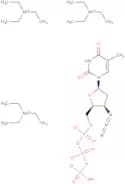
CAS:N-(2'-Deoxyguanosin-8-yl)-4-amino(biphenyl) (NGB) is a genotoxic compound that causes mutations in mammalian cells. It has been shown to cause cancer in rats, and it is carcinogenic in the bladder of both rats and humans. NGB is also mutagenic to the wild-type strain of bacteria, which may be due to its ability to affect DNA replication. This drug has been detected in human urine at levels as high as 2 micrograms per milliliter and has been found in tissues of mammals, including humans. NGB binds tightly to eicosatetraynoic acid (ETYA), a fatty acid that is an intermediate product of lipid metabolism, which may account for its genotoxic effects.Fórmula:C22H22N6O4Pureza:Min. 95%Peso molecular:434.45 g/mol3'-Azido-3'-deoxythymidine 5'-triphosphate triethylammonium salt
CAS:3'-Azido-3'-deoxythymidine 5'-triphosphate triethylammonium salt is a nucleoside analogue of 3'-azido-3'-deoxythymidine. It is an antiviral agent that inhibits the synthesis of viral DNA and RNA by inhibiting the activity of DNA polymerase, which has been shown to be effective against HIV and herpes simplex virus type 1. The phosphoramidites are synthesized from the corresponding phosphonate, 3'-azido-3'-deoxythymidine 5'-triphosphate, by treatment with a base (e.g., sodium methoxide). This novel nucleoside analogue has been shown to have anticancer properties in animal models.Fórmula:C10H16N5O13P3·3C6H15NPureza:Min. 95%Peso molecular:810.75 g/mol5-Aminoallyl-2'-deoxycytidine
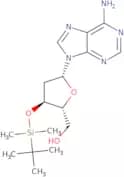
5-Aminoallyl-2'-deoxycytidine is an activator that has been shown to be a novel anticancer drug. It is an analogue of cytidine and is synthesized by the phosphoramidite method. 5-Aminoallyl-2'-deoxycytidine inhibits viral replication in human cells, but also has antiviral activity against HIV and influenza A virus. The compound has been shown to be active against small cell lung cancer in animal models.Pureza:Min. 95%3’-O-tert-Butyldimethylsilyl-2’-deoxyadenosine
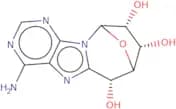
CAS:3’-O-tert-Butyldimethylsilyl-2’-deoxyadenosine is a nucleoside that is used as an antiviral and anticancer drug. It inhibits viral RNA synthesis by acting as a competitive inhibitor of the enzyme ribonucleotide reductase, which converts ribonucleotides to deoxyribonucleotides. 3′-O-tert-Butyldimethylsilyl-2’-deoxyadenosine has been shown to inhibit cancer cells in vitro and in vivo. This compound also has antiangiogenic effects and may inhibit tumor cell proliferation by targeting the Ras/Raf/MEK/ERK pathway.Pureza:Min. 95%8,5’(R)-Cycloadenosine
CAS:Please enquire for more information about 8,5’(R)-Cycloadenosine including the price, delivery time and more detailed product information at the technical inquiry form on this page
Fórmula:C10H11N5O4Pureza:Min. 95%Peso molecular:265.23 g/mol6-(2-Deoxy-5-O-DMT-b-D-ribofuranosyl)-3,4-dihydro-8H-pyrimido-[4,5-c][1,2]oxazin-7-one
CAS:6-(2-Deoxy-5-O-DMT-b-D-ribofuranosyl)-3,4-dihydro-8H-pyrimido-[4,5-c][1,2]oxazin-7-one is a synthetic diphosphate that is active as an activator of phosphoramidites. It has shown anticancer activity in vitro and in vivo. This compound has been shown to inhibit the DNA synthesis of tumor cells and to be effective against viruses such as herpes simplex virus type 1 and 2 (HSV1 and HSV2). 6-(2-Deoxy-5-O-DMT b -D ribofuranosyl)-3,4 -dihydro 8H pyrimido [4,5 c ][1,2]oxazin 7 one also inhibits the replication of RNA viruses such as influenza A virus (IAV), human immunodeficiency virusFórmula:C32H35N3O7Pureza:Min. 95%Peso molecular:573.64 g/mol3',5'-Diamino-3',5'-dideoxyadenosine
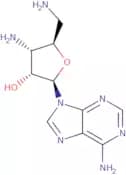
CAS:3',5'-Diamino-3',5'-dideoxyadenosine (3,5-ddA) is a nucleoside that has been shown to be an efficient inhibitor of HIV replication in vitro. It has been used for the treatment of AIDS, but it is not yet approved for this use. 3,5-ddA inhibits the conversion of dATP to dTTP and prevents DNA synthesis by blocking the enzyme ribonucleotide reductase. The drug can be synthesized with high efficiency by using a modified nucleoside amidite approach.
Fórmula:C10H15N7O2Pureza:Min. 95%Peso molecular:265.28 g/mol8-Aza-7-deaza-2'-deoxy-N2-DMF-5'-O-DMT-adenosine
CAS:8-Aza-7-deaza-2'-deoxy-N2-DMF-5'-O-DMT-adenosine is an activator of RNA synthesis. It is a novel, modified nucleoside that was synthesized to be used as a building block in the synthesis of ribonucleosides and deoxyribonucleosides. This compound has anticancer and antiviral activity. 8-Aza-7-deaza-2'-deoxy-N2-DMF-5'-O-DMT adenosine is phosphoramidite with CAS No. 8693551406. The purity of this reagent is high and it can be used for medical research.Fórmula:C34H36N6O5Pureza:Min. 95%Peso molecular:608.69 g/mol2'-Deoxycytidine-3'-monophosphate sodium salt
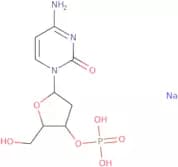
CAS:2'-Deoxycytidine-3'-monophosphate sodium salt is a synthetic phosphoramidite that can be used as an activator to synthesize DNA. It is a nucleoside that has antiviral and anticancer properties, and it is also being investigated for use in the treatment of diseases such as chronic myeloid leukemia. 2'-Deoxycytidine-3'-monophosphate sodium salt is a novel nucleoside with high purity and high quality. It has been shown to inhibit the growth of cancer cells by inhibiting DNA synthesis.Fórmula:C9H12N3O7P·2NaPureza:Min. 95%Peso molecular:351.16 g/mol6-Chloro-9-(2-C-methyl-beta-D-ribofuranosyl)-9H-purine
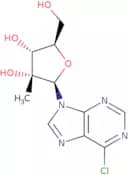
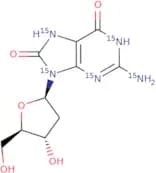
CAS:6-Chloro-9-(2-C-methyl-beta-D-ribofuranosyl)-9H-purine is a novel nucleoside analogue. It is synthesized by reacting 2,6-dichloro 9-(2'-C-methyl beta D ribofuranosyl) 9H purine with methyl bromoacetate in the presence of sodium methoxide in methanol. 6-chloro 9-(2'-C-methyl beta D ribofuranosyl) 9H purine has antiviral activity against DNA and RNA viruses that are sensitive to it. It is phosphoramidite and can be used for DNA synthesis.Fórmula:C11H13ClN4O4Pureza:Min. 95%Peso molecular:300.7 g/mol¹⁵N5, 2’-deoxy-8-oxoguanosine
CAS:A 15N5 labelled version of 2'-Deoxy-8-oxoguanosine (8-OHdG) ND06344.Supplied as 30ug in 1ml waterFórmula:C10H13N5O5Pureza:Min. 95%Peso molecular:288.2 g/mol2'-Bromo-2'-deoxyadenosine-5'-[(beta,gamma)-imido]triphosphate triethylammonium salt - 10mM aqueous solution
CAS:2'-Bromo-2'-deoxyadenosine-5'-[(beta,gamma)-imido]triphosphate triethylammonium salt (IDP) is a synthetic analog of adenosine that has been used as a bioreactor in tissue culture. IDP binds to the mineralocorticoid receptor and activates it, leading to increased levels of fatty acid synthesis in the blood sample. This drug has shown efficacy in treating cancer and inhibiting tumor growth in animal studies. IDP also has potential for use as an environmental pollutant due to its ability to be activated by wastewater treatment processes.Fórmula:C10H16N6O11P3BrPureza:Min. 95%Peso molecular:569.09 g/mol8-(2-Deoxy-b-D-ribofuranosyl)-imidazo[1,2-a]-1,3,5-triazine-2,4(3H,8H)-dione
CAS:8-(2-Deoxy-b-D-ribofuranosyl)-imidazo[1,2-a]-1,3,5-triazine-2,4(3H,8H)-dione is a monophosphate nucleotide analog that inhibits viral DNA polymerases. It is a novel and high quality nucleoside phosphoramidite. 8-(2-Deoxy-b-D-ribofuranosyl)-imidazo[1,2-a]-1,3,5-triazine-2,4(3H,8H)-dione is synthesized from 2'-deoxyribonucleosides and modified ribonucleosides. The CAS number for the compound is 35763855 2.
Fórmula:C10H12N4O5Pureza:Min. 95%Peso molecular:268.23 g/mol





![6-(2-Deoxy-5-O-DMT-b-D-ribofuranosyl)-3,4-dihydro-8H-pyrimido-[4,5-c][1,2]oxazin-7-one](/_next/image/?url=https%3A%2Fstatic.cymitquimica.com%2Fproducts%2F3D%2Fthumb-webp%2FND145589.webp&w=3840&q=75)
![2'-Bromo-2'-deoxyadenosine-5'-[(beta,gamma)-imido]triphosphate triethylammonium salt - 10mM aqueou…](/_next/image/?url=https%3A%2Fstatic.cymitquimica.com%2Fproducts%2F3D%2Fthumb-webp%2FNB166259.webp&w=3840&q=75)
![8-(2-Deoxy-b-D-ribofuranosyl)-imidazo[1,2-a]-1,3,5-triazine-2,4(3H,8H)-dione](/_next/image/?url=https%3A%2Fstatic.cymitquimica.com%2Fproducts%2F3D%2Fthumb-webp%2FND145594.webp&w=3840&q=75)