Nucleosídeos
Foram encontrados 3573 produtos de "Nucleosídeos"
8-Bromo-2'-O-methyladenosine
8-Bromo-2'-O-methyladenosine is a modified nucleoside that is used as an antiviral and anticancer drug. It is also a high quality, novel, phosphoramidite building block. 8-Bromo-2'-O-methyladenosine has been shown to inhibit the growth of human cancer cells in culture and has anti-inflammatory effects in mice.Pureza:Min. 95%Cytarabine-5-monophosphate-15N2,13C1
Cytarabine-5-monophosphate-15N2, 13C1 is a monophosphate nucleoside that inhibits viral replication. It is an antiviral agent used in the treatment of herpes simplex virus infections and other viruses such as HIV. Cytarabine-5-monophosphate-15N2, 13C1 also has anticancer properties and can be used to prevent cancer by inhibiting DNA synthesis. The compound is a modified nucleoside that lacks the 2' hydroxyl group and has an activated phosphate at the 3' position. This novel nucleoside is synthesized from deoxyribonucleosides using phosphoramidites as starting materials. CAS No.: 127468-52-8
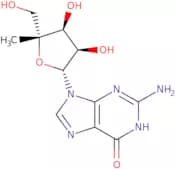
Pureza:Min. 95%4'-a-C-Methylguanosine
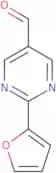
CAS:4'-a-C-Methylguanosine is a nucleoside that is synthesized by the condensation of 4'-amino-2',3'-dideoxyadenosine and 1,2-ethanediol. This product is an activator that can be used to synthesize novel DNA analogues with various chemical modifications. It has shown antiviral and anticancer activity in vitro. 4'-a-C-Methylguanosine was also found to be more active than guanosine when it came to inhibiting viral replication in human cells.Pureza:Min. 95%2-(2-Furyl)-5-pyrimidinecarbaldehyde
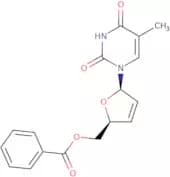
CAS:2-(2-Furyl)-5-pyrimidinecarbaldehyde (2FP) is a novel anticancer activator that belongs to the class of modified DNA. 2FP is a nucleoside analogue that inhibits the synthesis of DNA, RNA, and protein. It has been shown to inhibit the growth of cancer cells in vitro and in vivo. This compound may be used as an antiviral agent against HIV and herpes virus infections. 2FP has high purity and quality, with CAS number 959240-19-8.Fórmula:C9H6N2O2Pureza:Min. 95%Peso molecular:174.16 g/molBenzoyl stavudine
CAS:Benzoyl stavudine is a nucleoside that is used as an anti-HIV drug. It has been shown to be a prodrug of the active form, stavudine, by reductive elimination. Benzoyl stavudine has been shown to inhibit HIV replication by competitively binding to the viral reverse transcriptase enzyme and preventing the synthesis of RNA from DNA. This drug also inhibits ribonucleotide reductase, an enzyme that converts ribonucleotides into deoxyribonucleotides for DNA synthesis. This inhibition prevents the formation of new viral DNA and halts viral replication.Fórmula:C17H16N2O5Pureza:Min. 95%Peso molecular:328.32 g/mol2',3'-Didehydro-2',3'-dideoxy-5'-acetate inosine
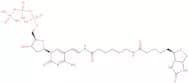
CAS:2',3'-Didehydro-2',3'-dideoxy-5'-acetate inosine (ddA) is a prodrug that is activated by hydrolysis to didanosine. The sodium salt of ddA has been shown to be effective in the treatment of HIV infection. Sodium ddA is a crystalline, neutralized salt with an alkaline pH and a pKa of 9.4. It has been crystallized from an alkaline solution using Raney nickel as a catalyst. This product can be used to synthesize intermediates for pharmaceuticals or other chemical products.Fórmula:C12H12N4O4Pureza:Min. 95%Peso molecular:276.25 g/molBiotin-11-deoxycytidine-5'-triphosphate, lithium salt - 1 mM aqueous solution
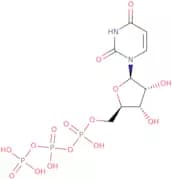
CAS:Biotin-11-deoxycytidine-5'-triphosphate, lithium salt - 1 mM aqueous solution is an antiviral nucleoside that has been shown to inhibit HIV and HCV replication in vitro. It also inhibits the proliferation of cancer cells in vitro and induces apoptosis in vivo. Biotin-11-deoxycytidine-5'-triphosphate, lithium salt - 1 mM aqueous solution is a novel nucleoside that was designed for use as an anticancer agent. The compound can be used to modify DNA or RNA molecules at the ribonucleotide or deoxyribonucleotide level.Fórmula:C28H46N7O16P3SPureza:Min. 95%Peso molecular:861.69 g/molUridine 5'-triphosphate
CAS:P2Y receptor agonist; precursor in RNA biosynthesis
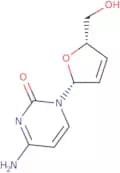
Fórmula:C9H15N2O15P3Pureza:Min. 95%Peso molecular:484.14 g/mol2',3'-Dideoxy-2',3'-didehydrocytidine
CAS:2',3'-Dideoxy-2',3'-didehydrocytidine (ddC) is a nucleoside analog that is used in the treatment of hepatitis B and C. This drug inhibits the reverse transcriptase enzyme and has cytostatic effects on viruses, for example, by preventing cell division. 2',3'-Dideoxy-2',3'-didehydrocytidine also inhibits viral replication by acting as an antigen and inducing antibody production. This drug binds to a variety of enzymes, including preparations of cellular enzymes, human immunodeficiency virus type 1 (HIV-1), and reverse transcriptase. The effective dose of ddC is 300 mg/day given orally.Fórmula:C9H11N3O3Pureza:Min. 95%Peso molecular:209.2 g/mol2',3',5'-Tri-O-acetylnebularine
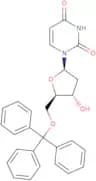
CAS:2',3',5'-Tri-O-acetylnebularine is a modified nucleoside that is synthesized from nebulareine. It has been shown to inhibit the growth of cancer cells, as well as HIV and influenza virus. This drug also has antiviral effects against herpes simplex virus type 1 (HSV-1) and herpes simplex virus type 2 (HSV-2). 2',3',5'-Tri-O-acetylnebularine inhibits viral replication by inhibiting DNA synthesis and RNA transcription, which prevents the production of proteins needed for cell multiplication.Fórmula:C16H18N4O7Pureza:Min. 95%Peso molecular:378.34 g/mol2'-Deoxy-5'-O-trityluridine
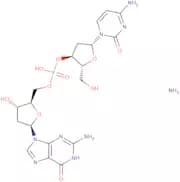
CAS:2'-Deoxy-5'-O-trityluridine is a nucleoside that has been synthesized for visualization purposes. It is an analog of uridine, with the structure shown in Figure 1. The trityl group is oriented on the 2' oxygen atom, which is attached to the ribose sugar. This configuration allows for a variety of interactions with other molecules and can be seen in Figure 2. The methyl group on the 5' carbon atom interacts with the benzene ring on xylene, while the moiety on the 3' carbon atom interacts with furanose. This nucleoside also has a symmetric conformation, as shown in Figure 3.Fórmula:C28H26N2O5Pureza:Min. 95%Peso molecular:470.52 g/mol2'-Deoxycytidyl-(3'-5')-2'-deoxyguanosine
CAS:2'-Deoxycytidyl-(3'-5')-2'-deoxyguanosine is a monophosphate nucleoside. It is an antiviral agent that inhibits the synthesis of DNA and RNA. 2'-Deoxycytidyl-(3'-5')-2'-deoxyguanosine has also been shown to be cytotoxic against cancer cells, with activities against leukemia and lymphoma cells. This drug can be used in the treatment of various cancers, such as chronic myelogenous leukemia, acute myelogenous leukemia, multiple myeloma, Hodgkin's lymphoma, and breast cancer.
Fórmula:C19H25N8O10P·NH3Pureza:Min. 95%Peso molecular:573.45 g/molN1-Methyl-2'-O-methyladenosine
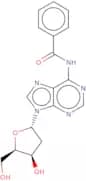
N1-Methyl-2'-O-methyladenosine is a phosphoramidite, deoxyribonucleoside and ribonucleoside analog that has antiviral activity. It inhibits the synthesis of viral DNA and RNA by competitive inhibition of viral DNA polymerases. N1-Methyl-2'-O-methyladenosine also inhibits the proliferation of tumor cells in vitro, which is mediated by its ability to inhibit the synthesis of cellular DNA. This drug has novel chemical structures with anticancer activity.Pureza:Min. 95%N6-Benzoyl-2'-deoxy-a-adenosine
N6-Benzoyl-2'-deoxy-a-adenosine is a synthetic nucleoside analog. N6-Benzoyl-2'-deoxy-a-adenosine has antiviral and anticancer properties. It is a potent inhibitor of DNA polymerase and also inhibits ribonucleotide reductase, which are enzymes crucial for DNA synthesis. N6-Benzoyl-2'-deoxy-a-adenosine inhibits the synthesis of viral RNA, leading to inhibition of viral replication. It has been shown to inhibit proliferation of tumor cells in vitro and in vivo by inhibiting DNA synthesis and inducing apoptosis.Fórmula:C17H17N5O4Pureza:Min. 95%Peso molecular:355.36 g/mol2'-Deoxy-N2-isobutyrylcytidine
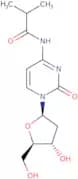
CAS:2'-Deoxy-N2-isobutyrylcytidine is a nucleoside analogue of cytidine that has been modified with a 2-amino-2-deoxyribose moiety. The transaminated product is more stable than the parent compound and has improved anticoagulant activity. It has also been shown to be active in inhibiting DNA synthesis and cell proliferation in vitro. 2'-Deoxy-N2-isobutyrylcytidine inhibits the growth of bacteria by binding to their ribosomes, preventing protein synthesis. This compound has also been shown to inhibit the formation of blood clots in mice.
Fórmula:C13H19N3O5Pureza:Min. 95%Peso molecular:297.31 g/mol2',3'-O-Isopropylidene-6-thioinosine
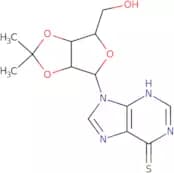
CAS:2',3'-O-Isopropylidene-6-thioinosine is a fluorinated analogue of 6-thioguanine, which is an important precursor in the synthesis of nucleotides. The compound contains a fluorine atom at the 2' position and a sulfur atom at the 3' position of the ribose ring. It is soluble in organic solvents and can be used as a tracer for biochemical studies. The thermal stability of 2',3'-O-Isopropylidene-6-thioinosine has been demonstrated by molecular modelling and thermally induced filtration experiments. Molecular modeling has also shown that 2',3'-O-Isopropylidene-6-thioinosine binds to the active site of uridine phosphorylase, which is involved in pyrimidine salvage pathways in cells.
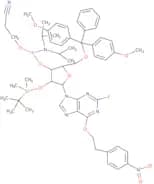
2',3'-O-Isopropylidene-6-thioinosFórmula:C13H16N4O4SPureza:Min. 95%Peso molecular:324.36 g/mol2-Fluoro-I ce-phosphoramidite (convertible G ce-phosphoramidite)
CAS:Please enquire for more information about 2-Fluoro-I ce-phosphoramidite (convertible G ce-phosphoramidite) including the price, delivery time and more detailed product information at the technical inquiry form on this pageFórmula:C54H67FN7O10PSiPureza:Min. 95%Peso molecular:1,052.2 g/mol5'-O-DMT-5-methyl-3'-O-propylphthalimidouridine
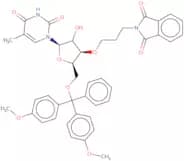
5'-O-DMT-5-methyl-3'-O-propylphthalimidouridine is a novel phosphoramidite monophosphate. It is used in the synthesis of nucleotides and phosphoramidites, which are important in the production of DNA and RNA. 5'-O-DMT-5-methyl-3'-O-propylphthalimidouridine has antiviral activity against herpes simplex virus type 1 and cytomegalovirus. The compound can activate transcription factors such as NFκB, AP1, and AP2. 5'-O-DMT-5-methyl-3'-O-propylphthalimidouridine has been shown to inhibit the growth of prostate cancer cells by inhibiting cell proliferation and inducing apoptosis.
Fórmula:C42H41N3O10Pureza:Min. 95%Peso molecular:747.81 g/molN4-Benzoyl-2'-deoxy-5'-O-levulinoylcytidine
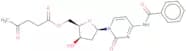
N4-Benzoyl-2'-deoxy-5'-O-levulinoylcytidine is a modified nucleoside that is synthesized from 2,4-dichloroacetophenone and cytidine. It has been shown to be an activator of the ribonucleotide reductase enzyme, which converts deoxyribonucleosides into their corresponding ribonucleotides. This drug is used in cancer therapy as well as antiviral and antiretroviral therapy. N4-Benzoyl-2'-deoxy-5'-O-levulinoylcytidine is also being investigated for use in treating other diseases such as malaria and AIDS.Fórmula:C21H23N3O7Pureza:Min. 95%Peso molecular:429.43 g/mol3’-Azido-3’-deoxy-b-L-uridine
CAS:3’-Azido-3’-deoxy-b-L-uridine is a novel nucleoside analog that inhibits DNA polymerase. It is a modified, phosphoramidite precursor of the antiviral drug AZT and has been shown to inhibit human immunodeficiency virus (HIV) in vitro. 3’-Azido-3’-deoxy-b-L-uridine has also been found to be cytotoxic against cancer cells and may have antitumor activity. The phosphoramidite form of 3’ azido 3’ deoxy b L uridine can be used for the synthesis of oligonucleotides with high purity and quality.Fórmula:C9H11N5O5Pureza:Min. 95%Peso molecular:269.21 g/mol