Nucleosídeos
Os nucleosídeos são building blocks fundamentais dos ácidos nucleicos, compostos por uma base nitrogenada ligada a uma molécula de açúcar. Nesta seção, você encontrará uma ampla variedade de nucleosídeos essenciais para pesquisas em biologia molecular, bioquímica e farmacologia. Esses compostos desempenham papéis cruciais na síntese de DNA e RNA, e também são vitais em vários processos metabólicos. Os nucleosídeos são usados para estudar material genético, desenvolver terapias antivirais e anticancerígenas, e entender os mecanismos celulares. Na CymitQuimica, fornecemos nucleosídeos de alta qualidade para apoiar suas necessidades de pesquisa e desenvolvimento, garantindo pureza e confiabilidade para suas aplicações experimentais.
Foram encontrados 3569 produtos de "Nucleosídeos"
Ordenar por
Pureza (%)
0
100
|
0
|
50
|
90
|
95
|
100
2,2’-Anhydro-5’-O-DMT-uridine
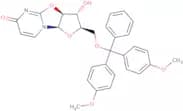
CAS:2,2’-Anhydro-5’-O-DMT-uridine is a high purity synthetic nucleoside that is modified with a hydroxymethyl group in the 2' position. It is a monophosphate and diphosphate derivative of uridine. This nucleoside has antiviral and anticancer properties, as well as the ability to inhibit HIV replication.Fórmula:C30H28N2O7Pureza:Min. 95%Peso molecular:528.55 g/mol6-(Trifluoromethyl)uracil
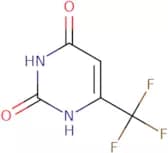
CAS:6-(Trifluoromethyl)uracil is a synthetic analog of uracil, which is a nucleobase that is found in RNA. It can be synthesized by reacting phosphorus oxychloride and trifluoromethyl chloride to form the corresponding chloroformate ester, followed by hydrolysis with anhydrous potassium carbonate. The compound has been shown to inhibit bacterial growth in bioassays and also has the ability to react with amines. 6-Trifluoromethyluracil has a constant chlorine atom that forms hydrogen bonds with other molecules, such as ammonia or amines, which may have antibacterial properties.Fórmula:C5H3F3N2O2Pureza:Min. 95%Peso molecular:180.08 g/mol5'-O-tert-Butyldimethylsilyluridine
CAS:<p>5'-O-tert-Butyldimethylsilyluridine (5'-O-TBDMSU) is a nucleoside that is used in the synthesis of nucleic acid probes. It is selective for the uridine residues in RNA and DNA, which are found at the 5' position. Sodium hydride reacts with this compound to form the corresponding hydroxyl group. This allows for further nucleobase additions or halogen substitutions to be made to the molecule, as well as desilylation reactions. 5'-O-TBDMSU can also be used to synthesize heteroaromatic nucleic acids and nucleotide derivatives.</p>Fórmula:C15H26N2O6SiPureza:Min. 98 Area-%Cor e Forma:PowderPeso molecular:358.46 g/mol2'-Deoxy-5'-O-DMT-5-methylcytidine
CAS:<p>2'-Deoxy-5'-O-DMT-5-methylcytidine is a nucleoside analog that can be used to treat cancer. This compound is synthesized by the conversion of 5′-O-dimethoxytrityl (DMT)-2'-deoxycytidine to its 5′-O-DMT phosphoramidite. The phosphoramidite is then reacted with methylene chloride, methanol, and ammonia to form the monophosphate. 2'-Deoxy-5'-O-DMT-5-methylcytidine has been shown to be an effective anticancer drug in vitro and in vivo. It targets DNA synthesis, which prevents the duplication of genetic material necessary for cell division.</p>Fórmula:C31H33N3O6Pureza:Min. 95%Cor e Forma:White to off-white solid.Peso molecular:543.63 g/mol8-(4-Aminophenyl)-2'-deoxyguanosine
<p>8-(4-Aminophenyl)-2'-deoxyguanosine is an Activator that has novel properties. It is a diphosphate of 8-(4-Aminophenyl)thymidine and is also known as 8-APT. It has been shown to have anticancer and antiviral activity in animal models, and it may be a potential treatment for HIV infection. The chemical name for 8-APT is 2'-deoxyguanosine, 8-(4-aminophenyl)-, (8R*,9S*)-.</p>Fórmula:C16H18N6O4Pureza:Min. 95%Peso molecular:358.35 g/mol8-Oxo-N2-isobutyryl-2-deoxyguanosine
CAS:<p>8-Oxo-N2-isobutyryl-2-deoxyguanosine is a modified synthetic nucleoside. It finds applications in understanding mutagenesis and DNA repair mechanisms.</p>Fórmula:C14H19N5O6Pureza:Min. 95%Peso molecular:353.33 g/mol2'-Deoxy-N6,N6-dimethyladenosine
2'-Deoxy-N6,N6-dimethyladenosine is a novel nucleoside that has been shown to inhibit the growth of cancer cells. It binds to DNA and inhibits the activity of bacterial RNA polymerase, which prevents transcription and replication. The monophosphate form of 2'-deoxy-N6,N6-dimethyladenosine is an activator for ribonucleotide reductase and an inhibitor for DNA gyrase. This drug also inhibits viral replication by inhibiting viral reverse transcriptase. 2'-Deoxy-N6,N6-dimethyladenosine has been shown to have antiviral activity against influenza virus type A (H1N1) and HIV in cell culture. This drug is chemically synthesized using phosphoramidites as raw materials and purified by high performance liquid chromatography (HPLC). The CAS number is 220763-81-8.Pureza:Min. 95%N6-Benzoyl-3'-deoxy-5'-O-DMT-adenosine 2'-CE phosphoramidite
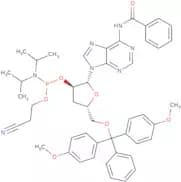
CAS:N6-Benzoyl-3'-deoxy-5'-O-DMT-adenosine 2'-CE phosphoramidite is a novel modified nucleoside that has antiviral, anticancer and antibacterial properties. The chemical name is N6-benzoyl-3'-deoxy-5'-O-DMT-adenosine 2'-CE phosphoramidite. It is a ribonucleotide. It is an activator of the enzyme kinase A which phosphorylates proteins and activates them. This product has not been tested in humans.Fórmula:C47H52N7O7PPureza:Min. 95%Peso molecular:857.93 g/mol2'-Deoxy-5'-O-DMT-N2-isobutyryl-guanosine-3'-lcaa-CPG
<p>2'-Deoxy-5'-O-DMT-N2-isobutyryl-guanosine-3'-lcaa-CPG is a modified nucleoside, which is synthetically prepared. It is an activator of DNA polymerase and has been shown to be active against human leukemia cells. 2'-Deoxy-5'-O-DMT-N2-isobutyryl Guanosine 3'-lcaa CPG has also been shown to inhibit the replication of the herpes simplex virus type 1 in vitro. The compound is a novel high quality nucleoside phosphoramidite that can be used as a building block in the synthesis of deoxyribonucleosides and modified nucleosides with novel chemical structures.</p>Pureza:Min. 95%3'-Deoxy-N2-DMF-5'-O-DMT-guanosine 2'-CE phosphoramidite
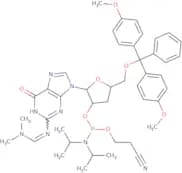
CAS:<p>3'-Deoxy-N2-DMF-5'-O-DMT-guanosine 2'-CE phosphoramidite is a novel nucleoside, which is structurally similar to cytidine and has been synthesized for the first time. 3'-Deoxy-N2-DMF-5'-O-DMT-guanosine 2'-CE phosphoramidite has antiviral and anticancer activities. It inhibits the growth of viruses by inhibiting DNA synthesis. 3'-Deoxy-N2-DMF-5'-O-DMT-guanosine 2'-CE phosphoramidite also inhibits the growth of cancer cells by inhibiting RNA synthesis.</p>Fórmula:C43H53N8O7PPureza:Min. 95%Peso molecular:824.9 g/mol4'-a-C-Methyladenosine
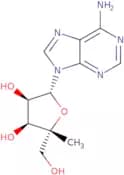
CAS:<p>4'-a-C-Methyladenosine is a nucleoside that has antiviral, anticancer and novel properties. It is a modified nucleoside with a methyl group in the 4' position. This modification prevents the phosphodiester bond from being hydrolyzed by nucleotide kinase enzymes. The methyl group also inhibits the formation of adenosine monophosphate (AMP) during DNA synthesis, which prevents the deactivation of adenosine triphosphate (ATP). 4'-a-C-Methyladenosine is used to synthesize oligonucleotides for use in DNA sequencing and gene mapping.</p>Pureza:Min. 95%3-Deazauridine-5'-triphosphate triethylamine salt
CAS:3-Deazauridine-5'-triphosphate triethylamine salt is a xanthosine analog that has been used as a biochemical reagent in animals and humans. It is postulated to be a potential cancer therapeutic agent because of its ability to inhibit DNA synthesis and cell division. 3-Deazauridine-5'-triphosphate triethylamine salt inhibits the biosynthesis of uridine in leukemic mice, hamster V79 cells, and mammalian cells. This drug inhibits the incorporation of uracil into RNA by competitive inhibition with respect to ATP. 3DATTP also inhibits the incorporation of thymidine into DNA by competitive inhibition with respect to dCTP.Fórmula:C10H16NO15P3Pureza:Min. 95%Peso molecular:483.15 g/molCytidine hemisulfate salt
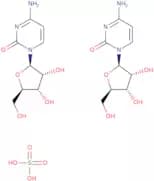
CAS:Cytidine hemisulfate salt is a postulated inhibitor of the blood group antigen. It inhibits the phosphatase activity of blood group-specific phosphatases, which may be caused by its specific inhibition of α-tocopherol and phenolphthalein. Cytidine hemisulfate salt has been shown to inhibit both adenylic and uridylic phosphatases, but does not inhibit other phosphatases. This drug is also an antigen that can stimulate B cells, which produce antibodies against it. Cytidine hemisulfate salt is found in DNA and RNA.Fórmula:C9H13N3O5H2SO4Pureza:Min. 95%Peso molecular:292.26 g/mol5'-O-p-Anisoyl-3'-fluoro-3'-deoxythymidine
<p>5'-O-p-Anisoyl-3'-fluoro-3'-deoxythymidine is a novel anticancer agent that has been shown to be active against leukemia, lymphoma and myeloma. The compound is a nucleoside analogue that inhibits DNA synthesis by inhibiting the activity of DNA polymerase. It has been shown to have antiviral activity in vitro against herpes simplex virus type 1 and type 2, influenza A virus and HIV. 5'-O-p-Anisoyl-3'-fluoro-3'-deoxythymidine can also inhibit protein synthesis by blocking the incorporation of amino acids into protein. This drug is synthesized from 3',5'-dideoxyuridine (dU) and fluoroacetyl chloride to produce 5'-O-p-anisoyl-3',5'-difluoroacetyl dU (ADUF). ADUF is then reacted with anisole to produce 5</p>Fórmula:C18H19FN2O6Pureza:Min. 95%Peso molecular:378.4 g/mol5-[N(6-(Trifluoroacetamido)hexyl)-3-(E)-acrylamido] -2'-deoxyuridine
CAS:<p>5-[N(6-(Trifluoroacetamido)hexyl)-3-(E)-acrylamido] -2'-deoxyuridine is a synthetic, modified nucleoside that functions as an activator of ribonucleotide reductase. It has been shown to be effective in the treatment of viral infections, including herpes simplex virus type 1 (HSV-1), herpes simplex virus type 2 (HSV-2), and human immunodeficiency virus type 1 (HIV-1). 5-[N(6-(Trifluoroacetamido)hexyl)-3-(E)-acrylamido] -2'-deoxyuridine is also synthesized into DNA or RNA molecules, which are used to study the structure of these compounds. It can also be used for phosphoramidite synthesis.</p>Fórmula:C20H27F3N4OPureza:Min. 95%Peso molecular:396.45 g/molStavudine 5'-monophosphate triethyammonium salt
<p>Stavudine 5'-monophosphate triethylammonium salt is a nucleoside analog that is structurally related to the natural deoxyribonucleosides. It has antiviral activity and is used in the treatment of HIV-1. Stavudine 5'-monophosphate triethylammonium salt inhibits viral replication by inhibiting DNA polymerase, which leads to a decrease in the production of new copies of the virus. This drug has also been shown to have anticancer properties, although it is not currently approved for this use. Stavudine 5'-monophosphate triethylammonium salt is synthesized in high purity and high quality, with a CAS number of 102747-23-2.</p>Pureza:Min. 95%N4-Benzoyl-5'-O-DMT-2'-O-(2-methylacetamido)-5-methylcytidine 3'-CE phosphoramidite
<p>N4-Benzoyl-5'-O-DMT-2'-O-(2-methylacetamido)-5-methylcytidine 3'-CE phosphoramidite is a novel, antiviral, and anticancer agent. It has high purity and quality, and is modified with an acetyl group (N4-benzoyl) at the 5' position of the nucleotide sugar. This product has a CAS No. of 636371-27-0 and may be used as a monophosphate or diphosphate. The N4-benzoyl group is not present in natural nucleosides; therefore, this analog can serve as an activator for ribonucleoside kinase by mimicking the natural substrate.</p>Pureza:Min. 95%5'-Fluoro-5'-deoxy-adenosine
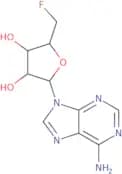
CAS:5'-Fluoro-5'-deoxy-adenosine (FDA) is a fluorinated adenosine derivative that has been shown to regulate glucose levels in plasma. It has been shown to increase the uptake of glucose in cells and improve insulin sensitivity, which may be due to its ability to increase the production of nitric oxide. FDA is also thought to act as an antioxidant and may be useful for treating autoimmune diseases such as insulin resistance and type II diabetes.Fórmula:C10H12FN5O3Pureza:Min. 95%Cor e Forma:PowderPeso molecular:269.23 g/mol5-Fluoro-1-(b-L-ribofuranosyl)-uracil
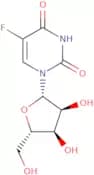
CAS:<p>5-Fluoro-1-(b-L-ribofuranosyl)-uracil is a triflate that is synthesized by the intramolecular, stereospecific reaction of l-guanosine and l-adenosine. It has been shown to have high yields in its synthesis. 5-Fluoro-1-(b-L-ribofuranosyl)-uracil can be used to produce glycosidations with d-galactose and l-thymidine. This product can also be used for the production of l-[5-(2,4,6-trimethoxybenzoyl)-1Hpyrazol]-3-[(2S,3R)-3-(bromomethyl)pyrrolidin]-2one (PBI), which is an inhibitor of protein kinase C.</p>Pureza:Min. 95%2,2'-Anhydro-5'-O-tert-butyldiphenylsilylthymidine
2,2'-Anhydro-5'-O-tert-butyldiphenylsilylthymidine is a novel monophosphate nucleoside analog that has antiviral activity against herpes simplex virus type 1 (HSV-1) and herpes simplex virus type 2 (HSV-2). This compound is chemically synthesized by the reaction between thymidine with bis-(2,6-diisopropylphenyl) disilazane in the presence of an activator. The synthesis of 2,2'-anhydro-5'-O-tert-butyldiphenylsilylthymidine is performed by reacting 5'-O-(4,4'-dimethoxytrityl)-thymidine with bis-(2,6-diisopropylphenyl) disilazane in the presence of tetrakis(triphenylphosphine)palladium(0Pureza:Min. 95%






![5-[N(6-(Trifluoroacetamido)hexyl)-3-(E)-acrylamido] -2'-deoxyuridine](/_next/image/?url=https%3A%2Fstatic.cymitquimica.com%2Fproducts%2F3D%2Fthumb-webp%2FNT57552.webp&w=3840&q=75)