Nucleosídeos
Foram encontrados 3569 produtos de "Nucleosídeos"
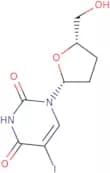
2',3'-Dideoxy-5-iodouridine
CAS:2',3'-Dideoxy-5-iodouridine is a synthetic nucleoside analog derived from uridine, one of the natural building blocks of RNA. This molecule has been chemically modified to disrupt the normal processes of DNA and RNA synthesis, making it a candidate for antiviral and anticancer research.Fórmula:C9H11IN2O4Pureza:Min. 95%Cor e Forma:PowderPeso molecular:338.1 g/mol2'-Azido-N4-benzoyl-2',3'-dideoxy-5'-O-DMT-cytidine
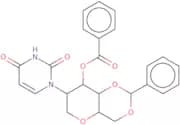
CAS:2'-Azido-N4-benzoyl-2',3'-dideoxy-5'-O-DMT-cytidine is a novel nucleoside that has been modified by the addition of a benzoyl group to the 2' position. The compound has shown antiviral activity against influenza A and B viruses, as well as anticancer activity against human breast cancer cells. The compound is phosphoramidite, CAS No. 170236-33-6.Fórmula:C37H34N6O6Pureza:Min. 95%Peso molecular:658.7 g/mol1,5-Anhydro-3-O-benzoyl-4,6-O-benzylidene-2-deoxy-2-(N4-benzoylcytidin-1-yl)-D-altro-hexitol
CAS:1,5-Anhydro-3-O-benzoyl-4,6-O-benzylidene-2-deoxy-2-(N4-benzoylcytidin-1-yl)-D-altro-hexitol is a synthetic nucleoside analog for use in researchFórmula:C24H22N2O7Pureza:Min. 95%Cor e Forma:White To Off-White SolidPeso molecular:450.45 g/mol1-(2'-O-4-C-Methylene-b-D-ribofuranosyl)thymine
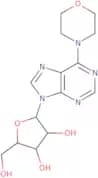
CAS:1-(2'-O-4-C-Methylene-b-D-ribofuranosyl)thymine is a nucleoside analog with a modified ribofuranosyl sugar, which includes a 2'-O-4'-C-methylene bridge that constrains the sugar conformation.Fórmula:C11H14N2O6Pureza:Min. 95%Cor e Forma:PowderPeso molecular:270.24 g/mol6-(4-Morpholino)-9-(β-D-ribofuranosyl)-9H-purine
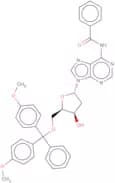
CAS:6-(4-Morpholino)-9-(β-D-ribofuranosyl)-9H-purine is a modified monophosphate analog of adenosine. It is an antiviral agent that inhibits the synthesis of nucleic acids in virus-infected cells, preventing viral replication and spread. 6-(4-Morpholino)-9-(β-D-ribofuranosyl)-9H-purine is also used as a radiosensitizer to treat cancer. This drug is synthesized by high purity, high quality and reliable suppliers.Fórmula:C14H19N5O5Pureza:Min. 95%Cor e Forma:PowderPeso molecular:337.33 g/molN6-Benzoyl-2'-deoxy-5'-O-DMT-a-adenosine
CAS:N6-Benzoyl-2'-deoxy-5'-O-DMT-a-adenosine is a novel nucleoside analog with antiviral, anticancer and immunomodulatory activities. It has been shown to inhibit the replication of HIV-1 and to induce apoptosis in tumor cells. N6-Benzoyl-2'-deoxy-5'-O-DMT-a-adenosine is a phosphoramidite that can be used for the synthesis of DNA, RNA, and deoxyribonucleotides. This product is synthesized by using an automated high purity process.Fórmula:C38H35N5O6Pureza:Min. 95%Cor e Forma:PowderPeso molecular:657.73 g/molN6,7-Dimethyldeoxyadenosine
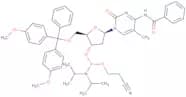
N6,7-Dimethyldeoxyadenosine is a nucleoside with antiviral and anticancer properties. It is a modified DNA monophosphate with the chemical formula C8H16N2O6P. N6,7-dimethyldeoxyadenosine has been shown to inhibit the replication of HIV and herpes simplex virus type 1 (HSV-1) in vitro. This compound also inhibits the growth of cancer cells in culture and has been suggested as an anticancer therapeutic agent.Pureza:Min. 95%N4-Benzoyl-2'-deoxy-5'-O-DMT-5-methylcytidine 3'-CE phosphoramidite
CAS:Nucleoside phosphoramidites are widely used as building blocks in the chemical synthesis of oligonucleotides. The use of a chemical synthesis rather than an enzymatic one allows bespoke oligonucleotides of a desired sequence to be obtained. 3’-Cyanoethyl phosphoramidites are typically modified by reaction with the 5’ hydroxyl of the next nucleoside in the desired sequence. The reaction is usually catalysed by 1H-tetrazole or 4,5-dicyanoimidazole in acetonitrile. N4-Benzoyl-2'-deoxy-5'-O-DMT-5-methylcytidine 3'-CE phosphoramidite, also called N4-Bz-5'-DMT-5-Me-dC phosphoramidite, is used in the synthesis of 2’-deoxy-5-methylcytidine-containing oligonucleotides as antisense drugs.Fórmula:C47H54N5O8PPureza:Min. 95%Cor e Forma:White PowderPeso molecular:847.93 g/mol5-Bromo-2'-deoxyuridine-5'-monophosphate sodium salt
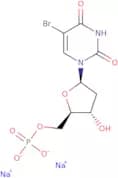
CAS:5-Bromo-2'-deoxyuridine-5'-monophosphate sodium salt (BrdUMP) is an antiviral agent that inhibits the synthesis of DNA. It has shown activity against herpes simplex virus and cytomegalovirus, and has been used in the treatment of Kaposi's sarcoma. BrdUMP is a monophosphate prodrug that is activated by ribonucleoside diphosphates to inhibit the production of viral DNA and RNA. This drug has anticancer properties due to its ability to inhibit cell division. BrdUMP is synthesized from 2'-deoxyuridine-5'-monophosphate, which is obtained from uracil or thymine. The CAS number for this compound is 51432-32-7, and it can be used as a phosphoramidite for the preparation of DNA, RNA, or oligonucleotide analogues.Fórmula:C9H12BrN2O8PNa2Pureza:Min. 97 Area-%Cor e Forma:PowderPeso molecular:433.06 g/mol2'-O-Acetyl-3'-deoxy-3'-fluoro-5'-O-toluoyluridine
2′-O-Acetyl-3′-deoxy-3′-fluoro-5′-O-toluoyluridine is a novel, activator ribonucleoside. It is synthesized by the phosphoramidite method and modified with an acetyl group at the 2′ position and a toluoyl group at the 3′ position. This compound has been shown to be active against cancer cells in vitro and in vivo.Fórmula:C19H19FN2O7Pureza:Min. 95%Peso molecular:406.36 g/mol5’(R)-C-Methyl-5-methyluridine
CAS:5’(R)-C-Methyl-5-methyluridine is an nucleoside and a ribonucleoside. It has antiviral, anticancer, and DNA modifying properties. This product is used in research to make phosphoramidites, diphosphates, and deoxyribonucleosides. 5’(R)-C-Methyl-5-methyluridine is also used in the production of modified oligonucleotides as well as other novel DNA compounds.
Pureza:Min. 95%4-Chloro-7-(2-deoxy-3,5-bis-O-(p-toluoyl)-β-D- ribofuranosyl)-5-iodo-7H-pyrrolo[2,3-d]pyrimidine
4-Chloro-7-(2-deoxy-3,5-bis-O-(p-toluoyl)-beta-D-ribofuranosyl)-5-iodo-7H-pyrrolo[2,3-d]pyrimidine is a synthetic activator that selectively activates the transcription of genes in cells. It has been shown to have anticancer activity and may be useful as a therapeutic agent for the treatment of certain cancers. 4C 7 (2dEB 3,5BT) 5I is also known to be an antiviral agent against HIV and influenza virus. The modification on the 2'-deoxyribose sugar moiety can enhance both activation and antiviral activities.Pureza:Min. 95%Acetyl hypoxanthine
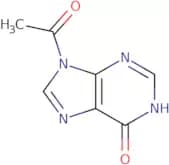
CAS:Acetyl hypoxanthine is an inorganic compound that has a cyclophosphate group. It can be synthesized from the reaction of acetic acid and 6-chloropurine, which is activated with trifluoroacetic acid and irradiated with ultraviolet light. Acetyl hypoxanthine can then be synthesized by ammonolysis of chloroacetone using ammonia or by chlorinating acetylene with chlorine. The advantages of this compound are its high yield and low cost.Fórmula:C7H6N4O2Pureza:Min. 95 Area-%Cor e Forma:PowderPeso molecular:178.15 g/molN6-Benzoyl-3’-deoxy-5'-O-DMT-3’- fluoroadenosine 2’-CE-phosphoramidite
N6-Benzoyl-3’-deoxy-5'-O-DMT-3’- fluoroadenosine 2’-CE-phosphoramidite is a novel and activator ribonucleoside with deoxyribonucleosides, diphosphate and phosphoramidites. It is an anti-cancer, antiviral, and antiinflammatory agent. N6-Benzoyl-3’-deoxy-5'-O-DMT-3’ -fluoro adenosine 2’ -CE phosphoramidite has a CAS no.Pureza:Min. 95%Denufosol tetrasodium
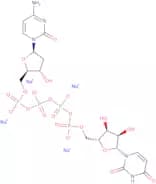
CAS:A P2Y2 receptor agonist that has been studied in cystic fibrosis and retinal diseases such as retinal detachment. Denufosol was studied as an inhaled drug for cystic fibrosis, due to its ability to activate an alternative chloride channel and avoiding the defective CFTR chloride channel. This enhances hydration of the lung mucosa and improves mucociliary clearance. The drug did not progress from phase III clinical trials. Denufosol resulted in subretinal fluid reabsorption in in vivo model of retinal detachment.
Fórmula:C18H23N5Na4O21P4Pureza:Min. 90 Area-%Cor e Forma:PowderPeso molecular:861.25 g/mol5'-O-DMT-N2-isobutyryl-2'-O-methylguanosine
CAS:5'-O-DMT-N2-isobutyryl-2'-O-methylguanosine is a nucleoside that has been synthesized using an oxime opening of the 5' position and a methylation at the 2' position. It has been shown to have an affinity for tissues in a chemotactic assay. The compound is minimised to remove non-specific binding sites, avoiding false positives on the checklist. This molecule has been analysed with fluorescence spectroscopy and microscopy techniques, which revealed that it is distributed in tissues as well as being found in dragonflies. It was also shown to be transduced by muscle cells and geochemically detected in limestone from China.Fórmula:C36H39N5O8Pureza:Min. 95%Cor e Forma:PowderPeso molecular:669.74 g/mol8-Hydrazinoadenosine
CAS:8-Hydrazinoadenosine is an inhibitor of phosphodiesterase, which is a key enzyme in the regulation of cellular processes. 8-Hydrazinoadenosine binds to the active site of the enzyme and inhibits its function. This binding prevents hydrolysis of the phosphate bond between two nucleotides and so prevents the formation of a new nucleotide from a nucleoside and a phosphate molecule. 8-Hydrazinoadenosine has been shown to inhibit phosphodiesterases in vitro and in animals, including rat brain and mouse lung. Strategies for 8-hydrazinoadenosine commercialization have been investigated, including attaching it to other molecules that are more easily absorbed by cells or using irradiation to produce 8-aminoadenosine, which can be converted into 8-hydrazinoadenosine.Pureza:Min. 95%8-Chloroadenosine
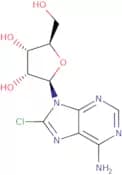
CAS:8-Chloroadenosine is a potent inhibitor of apoptosis, which is the process by which cells die. It has been shown to inhibit cell growth in murine hepatoma cells and synergize with other cytotoxic agents. 8-Chloroadenosine inhibits the activity of bcl-2 protein and thus blocks the release of cytochrome c from mitochondria. This causes DNA damage by inhibiting DNA synthesis and protein synthesis, leading to apoptosis. 8-Chloroadenosine has also been shown to be an active inhibitor of cancer cells, especially myeloma cell lines. The response element for 8-chloroadenosine is located in the promoter region of the gene encoding cyclooxygenase 2 (COX-2), which encodes a protein that produces prostaglandins involved in inflammation and tumor growth. The concentration of camp in cancer tissues determines whether these cells will respond favorably or unfavorably to this drug.Fórmula:C10H12ClN5O4Pureza:Min. 95%Cor e Forma:PowderPeso molecular:301.69 g/mol5-Hydroxymethyl-2’-O-(2-methoxyethyl)uridine
CAS:5-Hydroxymethyl-2’-O-(2-methoxyethyl)uridine (5HMEU) is a nucleoside that is synthesized from 2’,3’-dideoxyribonucleosides. 5HMEU has been shown to be an activator of the human telomerase enzyme and is used in the synthesis of DNA. It also has anticancer properties and can inhibit the growth of various cancer cells, including pancreatic, breast, prostate, lung, liver, and cervical cancer cells. 5HMEU is a modified nucleoside that contains a hydroxyl group at the 2’ position and an methoxyl group at the 5’ position. The chemical name for 5HMEU is 5-hydroxymethyl-2'-O-(2-methoxyethyl)uridine.Pureza:Min. 95%3',5'-O-(1,1,3,3-Tetraisopropyldisiloxane-1,3-diyl)-2'-ketouridine
CAS:Used as a protected 2'-ketouridine nucleoside in the synthesis of modified RNA oligonucleotides. The 1,1,3,3-tetraisopropyldisiloxane-1,3-diyl (TIPDS or TBDPSi2) group protects the 3' and 5' hydroxyl groups, while the 2'-keto (or 2'-oxo) modification introduces a specific functional group at the 2' position of the ribose sugar.Fórmula:C21H36N2O7Si2Pureza:Min. 95%Cor e Forma:White PowderPeso molecular:484.69 g/mol





![4-Chloro-7-(2-deoxy-3,5-bis-O-(p-toluoyl)-β-D- ribofuranosyl)-5-iodo-7H-pyrrolo[2,3-d]pyrimidine](/_next/image/?url=https%3A%2Fstatic.cymitquimica.com%2Fproducts%2F3D%2Fthumb-webp%2FNC162932.webp&w=3840&q=75)