Polissacáridos
Foram encontrados 506 produtos de "Polissacáridos"
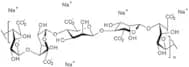
Apiogalacturonan polysaccharides sodium
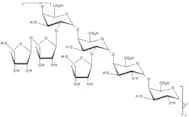
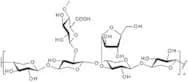
CAS:An apiose-rich pectic polysaccharide zosterin is found in the sea grass Zostera marina and is typical of similar structures occurring in higher plants. The structure consists of an α-1,4-D-galactopyranosyluronan backbone substituted by 1,2-linked apiofuranose oligosaccharides and single apiose residues. The average molecular mass of the polysaccharide has been shown to be about 4100 Da with a low polydispersity.Pureza:Min. 60%Cor e Forma:PowderPustulan
CAS:Pustulan is a β-1,6-glucan isolated from Lasallia pustulata MW (20 kDa). It is recognized by the membrane bound Dectin-1, a C-type lectin-like pattern recognition receptor. Detection of β-glucans by Dectin-1 receptor leads to the CARD9-dependent activation of NF-κB and MAP kinases. Studies have shown that pustulan can stimulate innate immune responses, inducing heat shock protein expression, eliciting phagocytosis, and production of pro-inflammatory cytokines. The image was kindly provided by Prof Mike Guiry from Cork who runs ‘The Seaweed Site’.Pureza:Min. 80%Cor e Forma:PowderDextran 6, MW 5,500 to 7,500
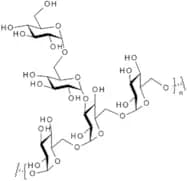
CAS:Dextran is α-(1,6)-linked α-D-glucan with α-(1,3)-linked glucose branch points produced by fermentation of Leuconostoc mesenteroides via the action of the enzyme dextransucrase on sucrose. The main use for native dextran is as an extender in blood transfusions and products having a range of sharp cut-off molecular weights are produced commercially for this and other applications. A complex of iron with dextran, known as iron dextran, is used as a source of iron for baby piglets which are often anaemic at birth.Cor e Forma:White PowderPullulan
CAS:Pullulan is a glucan elaborated by the fungus Aureobasidium pullulans. The chemical structure is essentially repeating units of maltotriose joined by α-1,6 linkages. Pullulan dissolves readily in water to form stable, viscous solutions that do not gel. The polysaccharide can be moulded, made into fibres and forms clear soluble films. Applications are in foods as a low calorie ingredient and the polysaccharide forms water soluble films that have been used as seed coatings and to coat fruit. Pullulan can also be used in industrial applications as a binder, film former and in pharmaceutical applications. Average MW is typically 100-200kDa. Viscosity is ca 120 mm2/s. The image was kindly provided by Dr. Chris Lawson.Cor e Forma:White Powder(Hydroxypropyl)methyl cellulose - Viscocity 2600-5600 cP
CAS:Hydroxypropyl methylcellulose (HPMC or hypromellose) is a semisynthetic, inert and viscoelastic polymer that is used as eye drops and as semi-synthetic substitute for tear-films. When applied, a hypromellose solution acts to swell and absorb water, by increasing the thickness of the tear-film, resulting in decreased eye irritation. In addition to its use in ophthalmic liquids, hypromellose has been used as an excipient in oral tablet and capsule formulations, where, depending on the grade, it functions as controlled-release agent. It is also used as a binder and as a component of tablet coatings. Hypromellose in aqueous solution, unlike methylcellulose, exhibits thermal gelation properties. HPMC is approved as a food additive, emulsifier, thickening and suspending agent, and as an alternative to animal gelatin (Codex Alimentarius code (E number) is E464).
Cor e Forma:White PowderPregelatinized starch
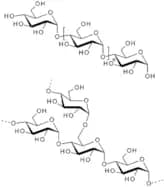
CAS:Starch is a two component polysaccharide mixture of amylose and amylopectin. Amylose is a linear polysaccharide of α (1,4)-linked glucose residues and averages 20 to 30% of the total in most native starches. Amylopectin is a highly branced glucan containing both a (1,4) and a (1,6) linkages. The number of glucose residues in a single starch molecule can vary from five hundred to several hundred thousand, depending on the type of starch. Starch is the major storage form of energy in plants, just as glycogen is the storage form of energy for animals. The plant directs the starch molecules to the amyloplasts, where they are deposited to form granules. Thus, both in plants and in the extracted concentrate, starch exists as granules varying in diameter from 2 to 130 μm.Pureza:Min. 95%Cor e Forma:PowderCarboxymethyl-dextran sodium salt - Average MW 10,000 - 20,000Da
CAS:Sodium carboxymethyl dextran is a white, odourless and tasteless powder, which is freely soluble in water or electrolyte solutions. Applications that have been described for carboxymethyl dextran include carriers of paramagnetic contrast agents, preparation of conjugates of pharmacologically active compounds and carboxymethyl dextrans in biosensors. A number of other uses in cosmetics, agriculture, foods, paints and textiles have been the subject of patent applications.Cor e Forma:White PowderOctyl-agarose, contain 20% ethanol solution
CAS:Octyl-agarose is a type of agarose gel that has been modified to contain 20% ethanol solution. It is used in the purification of oligosaccharides and monosaccharides, as well as in the synthesis of complex carbohydrate. Octyl-agarose can be custom synthesized or modified with glycosylation, methylation, sugar, or carbohydrate modifications.Cor e Forma:Slightly Turbid LiquidHyaluronic acid sodium salt - Average MW 1.5 - 2.5 million Da
CAS:The sodium salt of hyaluronic acid is a glycosaminoglycan found in many organs, where it functions as a joint lubricant and shock absorber. It is obtained principally from synovial fluid, vitreous humor of the eye, umbilical tissue and cocks comb. The chemical structure of hyaluronic is a disaccharide repeat of β-(1,3) glucuronic acid and β-(1,4) N-acetyl glucosamine.Fórmula:(C14H20NO11Na)nPureza:Min. 95%Cor e Forma:PowderAmidated Pectin
CAS:Pectins are derived from citrus fruits such as lemons and limes. Amidated pectin is a modified form of pectin in which some of the galacturonic acid residues are converted with ammonia to amides. These pectins are more tolerant to varying calcium concentrations that occur in use and behave like low-ester pectins, need less of and are more tolerant to excess calcium. In addition, these gels are thermoreversible.Fórmula:C5H10O5Pureza:Min. 95%Cor e Forma:PowderPeso molecular:150.13 g/molXylan - from corncob, MW 300-900
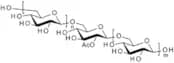
CAS:In their simplest forms, xylans are linear homopolymers of β-1,4-xylose residues. In nature they are partially substituted by acetyl, 4-O-methyl-D-glucuronosyl and α-1,3 L-arabinofuranosyl residues, forming complex heterogenous and polydispersed glycans. An example of this is in the L-arabino (methyl-D-glucurono) xylan from corn cob.Pureza:Min. 95 Area-%Cor e Forma:White Yellow PowderExopolysaccharide - from Bacillus polymixa
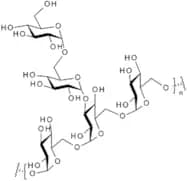
Bacterial exopolysaccharide from gram negative Bacillus polymixa
Fórmula:C23H36O18Pureza:Min. 95%Cor e Forma:PowderPeso molecular:600.52 g/molDextran 500 - MW 450,000 to 550,000
CAS:Dextran is α-(1,6)-linked α-D-glucan with α-(1,3)-linked glucose branch points produced by fermentation of Leuconostoc mesenteroides via the action of the enzyme dextransucrase on sucrose. The main use for native dextran is as an extender in blood transfusions and products having a range of sharp cut-off molecular weights are produced commercially for this and other applications. A complex of iron with dextran, known as iron dextran, is used as a source of iron for baby piglets which are often anaemic at birth.Cor e Forma:White PowderLaminaran, from laminaria digitata
CAS:Laminaran is a polysaccharide that co-occurs with fucoidan and alginate in brown seaweeds such as Laminaria digitata, Laminaria cloustoni, Eisenia bicyclis and Thallus laminariae. It is a β-1,3-linked glucan which it is claimed stimulates the immune system in mammals and fish.
The image was kindly provided by Prof Mike Guiry from Cork who runs ‘The Seaweed Site’.Pureza:Min. 95%Cor e Forma:Off-White PowderHeparan sulfate sodium salt
CAS:Heparin is a glycosaminoglycan which occurs in many mammalian tissues and has important anticoagulant and thrombolytic properties. The chemical structure is composed mainly of two disaccharide repeating units A and B. A is L-iduronic acid 2-suplhate linked α-(1,4) to 2-deoxy-2-sulfamido-D-galactose 6-sulphate while B is D-glucuronic acid β-(1,4) linked to 2-deoxy-2-sulfamido-D-glucose 6-sulphate.
Cor e Forma:White PowderColloidal Chitin
CAS:Chitin is a polysaccharide which is found widely in nature, where it functions in a manner similar to collagen in chordates. It forms the tough fibrous exoskeletons of insects, crustaceans and other arthropods, and, in addition to its presence in some fungi, it occurs in at least one alga. The structure of chitin is similar to that of cellulose but with glucose replaced with N-acetyl-D-glucosaminyl units linked β-D-(1,4) in a linear chain. It is normally produced from the shells of lobster, crab or shrimp.
Cor e Forma:PowderDextran sulfate sodium, MW 100,000
CAS:Dextran sulphate is a dextran derivative whose ulcer (colitis) -causing properties were first reported in hamsters and extrapolated a few years later to mice and rats. The exact mechanisms through which dextran sulphate induces intestinal inflammation are unclear but may be the result of direct damage of the monolayer of epithelial cells in the colon, leading to the crossing of intestinal contents (for e.g. commensal bacteria and their products) into underlying tissue and therefore induction of inflammation. The dextran sulphate sodium induced ulceration model in laboratory animals has some advantages, when compared to other animal models of colitis, due to its simplicity and similarities to human inflammatory bowel disease.Cor e Forma:PowderLaminaran - from Laminaria cloustoni
CAS:Laminaran is a polysaccharide that co-occurs with fucoidan and alginate in brown seaweeds such as Laminaria digitata, Laminaria cloustoni, Eisenia bicyclis and Thallus laminariae. It is a β-1,3-linked glucan which it is claimed stimulates the immune system in mammals and fish.
The image was kindly provided by Prof Mike Guiry from Cork who runs ‘The Seaweed Site’.Pureza:Min. 95%Cor e Forma:PowderSodium alginate, high viscosity
CAS:Sodium salt of a polysaccharide obtained from the brown seaweeds (e.g. Laminaria hyperborea, Fucus vesiculosus, Ascophyllum nodosum). The chemical structure consists of blocks of (1,4) linked-β-D-polymannuronic acid (poly M), (1,4) linked-α-L-polyguluronic acid (poly G) and alternating blocks of the two uronic acids (poly MG). Alginates form strong gels with divalent metal cations and the egg box model has been used to describe this form of gelation. The main use for alginate is in textile printing as a thickener in the printing of cottons with reactive dyes. In the food industry it is used as a thickener and gelling agent. Recently, it has been shown that ternary mixtures of Konjac glucomannan, Xanthan gum and Sodium alginate can form a non-covalently linked complex which exhibits enhanced rheological properties of value in, for example, functional foods. The image was kindly provided by Prof Mike Guiry from Cork who runs ‘The Seaweed Site’.High viscosity (500-500mPa.s).Pureza:Min. 95%Cor e Forma:White PowderIsolichenan
CAS:Isolichenan is a cold-water soluble (1,3)-(1,4)-α-D-glucan isolated from lichen Cetraria islandica to have MW of about 6-8 kDa. Lichens produce isolichenan-type polysaccharides with considerable variation in linkage ratios as well as MW, even within the same species. Occasionally these α-glucans can be branched at O2, O3 or O6. The immunomodulating activity of isolichenan was tested in in vitro phagocytosis and anti-complementary assays, and proved to be active in both cases.
The image was kindly provided by Prof Mike Guiry from Cork who runs ‘The Seaweed Site’.Pureza:Min. 85%Cor e Forma:Powder