Monossacáridos
Subcategorias de "Monossacáridos"
- Aloses(11 produtos)
- Arabinoses(21 produtos)
- Eritroses(11 produtos)
- Frutoses(9 produtos)
- Fucoses(36 produtos)
- Galactosamina(41 produtos)
- Galactoses(261 produtos)
- Glucoses(365 produtos)
- Ácidos Glucurónicos(52 produtos)
- Glico-substratos para enzimas(78 produtos)
- Guloses(6 produtos)
- Idoses(4 produtos)
- Inositóis(15 produtos)
- Lixoses(4 produtos)
- Mannoses(65 produtos)
- O-Glicanos(48 produtos)
- Psicoses(3 produtos)
- Ramnoses(10 produtos)
- Riboses(61 produtos)
- Ácidos siálicos(100 produtos)
- Sorboses(4 produtos)
- Açúcares(173 produtos)
- Tagatoses(4 produtos)
- Taloses(8 produtos)
- Xiloses(20 produtos)
Foram encontrados 6089 produtos de "Monossacáridos"
Naltrexone 3-D-glucuronide-D4
Naltrexone 3-D-glucuronide-D4 is a carbohydrate. It is a glycosylation product of naltrexone. The compound has been synthesized by the methylation of naltrexone and the glycosylation of the resultant product with glucose. Naltrexone 3-D-glucuronide-D4 is a high purity, custom synthesis, synthetic carbohydrate with a CAS number.Pureza:Min. 95%5-Deoxy-L-lyxose
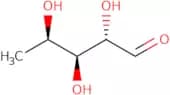
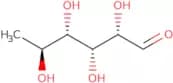
CAS:5-Deoxy-L-lyxose is a marine bioactive molecule that belongs to the group of 5-deoxy sugars. Its ring structure is similar to that of ribulose, and it has been found in marine sponges. This compound has a hydroxyl group in its structure and can be oxidized to produce orange pigments. The compound's nmr spectra show it to be an isomer of benzoate, with the sodium salt being more soluble in water than the sodium salts of other 5-deoxy sugars. 5-Deoxy-L-lyxose is also conjugated with amino acids or peptides.Fórmula:C5H10O4Pureza:Min. 95%Peso molecular:134.13 g/molRhein 8-b-D-glucuronide
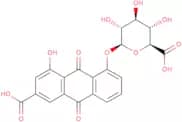
CAS:Rhein 8-b-D-glucuronide is a synthetic glycosylate that has been modified with fluorine. It is soluble in water and methanol. Rhein 8-b-D-glucuronide is used as a reagent in sugar chemistry, such as the synthesis of oligosaccharides and monosaccharides. The compound can be used to modify saccharides as well, such as methylation and Click modification. Rhein 8-b-D-glucuronide has CAS number 70793-10-1 and a high purity level of >99%.Fórmula:C21H16O12Pureza:Min. 95%Peso molecular:460.34 g/mol1-(4-methoxy-phenoxy)-a-D-talopyranose
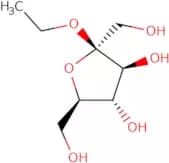
Methylation: The process of adding a methyl group to a molecule. Saccharide: A carbohydrate that is composed of sugar units, such as glucose or sucrose. Polysaccharide: A carbohydrate consisting of many sugar units linked together. CAS No.: Chemical Abstracts Service number assigned to a chemical compound, which provides unique identification and allows for the tracking of chemical substances. Modification: The process of altering the physical properties of an organic molecule by adding or removing functional groups. Oligosaccharide: A carbohydrate consisting of three to ten sugar units linked together. Carbohydrate: One type of macronutrient that contains carbon, hydrogen, and oxygen atoms in a ratio of 1:2:1 and can be classified as either simple or complex carbohydrates. Sugar: Carbohydrates that are composed solely of one type of monosaccharide unit and typically have a sweet taste.Pureza:Min. 95%Ethyl b-D-fructofuranoside
CAS:Ethyl b-D-fructofuranoside is a synthetic compound that is used in the synthesis of oligosaccharides and polysaccharides. It can be custom synthesized to suit the needs of the customer. This product is available for sale as a white powder with a purity of at least 99%.
Fórmula:C8H16O6Pureza:Min. 95%Peso molecular:208.21 g/mol(R)-Ketoprofen b-D-glucuronide
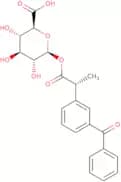
CAS:(R)-Ketoprofen b-D-glucuronide is a synthetic modified sugar that is produced by the glucuronidation of ketoprofen, a nonsteroidal anti-inflammatory drug. The modification of ketoprofen with glucuronic acid can be achieved through an enzymatic process, which is catalyzed by UDP-glucuronyltransferase. This modification increases the solubility of ketoprofen and its ability to penetrate cells. (R)-Ketoprofen b-D-glucuronide has been shown to have antibacterial properties against Gram positive bacteria such as Staphylococcus aureus and Streptococcus pyogenes. It has also shown antiviral activity against HIV-1 due to its inhibition of reverse transcriptase, which is an enzyme important for viral replication.
Fórmula:C22H22O9Pureza:Min. 95%Cor e Forma:White to off-white solid.Peso molecular:430.4 g/mol3,4,6-Tri-O-acetyl-2-azido-2-deoxy-a-D-galactopyranosyl bromide - stabilised with 2% CaCO3
CAS:3,4,6-Tri-O-acetyl-2-azido-2-deoxy-a-D-galactopyranosyl bromide - stabilised with 2% CaCO3 is a complex carbohydrate that is synthesized from 3,4,6-tri-O-acetylgalactose and 2-(bromoethyl) azide. This modification has been used to produce an oligosaccharide for use in the synthesis of glycoproteins. The modification was also used in the synthesis of a polysaccharide that is used as a reagent for the methylation of saccharides.Fórmula:C12H16BrN3O7Pureza:Min. 95%Peso molecular:394.18 g/mol2-Deoxy-D-ribose-anilide
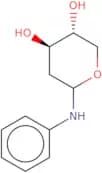
CAS:2-Deoxy-D-ribose-anilide is a fluorinated monosaccharide that is used as a synthetic building block for the synthesis of oligosaccharides, polysaccharides, and other complex carbohydrates. This compound has been modified with methyl groups and click chemistry to form new types of sugars. 2-Deoxy-D-ribose-anilide is also available in high purity and can be used for glycosylation reactions.Fórmula:C11H15NO3Pureza:Min. 95%Cor e Forma:Off-White To Light (Or Pale) Yellow SolidPeso molecular:209.24 g/mol6-Deoxy L-glucose
CAS:6-Deoxy L-glucose is a sugar analogue that inhibits the transport of glucose in bacteria. It competes with glucose for binding to transporter proteins and prevents glucose from being transported into the cell. 6-Deoxy L-glucose has been shown to inhibit the growth of wild-type strains, such as E. coli K12, in a dose-dependent manner. The antibiotic also reduces ATP production by inhibiting enzymes critical for glycolysis and gluconeogenesis. 6-Deoxy L-glucose has an optimum pH of 7.5 and is activated by hydrochloric acid or hydroxyl groups at the gamma position.
Pureza:Min. 95%D-Gluconic acid sodium salt
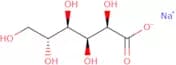
CAS:D-Gluconic acid sodium salt - USP grade is a biochemical reagent that is used in the synthesis of nucleotides and various other biomolecules. It is also used as an antimicrobial agent, with broad-spectrum activity against bacteria, fungi, and viruses. In addition to its antimicrobial activity, D-gluconic acid has been shown to inhibit carcinoma cell lines in vitro. This inhibition may be due to the inhibition of enzymes involved in phosphorylation reactions such as adenylate kinase, glyceraldehyde 3-phosphate dehydrogenase (GAPDH) and hexokinase. X-ray diffraction data on wild-type strains of E. coli have shown that D-gluconic acid binds to the enzyme phosphogluconate dehydrogenase (PGD), which catalyzes a reaction between D-gluconic acid and NAD+ or NADP+. The matrix effect for this reaction wasFórmula:C6H11NaO7Pureza:Min. 95%Peso molecular:218.14 g/mol1,3-O-Benzylidene-L-arabitol
CAS:1,3-O-Benzylidene-L-arabitol is an enantiomer of arabinitol. It has been shown to have cytotoxic effects on cultured human leukemia cells, but the mechanism of action is unclear. 1,3-O-Benzylidene-L-arabitol may inhibit glycosylation by inhibiting the formation of a key enzyme that catalyzes the transfer of glucose to serine in glycosphingolipids and glycosylation. 1,3-O-Benzylidene-L-arabitol also inhibits the synthesis of erythrosphingosine and psychosine by blocking galactosyl transferase.Fórmula:C12H16O5Pureza:Min. 95%Peso molecular:240.26 g/molHyaluronate dodecasaccharide
CAS:Hyaluronate dodecasaccharide is a complex carbohydrate that belongs to the group of oligosaccharides. It is made up of hyaluronic acid, which is a polysaccharide, and a series of sugar molecules. Hyaluronate dodecasaccharide has been modified in order to increase the stability and water solubility. This product can be used as a coating material for pharmaceuticals or as an additive for cosmetics.
Fórmula:C84H128N6O67Pureza:Min. 95%Peso molecular:2,293.9 g/molEthyl 4-amino-b-D-glucuronide
Ethyl 4-amino-b-D-glucuronide is a custom synthesis of an oligosaccharide with a saccharide backbone. The sugar moiety is a monosaccharide that is linked to the saccharide via an amide bond. This compound is fluorinated at the C4 position and methylated at the C2 position, which renders it unreactive to other molecules.Fórmula:C8H15NO6Pureza:Min. 95%Peso molecular:221.21 g/molMethimazole thio-b-D-glucuronide
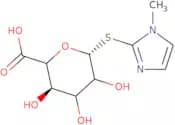
CAS:Methimazole is a drug that inhibits the synthesis of thyroid hormones by blocking the action of thyroperoxidase. Methimazole thio-b-D-glucuronide is a non-toxic, water-soluble derivative of methimazole. It is used in the treatment of hyperthyroidism and thyrotoxicosis. This compound can be synthesized from methimazole by click chemistry, fluorination or glycosylation. The product can be custom synthesized with high purity and high carbohydrate content.
Fórmula:C10H14N2O6SPureza:Min. 95%Peso molecular:290.29 g/molPolyphyllin A
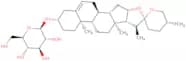
CAS:Polyphyllin A is a natural product that has been shown to have anti-oxidative effects. It has been demonstrated to inhibit the production of fatty acids by sephadex g-100, an enzyme activity by p. pastoris, and the production of antimicrobial peptides by tissue culture cells. Additionally, polyphyllin A has been shown to have anti-inflammatory properties and is used in traditional Chinese medicine for the treatment of cardiovascular diseases. Polyphyllin A also inhibits the oxidation of low density lipoprotein (LDL) cholesterol in coronary heart disease patients. Furthermore, polyphyllin A inhibits the proliferation of cancer cells such as leukemia HL-60 and K562 cells. The mechanism for this inhibition is not yet known but may be due to its ability to induce apoptosis or cause DNA damage.Fórmula:C33H52O8Pureza:Min. 95%Peso molecular:576.76 g/mol(R)-Naproxen acyl-b-D-glucuronide benzyl ester
(R)-Naproxen acyl-b-D-glucuronide benzyl ester is a custom-synthesized molecule. The synthesis of this compound is accomplished by the modification of naproxen, which is a commercially available drug. The fluorination and methylation steps are accomplished to provide a more potent drug. This compound exhibits anti-inflammatory properties that may be due to its inhibition of prostaglandin synthesis.
Fórmula:C27H28O9Pureza:Min. 95%Peso molecular:496.51 g/molMethyl D-galactofuranoside
CAS:Methyl D-galactofuranoside is a derivative of galactose that is used as an intermediate in the synthesis of other carbohydrates. It can be obtained by trimethylation of methyl galactopyranoside, or by the stepwise reaction of hydrogen fluoride with 1,2-dihydroxyacetone. The product yields are largely dependent on the stereoisomeric form of the starting material. Methyl D-galactofuranoside crystallizes in a monoclinic form and can be synthesized from glucose.Fórmula:C7H14O6Pureza:Min. 95%Cor e Forma:SolidPeso molecular:194.18 g/molEthyl b-D-ribo-hex-3-ulopyranoside
CAS:Ethyl b-D-ribo-hex-3-ulopyranoside is a synthetic, fluorinated monosaccharide that is used as a building block for the synthesis of complex carbohydrates. It is also used in glycosylations, click modifications, and methylations to modify saccharides.Pureza:Min. 95%6-Azido-6-deoxy-D-mannose
CAS:6-Azido-6-deoxy-D-mannose is a hexose sugar that has been implicated in the binding of lectins to glycoclusters. Lectins are carbohydrate binding proteins found on the surface of cells and some viruses, which bind to specific carbohydrates via their sugar moieties. This process is called lectinosis and it is sometimes used as a form of immune evasion by pathogens. 6-Azido-6-deoxy-D-mannose can be used as a linker to attach affinity ligands or affinity tags to glycoclusters, which are clusters of glycoconjugates that have an important biological function. 6AoDM also has anti-microbial properties, making it an opportunistic pathogen.Fórmula:C6H11N3O5Pureza:Min. 95%Peso molecular:205.17 g/mol1-O-Methyl-β-D-galactopyranoside
CAS:1-O-Methyl-beta-D-galactopyranoside is a monosaccharide sugar, which is a natural product of the degradation of plant cell walls. It is found in the blood of humans and other animals. 1-O-Methyl-beta-D-galactopyranoside has been shown to be an important reactive oxygen species (ROS) scavenger, which can protect cells from oxidative damage by reacting with ROS and converting them into less harmful molecules. 1-O-Methyl-beta-D-galactopyranoside binds to lectins and oligosaccharides, which are carbohydrate structures on the surface of cells that are involved in cellular recognition. This binding process may lead to uptake of 1OmBG by cells, which may be due to its ability to form hydrogen bonds with the hydroxyl group on polysaccharides such as polysaccharides in the plasma membrane or glycoproteinsFórmula:C7H14O6Pureza:Min. 98.0 Area-%Peso molecular:194.19 g/molRef: 3D-M-3591
-Unit-kgkgA consultar1kgA consultar100gA consultar250gA consultar500gA consultar2500gA consultar